WHY MAKE IT
A little comfort, a lot of flavor.
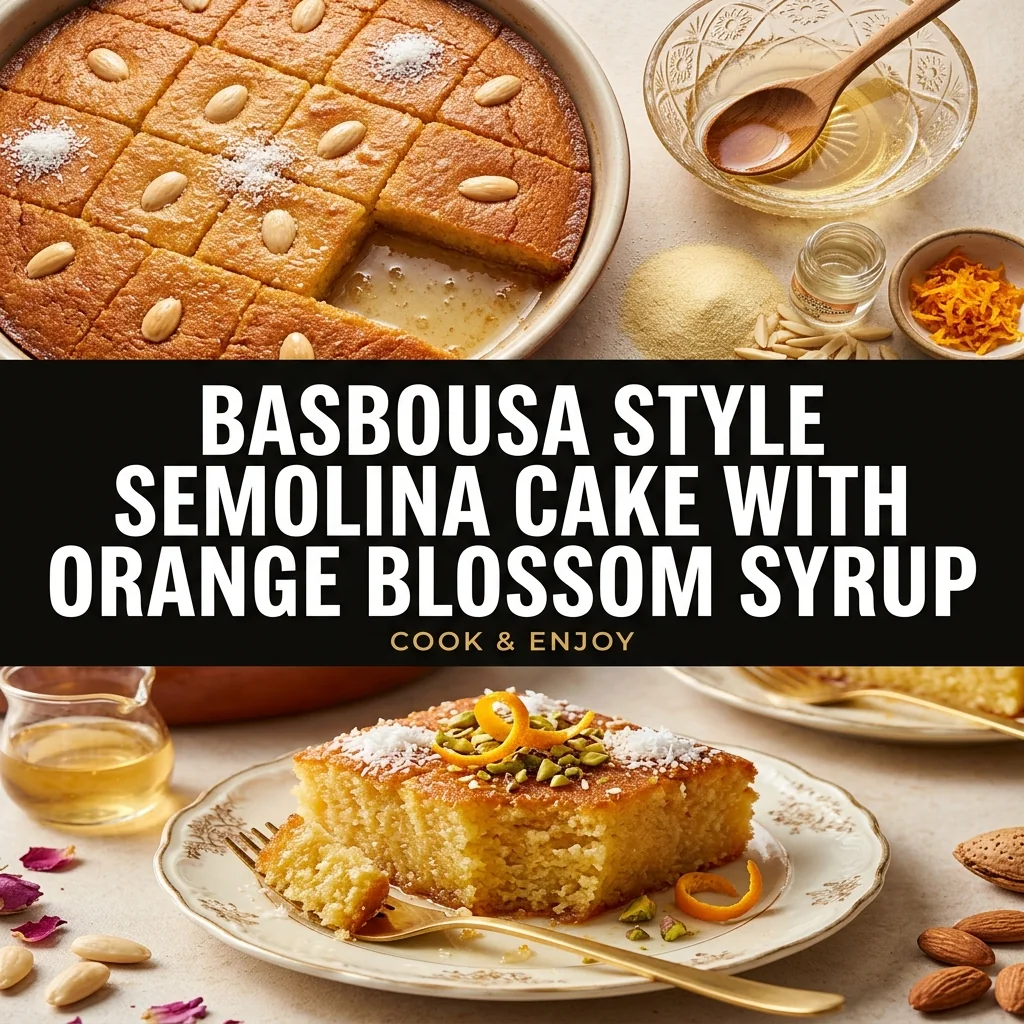
Basbousa is an enduring, fragrant semolina tray cake celebrated across the Middle East and North Africa. Made primarily with coarse wheat semolina, desiccated coconut, and fermented dairy such as whole yogurt, the cake features a distinctively granular, crumbly texture that contrasts with traditional flour-based sponge cakes. Its hallmark characteristic is the post-bake saturation process: as soon as the pan exits the oven with deep golden edges, a delicate floral syrup infused with orange blossom water and fresh lemon juice is ladled over the surface. The coarse semolina swells, locking in moisture and carrying the floral citrus perfume straight through to the base for a rich, satisfying confection.
Selecting Semolina and Coconut
Coarse semolina is the structural backbone of this traditional cake. Fine semolina or durum flour yields a dense, pasty crumb, whereas coarse semolina retains enough grain size to produce the characteristic tender bite that absorbs syrup without collapsing. Unsweetened desiccated coconut adds subtle fat, texture, and nutty undertones that temper the sweetness of the syrup. When blended with plain whole-milk yogurt, the natural acidity interacts with the leavening agents to produce a tender crumb while balancing the floral citrus notes that follow in the warm soak.
The Science of the Syrup Soak
The thermal relationship between the cake and the soaking liquid dictates the final crumb quality. Pouring warm syrup over a boiling-hot cake ensures immediate capillary action: the dry, baked semolina matrix drinks the liquid down into the bottom layers before the starches can gelatinize into a heavy paste. Simmering the sugar and water with a touch of lemon juice prevents unwanted crystallization, while adding the orange blossom water at the very end of cooking protects its delicate volatile floral compounds from evaporating under intense boiling.
Scoring and Serving Customs
Scoring the batter prior to baking serves both an aesthetic and functional role. Cutting shallow lines across the surface creates designated portions and allows the baker to center a blanched almond securely in each diamond or square. These lines also act as channels for the warm orange blossom syrup to disperse uniformly across the pan. Once the cake has rested for at least 45 minutes, follow the scored pathways with a sharp chef's knife to yield clean, glistening portions that hold together gracefully on a dessert plate.
Before you start
Pour warm syrup over the cake the instant it emerges piping hot from the oven. If both the cake and the syrup are cold, the liquid will pool around the edges rather than penetrating to the center of the dense semolina crumb. Conversely, boiling syrup poured onto hot cake can cause the crumb to turn gummy. Allowing the raw batter to rest for 15 minutes before baking is equally crucial, as it hydrates the coarse semolina granules for an even, tender texture.
THE RECIPE
Basbousa Style Semolina Cake with Orange Blossom Syrup
12 servings · 20 minutes preparation · 35 minutes cooking · 60 minutes cooling, chilling or resting
Ingredients
Step-by-step instructions
- Preheat the oven to 375 F (190 C). Grease a 9x13-inch (23x33 cm) metal baking pan with a thin layer of softened butter or neutral oil.
- Combine 350 g coarse semolina, 100 g desiccated coconut, 150 g granulated sugar, 1 tsp baking powder, 1/2 tsp baking soda, and 1/4 tsp salt in a large mixing bowl.
- Add 150 g plain whole-milk yogurt, 120 g melted butter, 60 ml milk, and 1 tsp alcohol-free vanilla extract to the dry ingredients; fold gently with a spatula until a thick, uniform paste forms.
- Spread the mixture evenly into the prepared pan, smoothing the surface with an offset spatula dipped in water; let rest on the counter for 15 minutes to allow the semolina grains to hydrate.
- Using a sharp knife dipped in water, score the unbaked batter into diamond or square shapes, pressing one whole blanched almond into the center of each portion.
- Bake at 375 F / 190 C for 30 to 35 minutes until the top and edges turn a deep golden brown.
- While the cake bakes, prepare the syrup by bringing 300 g sugar, 240 ml water, and 1 tbsp lemon juice to a gentle boil in a small saucepan over medium heat; simmer for 8 minutes, stir in 1 1/2 tbsp orange blossom water, and remove from heat.
- Remove the hot cake from the oven and immediately pour the warm syrup evenly over the entire surface in two or three additions.
- Allow the cake to rest undisturbed for at least 45 minutes at room temperature so the semolina grains fully absorb the aromatic syrup before slicing completely through the scored lines.
Kitchen notes
Pour warm syrup over the cake the instant it emerges piping hot from the oven. If both the cake and the syrup are cold, the liquid will pool around the edges rather than penetrating to the center of the dense semolina crumb. Conversely, boiling syrup poured onto hot cake can cause the crumb to turn gummy. Allowing the raw batter to rest for 15 minutes before baking is equally crucial, as it hydrates the coarse semolina granules for an even, tender texture.
Storage & make-ahead
Keep leftover cake in an airtight container at room temperature for up to 3 days, or refrigerate for up to 7 days. Because the high sugar concentration of the syrup preserves the crumb, room-temperature storage maintains the most pleasing, tender texture without butter crystallization. Refrigerate promptly within 2 hours if stored in hot ambient conditions. Serve chilled or bring back to room temperature before enjoying; reheating is generally not required for this cold or ambient dessert.
An original recipe guide inspired by themes in our Pinterest research. Recipe has not been independently kitchen-tested. AI-generated image is illustrative; your finished dish may look different.
Frequently asked questions
Why did my basbousa turn out dry in the center?
A dry interior usually indicates that the syrup was poured when it was too cold, or that the cake was not baked long enough for the crumb to expand properly. Ensure the syrup is warm and poured immediately over the piping-hot cake so it absorbs evenly down to the center.
Can I substitute rose water for the orange blossom water?
Yes, food-grade rose water can be substituted in equal measure for orange blossom water. Both floral waters provide traditional aromatics, though rose water tends to be slightly more potent, so you may choose to start with one tablespoon depending on personal flavor preferences.
Why do I need to score the cake before baking?
Scoring before baking creates defined portions for pressing the almonds and forms shallow guides that prevent the crust from tearing when sliced after absorbing syrup. It also helps the fragrant liquid penetrate deep into the cake rather than running toward the pan edges.