WHY MAKE IT
A little comfort, a lot of flavor.
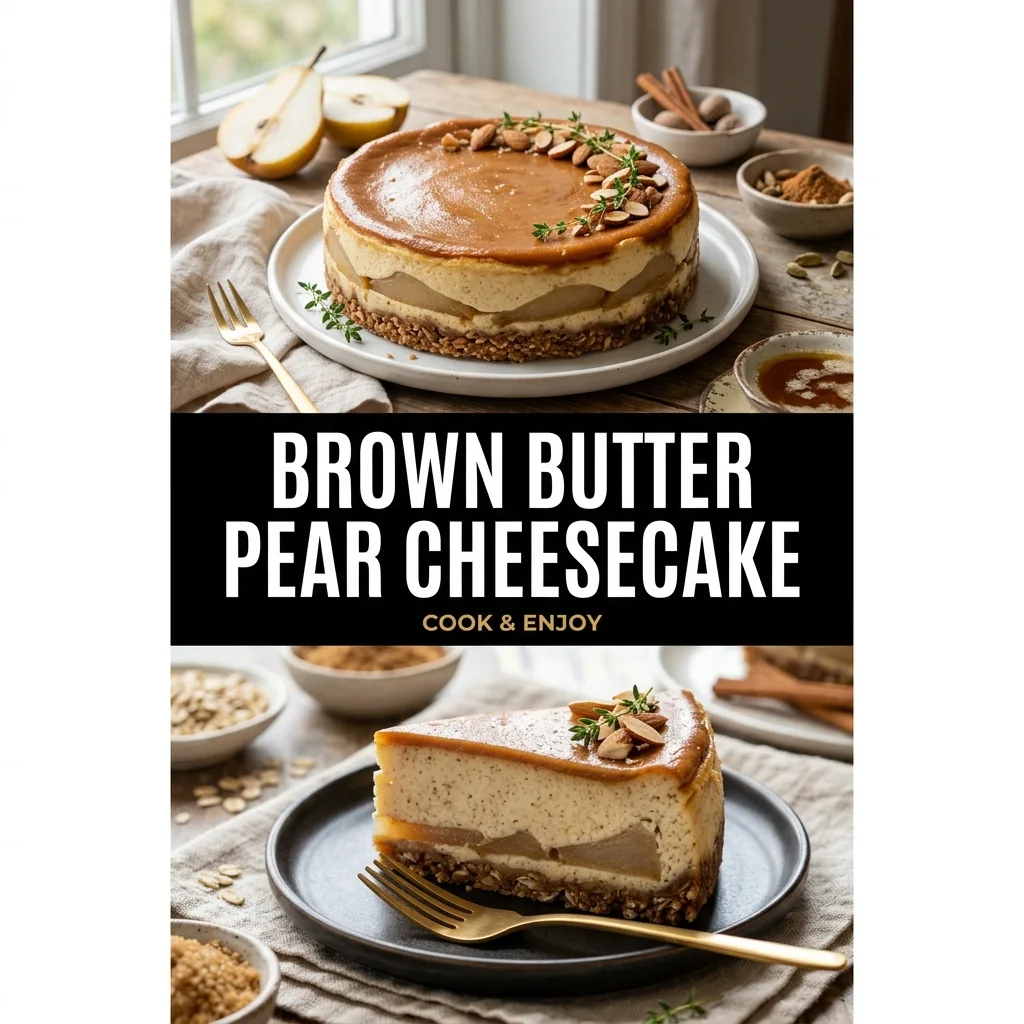
Brown Butter Pear Cheesecake celebrates warm culinary depth through the transformative art of browning butter, known classical French technique as beurre noisette. By gently toasting dairy solids until they caramelize into golden specks, ordinary butter acquires an enchanting aroma reminiscent of roasted hazelnuts and toasted brioche. This rich component is woven seamlessly through an aromatic graham crust and a spiced sautéed pear compote. Beneath the orchard topping lies an impeccably silky, water-bath-baked cream cheese core enriched with tangy sour cream. The harmonious interplay between sweet spiced orchard fruit, nutty browned butter, and dense, cool custard results in a remarkably balanced dessert that redefines classic fruit cheesecakes with sophisticated warmth and textural elegance.
The Science of Brown Butter
Browning butter is an application of the Maillard reaction, wherein heat prompts amino acids in dairy milk proteins to recombine with lactose sugars. As water boils away at 212°F (100°C), the pan temperature rises toward 260°F (127°C), browning the protein precipitates. Removing the pan immediately when sediment turns deep amber preserves delicate nutty aromatic compounds without introducing harsh, bitter ash. Splitting this browned liquid fat between the foundational crust and the sautéed topping threads a cohesive nutty profile across the entire dish.
Water Bath Precision and Egg Custard Baking
Custard cheesecakes call for gentle, buffered thermal energy to bake evenly from edge to center. Baking inside a bain-marie (water bath) caps the surrounding heat transfer at 212°F (100°C), which shields the perimeter from overbaking while allowing heat to penetrate the deep core. This uniform cooking prevents the eggs from curdling or separating, ensuring a creamy, dense texture devoid of unsightly fissures. Leaving the cheesecake to cool gradually inside the powered-down oven prevents thermal shock, which is the primary cause of surface cracks.
Selecting and Sautéing Orchard Pears
Pear texture dictates the success of the garnish. Bosc pears excel because their cellular matrix retains structural firmness even when subjected to simmering butter, acid, and sugars. Slicing the fruit into uniform 1/4-inch crescents guarantees even caramelization without breaking. The addition of fresh lemon juice serves a dual role: it prevents enzymatic browning and injects vital acidity to cut through the richness of the maple syrup and browned butter. Always cool the compote completely before spooning it over the chilled cheesecake.
Before you start
Browning butter requires vigilant attention because the milk solids can transition from fragrant amber to acrid char within seconds. Use a stainless steel or enameled pan rather than dark nonstick so you can clearly track the shift in color. For the fruit topping, select firm pears such as Bosc or crisp Anjou. Soft, overripe Bartlett pears will disintegrate into mush when sautéed with butter and spices, sacrificing the elegant crescent presentation on top of the slice.
THE RECIPE
Brown Butter Pear Cheesecake
12 servings · 40 minutes preparation · 90 minutes cooking · 480 minutes cooling, chilling or resting
Ingredients
Step-by-step instructions
- Melt 170 grams unsalted butter in a light-colored saucepan over medium heat, swirling continuously for 5 to 7 minutes until the foaming subsides, milk solids turn deep hazelnut brown, and a rich nutty aroma emerges; immediately pour the brown butter into a heatproof bowl to halt cooking and let cool for 10 minutes. Measure out 150 grams of browned butter, dividing it into100 grams for crust and50 grams for topping; reserve any extra.
- Preheat the oven to 350°F (175°C). In a bowl, combine 200 grams graham cracker crumbs, 50 grams packed light brown sugar, 1 gram sea salt, and 100 grams of the warm browned butter, stirring thoroughly; press firmly across the bottom and 1 inch up the sides of a 9-inch (23 cm) springform pan. Bake for 10 minutes, then cool on a wire rack while reducing oven temperature to 325°F (163°C).
- Tightly wrap the exterior base and sides of the springform pan with three layers of heavy-duty aluminum foil to create a watertight seal for the upcoming water bath.
- In a stand mixer fitted with the paddle attachment, beat 900 grams room-temperature cream cheese and 220 grams granulated sugar on low speed for 3 minutes until uniform and creamy, scraping the bowl frequently.
- Add 200 grams room-temperature sour cream, 10 milliliters alcohol-free vanilla extract, and 1 gram sea salt; beat on low speed for 1 minute until incorporated.
- Incorporate 4 room-temperature eggs one at a time on low speed, mixing just until each yolk disappears to avoid beating excess air into the dense custard.
- Pour the cream cheese batter over the parbaked crust. Set the wrapped pan inside a large roasting pan, position it on the oven rack, and carefully pour boiling water into the roasting pan until it reaches halfway up the sides of the springform pan. Bake at 325°F (163°C) for 65 to 70 minutes until the edges are set and the center retains a slight gentle wobble. Verify the center reaches 160 F (71 C); continue baking gently if necessary.
- Turn off the oven, prop the oven door open slightly with a wooden spoon, and let the cheesecake rest inside the water bath for 60 minutes. Remove from the water bath, discard foil, cool completely on a wire rack at room temperature for 60 minutes (2 hours total cooling), then chill in the refrigerator for at least 360 minutes (6 hours).
- Shortly before serving, prepare the pear topping: melt the remaining 50 grams browned butter in a large skillet over medium heat, add 500 grams prepared Bosc pear slices, 45 grams maple syrup, 3 grams cinnamon, 1 gram cardamom, 1 gram salt, 5 milliliters alcohol-free vanilla extract, and 15 milliliters lemon juice; sauté for 8 to 10 minutes until pears are tender yet hold their shape. Cool topping to room temperature for 20 minutes before arranging artfully over the chilled cheesecake.
Kitchen notes
Browning butter requires vigilant attention because the milk solids can transition from fragrant amber to acrid char within seconds. Use a stainless steel or enameled pan rather than dark nonstick so you can clearly track the shift in color. For the fruit topping, select firm pears such as Bosc or crisp Anjou. Soft, overripe Bartlett pears will disintegrate into mush when sautéed with butter and spices, sacrificing the elegant crescent presentation on top of the slice.
Storage & make-ahead
Refrigerate perishables promptly within 2 hours of cooling. Keep the cheesecake covered in the refrigerator for up to 4 days. If making ahead, bake and chill the cheesecake base up to 2 days in advance, then cook and apply the pear topping on the day of service for optimal freshness and texture. Leftover slices should be consumed cold straight from the refrigerator.
An original recipe guide inspired by themes in our Pinterest research. Recipe has not been independently kitchen-tested. AI-generated image is illustrative; your finished dish may look different.
Frequently asked questions
Can I bake this cheesecake without a water bath?
While technically possible, omitting the water bath increases the risk of severe surface cracking and dry, rubbery edges. If you cannot submerge the pan, place a roasting pan filled with boiling water on the bottom rack beneath the cheesecake to create a humid baking environment.
Why did water seep through my aluminum foil into the crust?
Standard foil often has microscopic perforations that leak under pressure. Always use wide, heavy-duty aluminum foil and double- or triple-wrap the springform pan seamlessly, or insert the springform pan into an oven-safe silicone baking pan before resting it in the water bath.
Can I prepare the pear topping several days in advance?
Yes. Sauté the pears, transfer them to a sealed glass container, and refrigerate for up to 3 days. Bring them to room temperature before layering them atop the chilled cheesecake to prevent the butter solids in the sauce from solidifying into hard clumps.


