WHY MAKE IT
A little comfort, a lot of flavor.
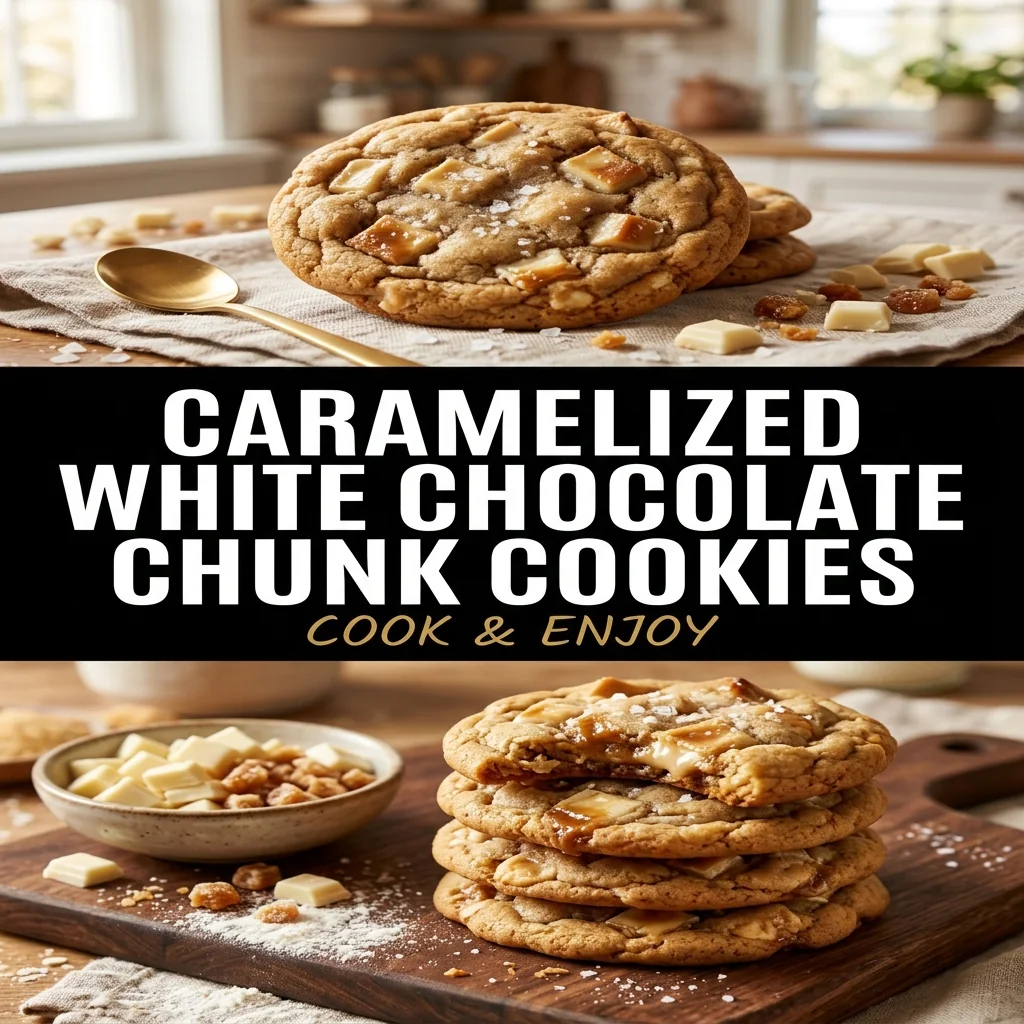
Caramelizing white chocolate transforms ordinary sweet cocoa butter into a complex confection reminiscent of dulce de leche, toasted shortbread, and hazelnut praline. While standard white chocolate is intensely sugary and one-dimensional, slow roasting in a low-temperature oven induces the Maillard reaction between the milk proteins and sugars. Folding these firm, roasted golden shards into a buttery, brown sugar-rich cookie dough creates an exceptional contrast against delicate flakes of sea salt. The dough itself relies on melted butter and an extra egg yolk to secure dense, bendable centers and lightly crisp, crinkled perimeters. These cookies deliver bakery-level sophistication straight from your home oven using straightforward pantry staples and precise temperature control.
The Science of Roasting White Chocolate
Roasting white chocolate relies on gradual thermal transformation. Because cocoa butter has a low melting point and milk solids scorch easily, roasting must proceed at a gentle 250°F (120°C). As the mixture heats, natural milk sugars undergo Maillard browning rather than simple sugar caramelization, yielding nutty, malted flavor compounds. Stirring every ten minutes is critical because it breaks up developing crusts and ensures uniform heat distribution. If the chocolate looks lumpy midway through, keep stirring; the cocoa butter will re-emulsify as the milk proteins toast evenly across the silicone mat.
Optimizing Dough Hydration and Spread
Melted butter creates a denser, chewier cookie than creaming softened butter with sugar because it incorporates less mechanical air. Combining melted butter with dark brown sugar maximizes moisture through hygroscopic molasses, which retains water during baking. Resting the mixed dough for thirty minutes before portioning allows the wheat starches in the flour to absorb free liquid from the egg and butter. This essential resting period prevents the cookies from spreading too thinly in the oven, ensuring thick, tender centers surrounded by structured, golden edges that hold heavy chocolate chunks securely.
Halal Compliance and Quality Standards
Maintaining strict halal standards in confectionery baking requires verifying flavorings and chocolate sources. Many commercial vanilla extracts extract flavor using ethanol, rendering them unsuitable. This recipe explicitly utilizes high-grade alcohol-free vanilla extract derived using vegetable glycerin or water bases. Furthermore, check the ingredient deck of your chosen white chocolate to confirm it contains purely cocoa butter, milk, sugar, and halal-suitable lecithin without unauthorized animal shortenings or spirit-based processing aids. Flaky sea salt finishes the cookie, cutting through sweetness without requiring artificial flavor boosters or noncompliant enhancers.
Before you start
Pay close attention to cocoa butter content when selecting white chocolate. Bars with at least thirty percent cocoa butter roast smoothly without seizing, whereas confectionery chips contain vegetable fats that burn rather than caramelize. Do not worry if the chocolate appears slightly chalky or gritty around the twenty-minute mark; continuous stirring redistributes the fat and smooths the paste. Ensure your spatula and sheet are completely dry, as even tiny water droplets cause seizing.
THE RECIPE
Caramelized White Chocolate Chunk Cookies
16 servings · 25 minutes preparation · 50 minutes cooking · 90 minutes cooling, chilling or resting
Ingredients
Step-by-step instructions
- Preheat the oven to 250°F (120°C). Spread 250 g of chopped white chocolate evenly across a large rimmed baking sheet lined with a silicone baking mat.
- Roast the chocolate for 40 minutes, stirring and smoothing it thoroughly with a dry heatproof spatula every 10 minutes until it turns a deep amber-caramel hue and smells nutty.
- Scrape the warm caramelized chocolate onto a sheet of parchment paper, spread it 1/2-inch thick, and cool at room temperature for 45 minutes until firm, then cut into rustic 1/2-inch chunks.
- Increase the oven temperature to 350°F (177°C) and line two large baking sheets with parchment paper.
- In a medium bowl, whisk together 280 g all-purpose flour, 1 tsp baking soda, and 1/2 tsp fine sea salt until well aerated.
- In a large bowl, vigorously whisk 170 g melted butter, 150 g dark brown sugar, and 100 g granulated sugar for 2 minutes until glossy; whisk in the whole egg, egg yolk, and 2 tsp alcohol-free vanilla extract until thick and pale.
- Fold the dry ingredients into the butter mixture using a flexible spatula until barely combined, then fold in the prepared caramelized white chocolate chunks, reserving a handful for the tops.
- Let the dough rest in the mixing bowl at cool room temperature for 30 minutes to allow the flour starch to hydrate fully.
- Portion into 16 balls (about 50 g each), space 2 inches apart on baking sheets, press reserved chunks on top, and bake at 350°F (177°C) for 10 to 12 minutes until edges are golden; sprinkle immediately with flaky sea salt and cool on trays for 15 minutes before transferring to a wire rack.
Kitchen notes
Pay close attention to cocoa butter content when selecting white chocolate. Bars with at least thirty percent cocoa butter roast smoothly without seizing, whereas confectionery chips contain vegetable fats that burn rather than caramelize. Do not worry if the chocolate appears slightly chalky or gritty around the twenty-minute mark; continuous stirring redistributes the fat and smooths the paste. Ensure your spatula and sheet are completely dry, as even tiny water droplets cause seizing.
Storage & make-ahead
Store cooled cookies in an airtight container at room temperature for up to 4 days. Baked cookies can be frozen in a sealed freezer bag for up to 2 months; thaw at room temperature. Unbaked dough portions can be frozen solid on a tray, transferred to a freezer container for up to 3 months, and baked directly from frozen by adding 2 minutes to the total baking time.
An original recipe guide inspired by themes in our Pinterest research. Recipe has not been independently kitchen-tested. AI-generated image is illustrative; your finished dish may look different.
Frequently asked questions
Can I roast the white chocolate inside a microwave instead?
A microwave heats unevenly and easily scorches delicate dairy solids. An oven at 250°F (120°C) with periodic stirring allows controlled, uniform caramelization throughout the entire batch.
Why did my roasted white chocolate turn stiff and dry?
The chocolate likely lacked sufficient cocoa butter or encountered moisture. Use pure white chocolate containing at least thirty percent cocoa butter, and ensure all utensils are completely dry.
Can I prepare the cookie dough ahead of time?
Yes. Portion the dough onto parchment-lined sheets, cover tightly, and refrigerate for up to 48 hours. Let cold portions sit at room temperature for 10 minutes before baking.