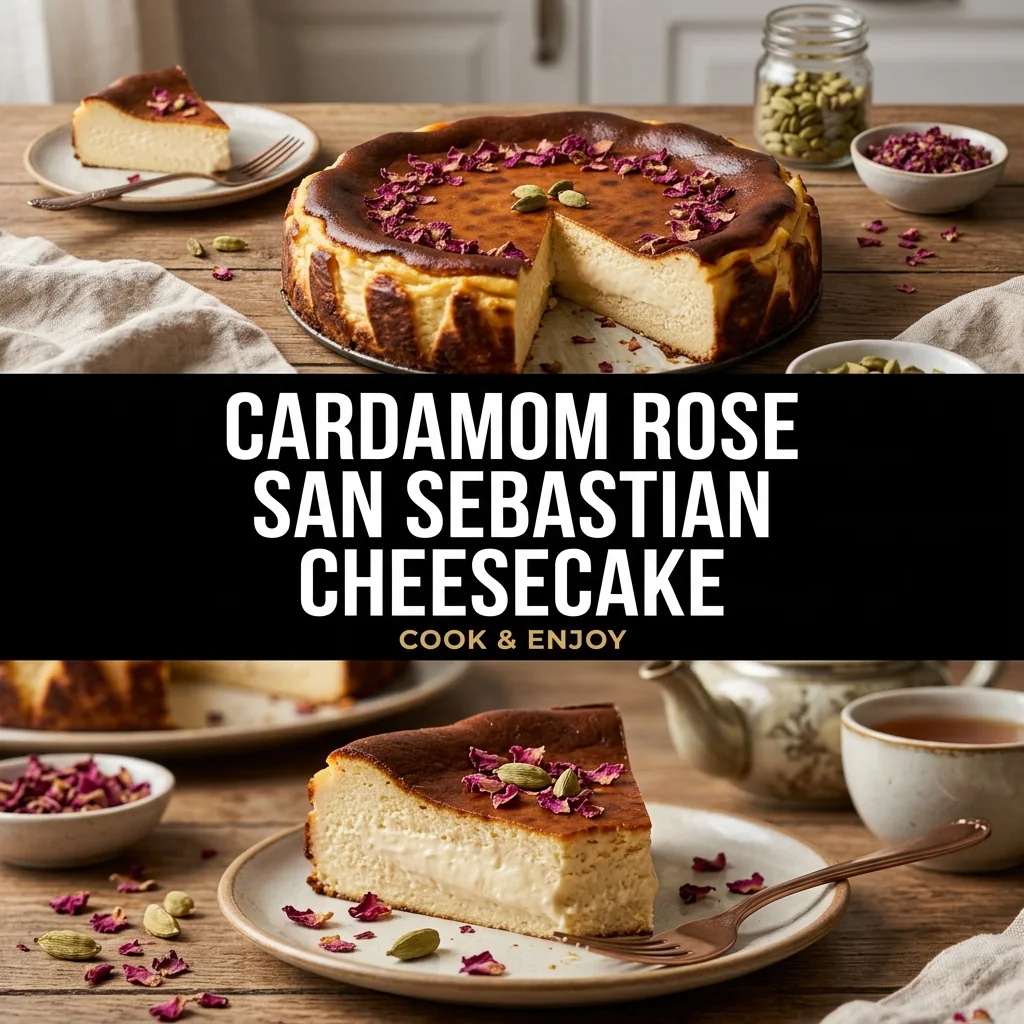
WHY MAKE IT
A little comfort, a lot of flavor.
Cardamom rose San Sebastian cheesecake merges the dramatic scorched exterior of traditional Basque baking with fragrant botanicals. Baked without a pastry or biscuit crust at an intense 215 C (425 F), the cheesecake caramelizes rapidly along its perimeter, forming a bittersweet, bronzed mantle that encases an ultra-creamy, custardy interior. Freshly ground green cardamom introduces warm camphor and citrus notes throughout the rich dairy, while a delicate culinary rose water syrup brushed over the surface provides floral lift. The high proportion of heavy cream and full-fat cream cheese yields an unctuous texture that contrasts against the blistered top. Elegant yet rustic, this dessert commands attention on any dining table while remaining exceptionally straightforward to assemble.
The Role of High-Heat Baking
San Sebastian cheesecake defies classic cheesecake rules by skipping the insulated water bath and low baking temperatures. Placing the pan directly into a 215 C (425 F) oven triggers non-enzymatic Maillard browning and sugar caramelization on the exposed surface long before the core reaches coagulation temperature. The center should remain distinctly wobbly when removed from the oven. As the cheesecake rests at room temperature and then chills, the residual heat sets the dairy emulsion into a smooth, sliceable custard without overcooking the delicate egg proteins.
Working with Floral Rose Water
Culinary rose water is a potent hydro distillate that requires careful measuring. When used excessively, rose water can impart an unpalatable, soapy profile to dairy desserts. In this formula, the rose water is kept out of the heavy batter entirely and applied as a cooled finishing syrup brushed over the caramelized crust. This targeted application delivers an immediate aroma when the cake is sliced and tasted, pairing cleanly with the warm, ground green cardamom dispersed within the cheesecake interior.
Lining the Basque Pan
Achieving the characteristic pleated edges of a Basque cheesecake requires rustic parchment preparation. Rather than trimming circles to fit snugly, press two large overlapping squares of crumpled parchment paper into the springform pan. Pleating the paper up the pan walls creates space for the batter to rise as it bakes without spilling over the metal rim. The crumpled paper also creates structural ridges along the sides of the cake, which turn deep golden-brown and impart the rustic appearance central to this iconic dessert style.
Before you start
Unlike traditional cheesecakes that require a gentle water bath, San Sebastian cheesecake relies on high ambient heat to produce its signature deeply scorched exterior while leaving the center silky. Resist the urge to whip the batter on high speed; excessive incorporated air bubbles will cause the cheesecake to puff dramatically like a soufflé and crack unevenly rather than settling into a custard-like core. Ensure your culinary rose water is authentic and used conservatively to prevent medicinal undertones.
THE RECIPE
Cardamom Rose San Sebastian Cheesecake
10 servings · 20 minutes preparation · 55 minutes cooking · 300 minutes cooling, chilling or resting
Ingredients
Step-by-step instructions
- Preheat your oven to 215 C (425 F) and line a 23 cm (9-inch) springform pan with two overlapping sheets of parchment paper, pressing them into the bottom and up the sides so at least 5 cm of paper extends above the rim.
- Beat the 900 g of room-temperature full-fat cream cheese and 300 g of granulated white sugar in a stand mixer with the paddle attachment on low speed for 3 minutes until smooth and lump-free, scraping the bowl sides thoroughly.
- Add the 5 large eggs and 1 large egg yolk one at a time, mixing on low speed until each egg is just incorporated to avoid beating excess air into the batter.
- Pour in the 420 ml of heavy cream, 1 tsp of alcohol-free vanilla extract, 1 1/2 tsp of freshly ground green cardamom, and 1/4 tsp of fine sea salt, stirring on low speed until combined.
- Sift the 30 g of all-purpose flour over the batter and fold gently with a silicone spatula until no dry streaks of flour remain visible.
- Pour the batter into the prepared parchment-lined pan, tap the pan firmly against the counter once to release large air bubbles, and bake at 215 C (425 F) for 50 to 55 minutes until the top is deeply caramelized brown and the center retains a pronounced wobble. Verify the center reaches 160 F (71 C); continue baking gently if necessary.
- Remove the cheesecake from the oven and cool it in its pan on a wire rack at room temperature for 60 minutes.
- Transfer the cheesecake to the refrigerator and chill uncovered for at least 240 minutes (4 hours) until fully set and firm throughout.
- Combine the 60 ml of water and 50 g of sugar in a small saucepan over medium heat for 4 minutes until dissolved, stir in the 1 1/2 tsp of culinary rose water, cool for 10 minutes, brush lightly over the chilled cheesecake, and garnish with 1 tbsp of edible rose petals.
Kitchen notes
Unlike traditional cheesecakes that require a gentle water bath, San Sebastian cheesecake relies on high ambient heat to produce its signature deeply scorched exterior while leaving the center silky. Resist the urge to whip the batter on high speed; excessive incorporated air bubbles will cause the cheesecake to puff dramatically like a soufflé and crack unevenly rather than settling into a custard-like core. Ensure your culinary rose water is authentic and used conservatively to prevent medicinal undertones.
Storage & make-ahead
Cover the chilled cheesecake loosely with parchment paper or place it in an airtight container in the refrigerator within 2 hours of baking. The cake holds its texture for up to 4 days. Serve cold directly from the refrigerator for clean, dense slices, or let slices sit at room temperature for 15 minutes for a softer, custard-like texture.
An original recipe guide inspired by themes in our Pinterest research. Recipe has not been independently kitchen-tested. AI-generated image is illustrative; your finished dish may look different.
Frequently asked questions
Why is my cheesecake so jiggly when I take it out of the oven?
The pronounced jiggle is intentional; the center finishes setting through residual heat as it cools. If baked until completely firm, the interior will lose its distinctive creamy custard texture once chilled.
Can I omit the flour to make this recipe gluten-free?
Yes, you can substitute the 30 grams of all-purpose flour with an equal weight of cornstarch or gluten-free 1-to-1 baking flour to achieve identical structural stability.
Why did my parchment paper smoke in the oven?
Ensure standard kitchen parchment rated up to 220 C (428 F) is used. Trim excessive overhang that extends beyond 5 cm above the pan rim so paper does not touch oven heating elements.


