WHY MAKE IT
A little comfort, a lot of flavor.
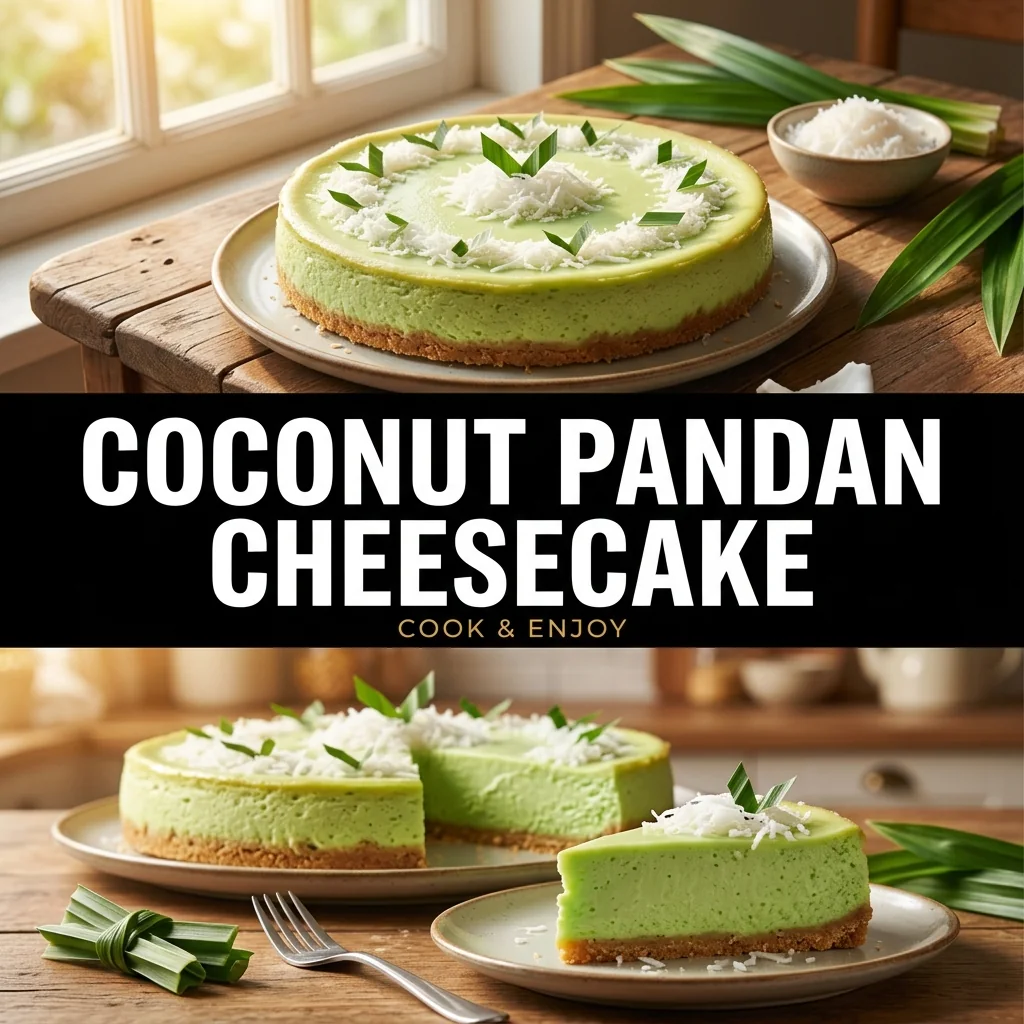
Coconut Pandan Cheesecake unites two quintessential Southeast Asian botanical flavors within a traditional baked cheesecake structure. Pandan leaf, often called the vanilla of Southeast Asia, imparts a deeply fragrant, grassy, and sweet aroma with distinct hints of toasted rice. When blended directly with rich, full-fat coconut cream and tangy cream cheese, the natural bitterness sometimes associated with raw pandan is effortlessly softened. The pale green custard bakes inside a gentle water bath to maintain an exceptionally silken, dense crumb without scorching or drying at the edges. Resting atop a crisp crust fortified with toasted desiccated coconut, this dessert offers an elegant balance of herbal perfume, nutty fats, and balanced lactic acidity that appeals to both classic cheesecake lovers and adventurous dessert tables.
Selecting and Extracting Pandan Essence
For the cleanest flavor profile and natural pale hue, use alcohol-free pandan juice prepared by blending fresh or thawed frozen pandan leaves with a splash of water and straining through fine cheesecloth. Commercial green pandan paste can be substituted if verified alcohol-free, but it often carries concentrated artificial coloring; reduce the quantity to one teaspoon if using industrial paste to prevent an overwhelming chemical aftertaste. Avoid pandan flavorings suspended in alcohol bases to ensure compliance with halal guidelines. The grassy notes should harmonize gently with the cream cheese rather than dominate the palate.
Water Bath Mechanics and Moisture Management
A bain-marie is mandatory for this recipe due to the delicate protein network formed by coconut milk and eggs. Direct, unbuffered dry heat causes the coconut fats to separate and will overbake the eggs into a curdled, rubbery rim before the dense center sets. Surrounding the pan with boiling water regulates the oven temperature around the pan wall at an even 212°F (100°C). Foil wrapping must be seamless and heavy-duty to prevent water leaking into the buttery coconut crust, which would ruin the texture permanently.
Cooling Protocol for a Mirror Finish
Cheesecakes contract significantly as their rich fats solidify. Rushing the cooling process by moving the hot cake directly into a cold refrigerator creates rapid thermal shock, pulling the custard away from the edges and tearing the delicate surface. Allowing the cake to cool slowly inside the turned-off oven with the door ajar allows the center to finish setting via residual heat up to the required 160°F (71°C) mark. Once brought gently to room temperature, the prolonged six-hour refrigeration fully stabilizes the emulsion for clean, knife-wiped slices.
Before you start
To prevent water seepage, place your foil-wrapped springform pan inside an oven-safe silicone baking bag or an 10-inch cake pan before setting it into the water bath. Always mix the batter on low speed; whipping excess air into cream cheese causes the cake to puff during baking and collapse into noticeable cracks upon cooling. Ensure the coconut cream is thoroughly stirred prior to measuring so the solids and liquid fat do not separate in the batter.
THE RECIPE
Coconut Pandan Cheesecake
12 servings · 25 minutes preparation · 70 minutes cooking · 480 minutes cooling, chilling or resting
Ingredients
Step-by-step instructions
- Preheat the oven to 325°F (163°C). Grease a 9-inch (23 cm) springform pan with butter and line the base with parchment paper, then tightly wrap the outside with two layers of heavy-duty aluminum foil.
- In a medium mixing bowl, combine 200 g digestive biscuit crumbs, 40 g toasted desiccated coconut, and 75 g melted unsalted butter until the mixture resembles damp sand.
- Press the crust mixture firmly and evenly across the bottom of the prepared springform pan using the flat bottom of a drinking glass, then bake at 325°F (163°C) for 10 minutes before cooling on a wire rack.
- In a large bowl using a stand mixer fitted with the paddle attachment on low speed, beat 750 g softened cream cheese, 180 g granulated sugar, 20 g cornstarch, and 1.5 g fine sea salt for 2 minutes until creamy and free of lumps, scraping down the bowl as needed.
- Add 240 ml coconut cream, 30 ml alcohol-free pandan leaf extract, and 5 ml alcohol-free vanilla extract, mixing on low speed until the batter is homogeneous and uniformly pale green.
- Add the 4 room-temperature eggs and 1 egg yolk one at a time, mixing on the lowest speed just until each egg is incorporated, taking care not to whip excess air into the custard.
- Pour the smooth filling over the cooled crust, tap the pan gently on the counter twice to dislodge large air bubbles, and place the springform pan inside a large roasting pan.
- Pour boiling water into the roasting pan until it reaches halfway up the sides of the springform pan, then transfer carefully to the oven and bake at 325°F (163°C) for 60 minutes until the edges are set and the center retains a slight gentle wobble (internal temperature reaches 160°F / 71°C).
- Turn off the oven, prop the oven door open 4 inches with a wooden spoon, and let the cheesecake rest in the water bath for 60 minutes; transfer the pan to a wire rack to cool at room temperature for 60 minutes, then refrigerate uncovered for 6 hours (360 minutes) until thoroughly chilled and set.
Kitchen notes
To prevent water seepage, place your foil-wrapped springform pan inside an oven-safe silicone baking bag or an 10-inch cake pan before setting it into the water bath. Always mix the batter on low speed; whipping excess air into cream cheese causes the cake to puff during baking and collapse into noticeable cracks upon cooling. Ensure the coconut cream is thoroughly stirred prior to measuring so the solids and liquid fat do not separate in the batter.
Storage & make-ahead
Cover the chilled cheesecake loosely with parchment paper and an airtight layer of foil. Store in the refrigerator at or below 40°F (4°C) for up to 4 days. Promptly refrigerate any sliced portions within 2 hours of serving. This cheesecake can be baked up to 2 days ahead of time. Freezing whole or sliced cake tightly double-wrapped in plastic wrap and heavy foil is suitable for up to 1 month; thaw completely in the refrigerator overnight before slicing.
An original recipe guide inspired by themes in our Pinterest research. Recipe has not been independently kitchen-tested. AI-generated image is illustrative; your finished dish may look different.
Frequently asked questions
Can I use canned coconut milk instead of coconut cream?
Coconut cream is essential because it contains a higher fat content and lower water percentage. Standard canned coconut milk introduces excessive moisture, which prevents the egg custard from setting firmly and creates a loose, watery center even after the full chilling duration.
Why did my pandan cheesecake turn brown on top?
Browning occurs if your oven runs hot or if the cake is positioned too close to the upper heating element. Bake strictly on the middle rack at 325°F (163°C), and tent the pan loosely with foil halfway through baking if the top begins to take on color.
How do I ensure clean slices when serving?
Dip a sharp, thin chef's knife into a tall container of hot water, wipe the blade completely dry with a clean kitchen towel, and make a single downward slice. Wipe and reheat the knife between every individual cut to maintain smooth, pristine edges.


