WHY MAKE IT
A little comfort, a lot of flavor.
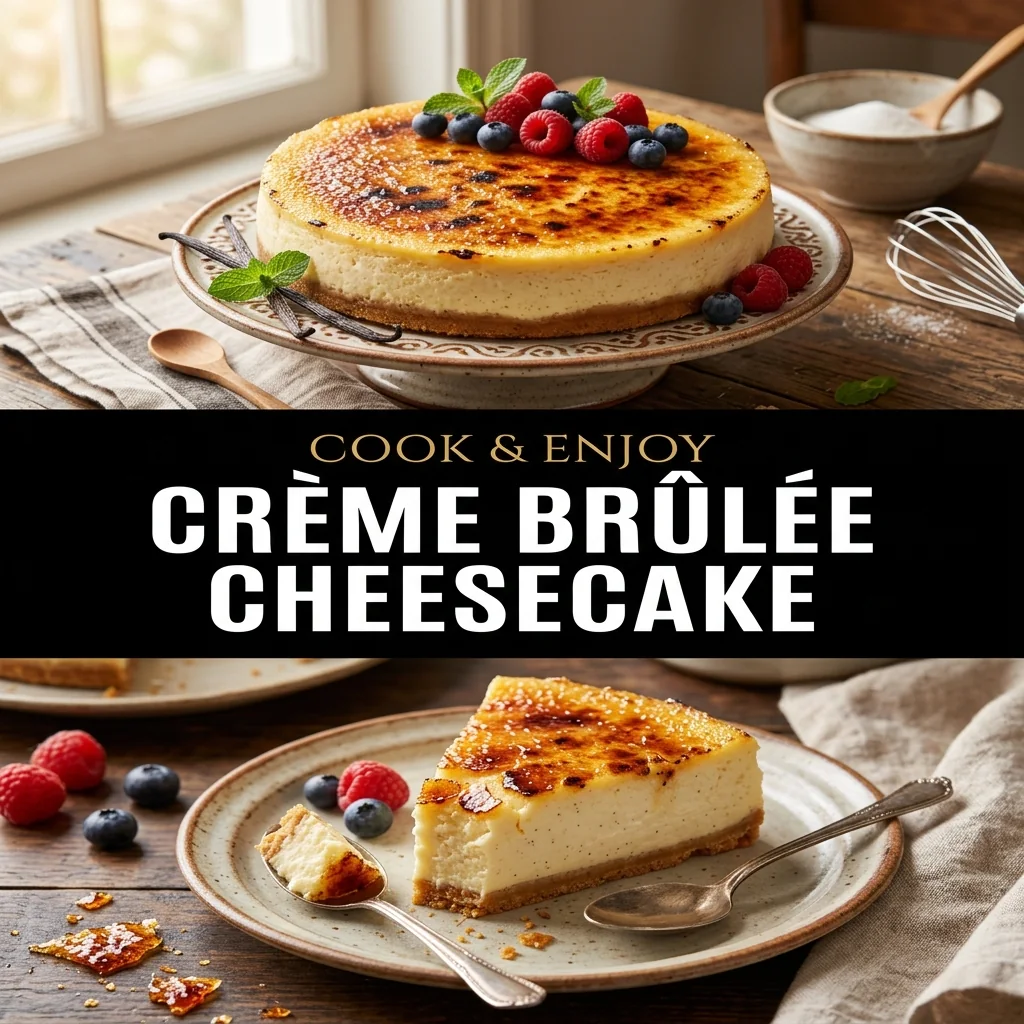
Crème Brûlée Cheesecake unifies two of the world's most revered custard desserts into a singular, showstopping presentation. Traditional crème brûlée relies entirely on heavy cream and egg yolks baked to a delicate wobble, while classic cheesecake emphasizes rich cream cheese density. This hybrid recipe introduces three extra egg yolks and liquid heavy cream into the cream cheese batter, delivering an exceptionally silkier, custard-forward texture studded with real vanilla bean caviar. The real theater occurs at the table: scattering superfine sugar across the chilled surface and caramelizing it with a culinary torch until it forms a brittle, amber pane that shatters satisfyingly under the gentle press of a dessert fork.
Emphasizing Custard Richness
The secret to duplicating the mouthfeel of genuine crème brûlée inside a stable cheesecake slice lies in the yolk-to-white ratio. Whole egg whites contain albumin, which coagulates firmly into an opaque, structural lattice. By replacing some whole eggs with rich egg yolks and blending in heavy cream, we boost fat content and lecithin. This creates a luxurious custard texture that melts on the tongue like a classic pot de crème, while maintaining enough structural integrity to hold clean vertical edges when sliced.
Mastering the Sugar Glass
Using superfine granulated sugar ensures rapid, uniform caramelization under the flame before thermal energy penetrates and curdles the cold cheese beneath. Regular granulated sugar features larger crystals that require extended heat exposure, potentially warming the top layer of cheesecake into liquid butter. Maintain steady circular motions with a butane torch nozzle positioned three to four inches from the surface, coaxing the sugar from molten clear bubbles into a rich, mahogany-hued sheet. Never use your oven broiler, as it heats the entire cake unevenly.
Vanilla Infusion Strategies
Because this cheesecake celebrates pure custard notes, the choice of vanilla defines the overall flavor profile. Scraping the seeds directly from a fresh Madagascar or Tahitian vanilla bean pod infuses the batter with floral, creamy aromatics and gorgeous dark flecks throughout the pale filling. If whole beans are unavailable, choose a concentrated, high-quality vanilla bean paste rather than liquid extract. Extracts contain higher alcohol concentrations that volatilize rapidly during baking, leaving behind less nuance than whole seed paste.
Before you start
Torch the sugar topping only immediately before serving your guests. The caramelized sugar layer is exceptionally hygroscopic; it draws ambient moisture from both the refrigerator and the moist cheesecake below. If torched in advance and refrigerated, the crisp glassy crust will dissolve into a sticky syrup within thirty to forty-five minutes, completely losing its signature auditory crack.
THE RECIPE
Crème Brûlée Cheesecake
12 servings · 30 minutes preparation · 85 minutes cooking · 420 minutes cooling, chilling or resting
Ingredients
Step-by-step instructions
- Position an oven rack in the lower-middle tier and preheat the oven to 325°F (163°C). Combine graham cracker crumbs, two tablespoons of granulated sugar, and melted butter in a bowl. Press firmly into the bottom and 1 inch up the sides of a 9-inch springform pan; bake for 10 minutes, then cool completely on a wire rack.
- Wrap the exterior of the cooled 9-inch springform pan with two layers of heavy-duty aluminum foil to guard against water bath leaks. In a large mixing bowl, combine softened cream cheese and one cup of granulated sugar, beating on medium-low speed for 3 minutes until smooth and free of lumps.
- Whisk heavy cream, cornstarch, scraped vanilla bean seeds, and sea salt in a small measuring cup until smooth. Pour this vanilla-infused cream mixture into the cream cheese base, mixing on low speed for 1 minute until completely homogeneous, pausing to scrape down the bottom and sides of the bowl.
- Gently add the three whole eggs and three egg yolks one at a time, mixing on the lowest speed setting just until each yolk integrates into the batter. Avoid rapid beating to prevent entraining unwanted air bubbles into the delicate custard.
- Pour the smooth, specked custard batter over the pre-baked crust in the 9-inch springform pan. Place the assembled pan inside a large roasting pan, then place both pans on the oven rack.
- Carefully pour boiling water into the roasting pan until the water reaches halfway up the side of the springform pan. Bake at 325°F (163°C) for 65 to 75 minutes until the perimeter is firm and set, but the center 2 inches still wobbles slightly when nudged.
- Turn off the oven and let the cheesecake rest inside with the door slightly ajar for 60 minutes. Remove from the water bath, peel off the foil, and cool to room temperature on a wire rack for no more than 1 hour before chilling uncovered in the refrigerator for at least 5 hours.
- Just prior to serving, blot any surface condensation with a paper towel and sprinkle superfine sugar evenly across the top. Melt and caramelize the sugar using a kitchen culinary blowtorch held 3 inches away, sweeping in continuous circles until deep amber and crackling; rest 3 minutes before cutting.
Kitchen notes
Torch the sugar topping only immediately before serving your guests. The caramelized sugar layer is exceptionally hygroscopic; it draws ambient moisture from both the refrigerator and the moist cheesecake below. If torched in advance and refrigerated, the crisp glassy crust will dissolve into a sticky syrup within thirty to forty-five minutes, completely losing its signature auditory crack.
Storage & make-ahead
Store leftover cheesecake in the refrigerator tightly covered for up to 4 days. Keep in mind that once the sugar top is torched, that crunchy shell cannot be restored by re-torching the dissolved syrup; for make-ahead entertaining, keep the chilled cheesecake plain and torch individual slices or the whole top moments before serving. Un-torched cheesecake slices freeze well wrapped tightly for up to 1 month.
An original recipe guide inspired by themes in our Pinterest research. Recipe has not been independently kitchen-tested. AI-generated image is illustrative; your finished dish may look different.
Frequently asked questions
Can I use an oven broiler instead of a blowtorch?
We strongly discourage using an oven broiler. A broiler heats the entire springform pan, softening the delicate cream cheese filling and melting the cake long before the sugar caramelizes into a glass layer. An inexpensive culinary butane torch provides targeted, instant surface heat without warming the cold interior.
What is superfine sugar and how can I make it at home?
Superfine sugar, also known as caster sugar, consists of finely ground white sucrose crystals that melt faster than standard table sugar. You can make it at home by pulsing ordinary granulated white sugar in a clean food processor or high-speed blender for sixty seconds until finely ground but not powdery.
Why did my torched sugar layer turn soft and sticky?
Caramelized sugar absorbs moisture from the cheesecake and surrounding air. Blot the chilled surface dry, add the sugar, and torch just before serving. Refrigerate leftovers promptly; the topping may soften in the refrigerator.


