WHY MAKE IT
A little comfort, a lot of flavor.
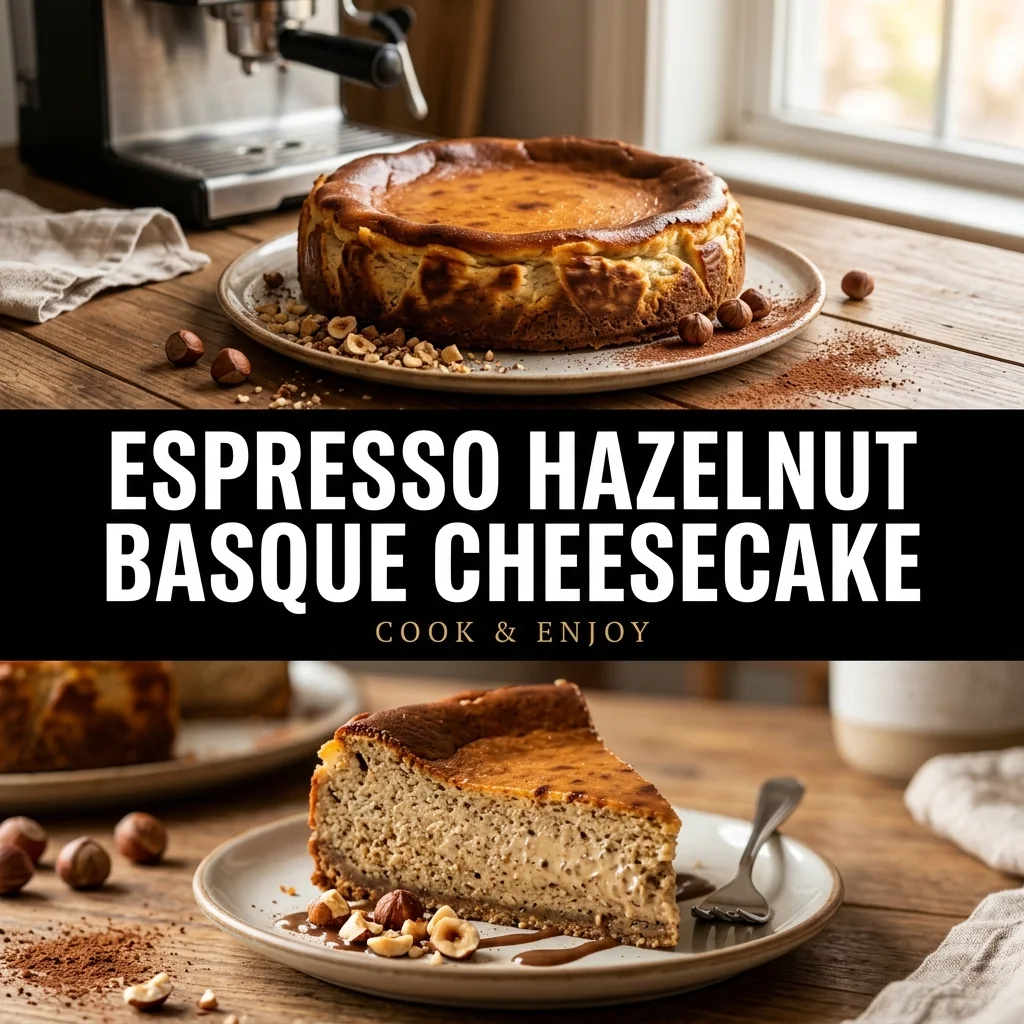
Espresso Hazelnut Basque Cheesecake merges the rustic, deeply blistered character of San Sebastián baking with the aromatic intensity of specialty dark roast coffee. Unlike dense New York styles supported by pressed crusts and baked inside tempered water baths, a Basque cheesecake thrives in aggressive, direct convection heat. The top scorches into a complex, bitter-caramel mantle that balances the unctuous richness of sweet dairy fat. Brewed espresso cuts cleanly through the thick cream cheese, lending earthy roast notes that accentuate the nutty warmth of chopped toasted hazelnuts folded throughout the batter. Chilling after a measured cooling period allows the center to settle from an impossibly molten custard into a satiny, sliceable texture that holds crisp structural integrity on the plate.
Coffee Extraction and Batter Balance
Using brewed liquid espresso introduces true roast aromatics without the synthetic aftertaste sometimes linked to chemical powders. Because excess fluid destabilizes the delicate emulsion of egg proteins and fat globules, the espresso must be drawn double-strength so that a mere 60 milliliters delivers assertive flavor. Allow the hot coffee to cool to lukewarm before incorporating it; scalding liquid curds the raw eggs and prematurely melts dairy solids. The small addition of sifted flour binds free moisture, giving the custard enough cohesion to withstand rapid high-heat expansion without slumping completely.
Mastering the High-Heat Caramelization
Basque cheesecakes demand fearless heat exposure. Baking at 425°F (218°C) quickly prompts Maillard reactions and sugar caramelization along the surface long before the core reaches a conventional set. Novice bakers often remove the pan prematurely when observing the dark mahogany color, leaving an entirely runny center. Look for edges that rise slightly up the parchment wall and feel resilient to a light fingertip tap, while the inner circle wobbles in a wave-like cadence. The residual heat finishes setting the center during resting.
Slicing, Textural Finish, and Service
A newly baked Basque cheesecake requires patient cooling. Slicing warm leads to a collapsed, messy presentation because the dairy fats have not recrystallized. After the full chilling protocol, run a sharp, thin slicing knife under hot water, wipe it dry, and glide straight through the cake in a single continuous downward pull. Clean the blade thoroughly between every portion. The contrast between the crunchy roasted hazelnuts nestled within and the molten, coffee-perfumed interior creates a remarkable dessert experience.
Before you start
Room temperature ingredients are mandatory for achieving a silky, lump-free batter without incorporating unwanted air bubbles. Cold cream cheese forces prolonged mechanical whipping, which traps micro air pockets that cause the cheesecake to dome excessively and split prematurely during the high-heat bake. If your hazelnuts retain bitter brown skins, toast them whole first, bundle them inside a clean tea towel, rub vigorously to slough off papery skins, and chop finely once cooled.
THE RECIPE
Espresso Hazelnut Basque Cheesecake
10 servings · 25 minutes preparation · 50 minutes cooking · 480 minutes cooling, chilling or resting
Ingredients
Step-by-step instructions
- Position an oven rack in the center position and preheat the oven to 425°F (218°C). Brush the interior of a 9-inch (23 cm) round springform pan with 15 grams melted butter, then line it with two overlapping sheets of parchment paper, pressing the paper firmly into the corners and allowing at least 2 inches (5 cm) of excess parchment to pleat and extend above the pan rim.
- Spread 120 grams raw chopped hazelnuts across a small baking sheet and toast in the preheating oven at 425°F (218°C) for 6 to 8 minutes until fragrant and lightly golden; transfer immediately to a plate to cool completely.
- In a large mixing bowl fitted to a stand mixer with the paddle attachment, beat 900 grams room-temperature cream cheese and 300 grams granulated sugar on medium-low speed for 3 to 4 minutes until completely smooth, scraping down the sides and base of the bowl with a silicone spatula twice to eliminate lumps.
- Add 5 room-temperature eggs one at a time on low speed, mixing for roughly 20 seconds after each addition until just incorporated, taking care not to whip excess air into the batter.
- Pour in 350 milliliters heavy cream, 60 milliliters cooled double-strength espresso, 10 milliliters alcohol-free vanilla extract, and 3 grams fine sea salt; beat on low speed for 1 minute until evenly blended and uniformly tinted mocha brown.
- Sift 30 grams all-purpose flour directly over the batter and mix on low speed for 30 seconds until no dry streaks remain, then gently fold in 90 grams of the cooled toasted chopped hazelnuts using a flexible spatula, reserving the remaining 30 grams for post-bake garnishing.
- Pour the batter into the prepared springform pan, lightly rap the pan twice on the counter to dislodge large air bubbles, and bake at 425°F (218°C) for 40 to 45 minutes until the top is deeply scorched dark brown and the outer perimeter feels set while the center 3 inches remain dramatically jiggly when gently nudged. Verify the center reaches 160 F (71 C); continue baking gently if necessary.
- Transfer the cheesecake in its pan to a wire cooling rack and let cool completely undisturbed at room temperature for 120 minutes (2 hours), then transfer to the refrigerator to chill for at least 360 minutes (6 hours) to set the custard core firmly before unclamping the pan, peeling back the parchment, and scattering the reserved 30 grams toasted hazelnuts over the caramelized surface.
Kitchen notes
Room temperature ingredients are mandatory for achieving a silky, lump-free batter without incorporating unwanted air bubbles. Cold cream cheese forces prolonged mechanical whipping, which traps micro air pockets that cause the cheesecake to dome excessively and split prematurely during the high-heat bake. If your hazelnuts retain bitter brown skins, toast them whole first, bundle them inside a clean tea towel, rub vigorously to slough off papery skins, and chop finely once cooled.
Storage & make-ahead
Refrigerate perishables promptly within 2 hours of baking. Store sliced or whole cheesecake in an airtight container or tightly covered with foil in the refrigerator for up to 4 days. Serve chilled or let individual slices sit on the counter for 20 minutes to soften slightly. Freezing whole or cut slices wrapped in parchment and heavy plastic wrap preserves quality for up to 1 month; thaw completely in the refrigerator overnight before service.
An original recipe guide inspired by themes in our Pinterest research. Recipe has not been independently kitchen-tested. AI-generated image is illustrative; your finished dish may look different.
Frequently asked questions
Can I replace the freshly brewed espresso with espresso powder?
Yes. Dissolve 15 grams of pure instant espresso granules into 60 milliliters of lukewarm whole milk or warm water. Ensure the mixture cools fully before blending it into the batter so that the eggs do not coagulate prematurely.
Why did my Basque cheesecake leak butter during baking?
Cheesecakes leak fat if the batter is overmixed at high speeds, which shears the emulsion, or if low-fat cream cheese with excessive moisture additives was used. Always use block-style full-fat cream cheese and blend strictly on low to medium-low speed.
How do I know the core is safely cooked?
Even with an intentional Basque wobble, the thickest central point of the custard reaches at least 160°F (71°C) during resting, cooking the egg proteins thoroughly while remaining wonderfully unctuous after thorough refrigeration.


