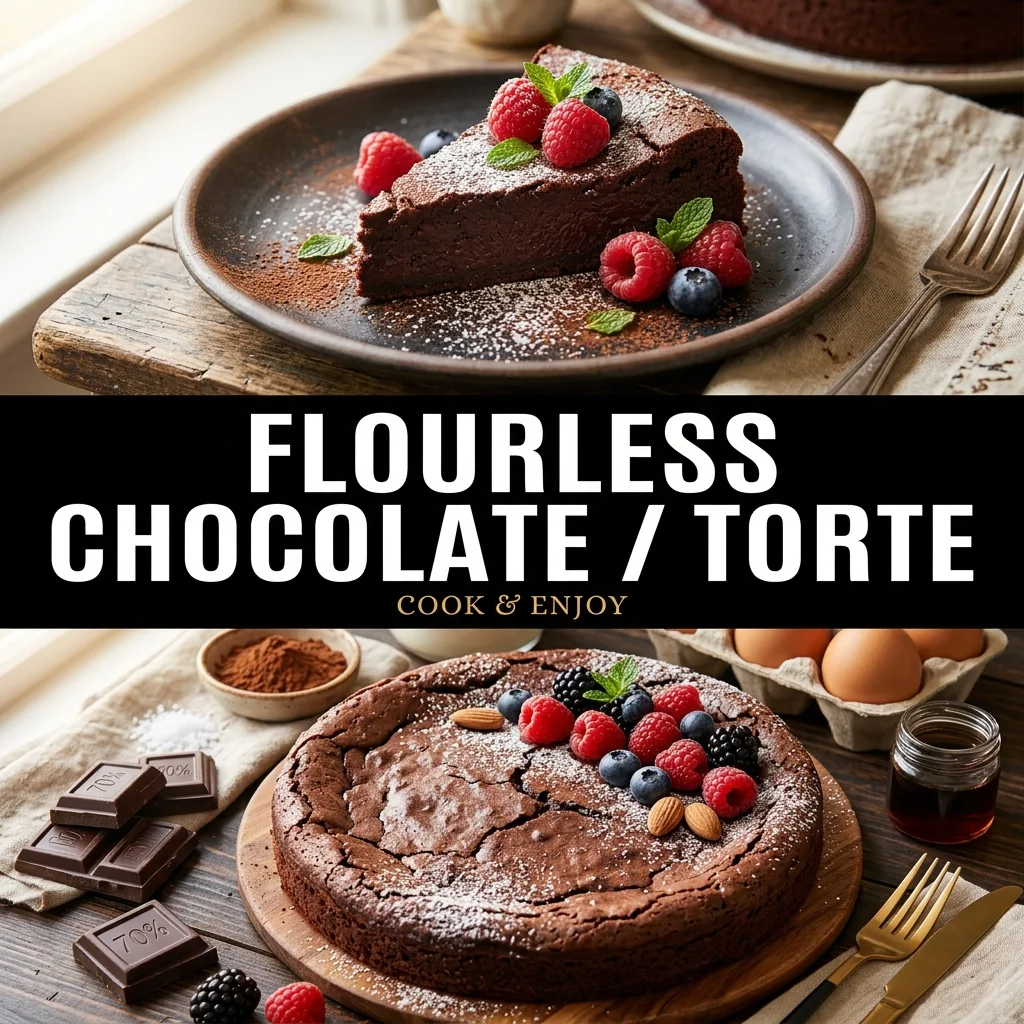
WHY MAKE IT
A little comfort, a lot of flavor.
A classic flourless chocolate torte occupies the culinary space between a baked chocolate mousse and a dense confectionery truffle. Because this formula contains no wheat flour or chemical leaveners, its final structure relies entirely on the suspension of fat, sugar, and whipped egg proteins. High-quality chocolate with a cocoa percentage between 60 and 70 percent provides essential cocoa solids and cocoa butter, which set into a stable crumb as the cake cools. Emulsifying the melted chocolate with egg yolks establishes richness, while separately whipped egg whites introduce pockets of trapped air that expand during baking to provide rise. As the torte cools and rests, the center naturally contracts into a dense, velvety layer, yielding a sophisticated centerpiece suited for formal dinners and celebratory gatherings.
Selecting Chocolate and Cocoa
The flavor profile and consistency of this torte hinge entirely on chocolate quality. Bittersweet varieties ranging from 60 to 70 percent cacao balance intense roasted cocoa notes with sufficient sugar, preventing the dessert from tasting cloying or bitter. Avoid chocolate chips containing added stabilizers like soy lecithin or vegetable fats, which impede smooth melting and yield a waxy mouthfeel. Dutch-process cocoa powder is preferred for prepping the pan because its alkalized nature yields a darker hue and smoother chocolate profile than acidic natural cocoa, enhancing overall color and aroma.
Temperature Management and Emulsion
Managing ingredient temperatures prevents textural defects such as curdled yolks or seized chocolate. When combining melted chocolate and butter with the egg yolks, ensure the chocolate mixture cools below 110°F (43°C); excessively hot chocolate can scramble raw yolks upon contact. Room temperature eggs blend far more readily than cold eggs, preventing the melted cocoa butter from prematurely solidifying into tiny, gritty beads. Gentle whisking during initial incorporation establishes a stable lipid-in-water emulsion that bakes evenly without leaking butter into the bottom of the springform pan.
Slicing and Presentation Standards
Because this cake is remarkably dense and moist, cutting clean portions requires specific technique. Chill the cake thoroughly for several hours before attempting to slice. Dip a long, thin chef's knife into a tall container of hot water, wipe the blade completely dry with a clean kitchen towel, and draw the knife smoothly through the cake in a single, continuous motion. Wipe and reheat the blade between every single slice. Serve plain, with unsweetened whipped cream, or beside tart berry coulis to cut through the decadence.
Before you start
Pay close attention to egg white volume during folding. Over-whipping whites into stiff, dry clumps makes them stubborn to integrate, forcing excessive folding that deflates the batter. Stop whipping as soon as peaks hold their shape with slight curving tips. When folding, use a wide rubber spatula and turn the bowl continuously. If your baked torte forms deep surface cracks, rest assured this is normal; a dusting of cocoa powder or a layer of warm chocolate ganache seamlessly covers the top.
THE RECIPE
Flourless Chocolate Torte
10 servings · 25 minutes preparation · 40 minutes cooking · 240 minutes cooling, chilling or resting
Ingredients
Step-by-step instructions
- Preheat the oven to 350°F (175°C) with a rack set in the center position. Grease a 9-inch springform pan with butter, line the bottom with a round of parchment paper, and dust the interior sides with Dutch-process cocoa powder, tapping out any excess.
- Combine the chopped bittersweet chocolate and cubed butter in a heatproof bowl set over a saucepan of gently simmering water, ensuring the water does not touch the bowl. Stir occasionally with a heat-resistant spatula until completely melted and glossy, then remove from heat and cool for 10 minutes.
- Whisk the 6 egg yolks, 3/4 cup (150 g) of granulated sugar, vanilla extract, kosher salt, and espresso powder together in a large mixing bowl until pale and slightly thickened. Slowly pour the warm chocolate mixture into the yolk base, whisking constantly until completely emulsified and cohesive.
- In a clean, dry bowl, beat the 6 egg whites using a stand mixer or hand mixer on medium speed until soft peaks form. Gradually add the remaining 1/4 cup (50 g) granulated sugar and whip on medium-high until glossy, firm peaks develop without turning dry or clumpy.
- Gently stir one-third of the whipped egg whites into the chocolate batter using a rubber spatula to lighten its density. Fold in the remaining egg whites in two additions, cutting down the center and sweeping along the bottom of the bowl until no white streaks remain, working gently to preserve aeration.
- Pour the aerated batter into the prepared springform pan, smoothing the surface level. Bake at 350°F (175°C) for 38 to 42 minutes until the edges are puffed and set, and the center displays a slight wobble when gently shaken with a dry, cracked top surface.
- Cool the torte completely in its pan on a wire rack for 2 hours, during which the center will settle. Run a thin knife around the perimeter, release the pan latch, and transfer the torte to the refrigerator for at least 2 hours to firm before slicing.
- If glazing, heat heavy cream until steaming, pour over the chopped semisweet chocolate, let sit for 2 minutes, then whisk smooth. Pour the warm glaze over the chilled torte, spreading to the edges, and chill 30 minutes until set before slicing with a hot knife.
Kitchen notes
Pay close attention to egg white volume during folding. Over-whipping whites into stiff, dry clumps makes them stubborn to integrate, forcing excessive folding that deflates the batter. Stop whipping as soon as peaks hold their shape with slight curving tips. When folding, use a wide rubber spatula and turn the bowl continuously. If your baked torte forms deep surface cracks, rest assured this is normal; a dusting of cocoa powder or a layer of warm chocolate ganache seamlessly covers the top.
Storage & make-ahead
Store the chilled torte tightly wrapped in plastic or under a cake dome in the refrigerator for up to 5 days. For freezing, slice the chilled torte, wrap individual portions in parchment paper followed by aluminum foil, and freeze for up to 2 months. Thaw frozen slices overnight in the refrigerator. Serve chilled for a fudgy texture, or bring slices to room temperature for 30 minutes prior to service for a softer, creamier consistency.
An original recipe guide inspired by themes in our Pinterest research. Recipe has not been independently kitchen-tested. AI-generated image is illustrative; your finished dish may look different.
Frequently asked questions
Can I use milk chocolate instead of bittersweet chocolate?
Milk chocolate contains substantially higher sugar and dairy solids and far less cocoa butter, which will cause the torte to bake into an overly sweet, greasy, and structurally soft cake. Stick to bittersweet chocolate between 60% and 70% cacao for proper setting.
Why did my torte sink deeply in the center as it cooled?
Some sinking is completely normal and expected for flourless tortes. Without starch to build a rigid framework, the air pockets created by the whipped whites gently deflate as steam escapes and the cocoa butter firms, resulting in the signature dense, fudgy core.
How do I know the torte is done without a toothpick test?
A toothpick inserted into this torte will not come out clean due to the rich melted chocolate. Look instead for puffed, matte edges that have pulled slightly away from the pan, accompanied by a center that retains a slight, uniform jiggle.