WHY MAKE IT
A little comfort, a lot of flavor.
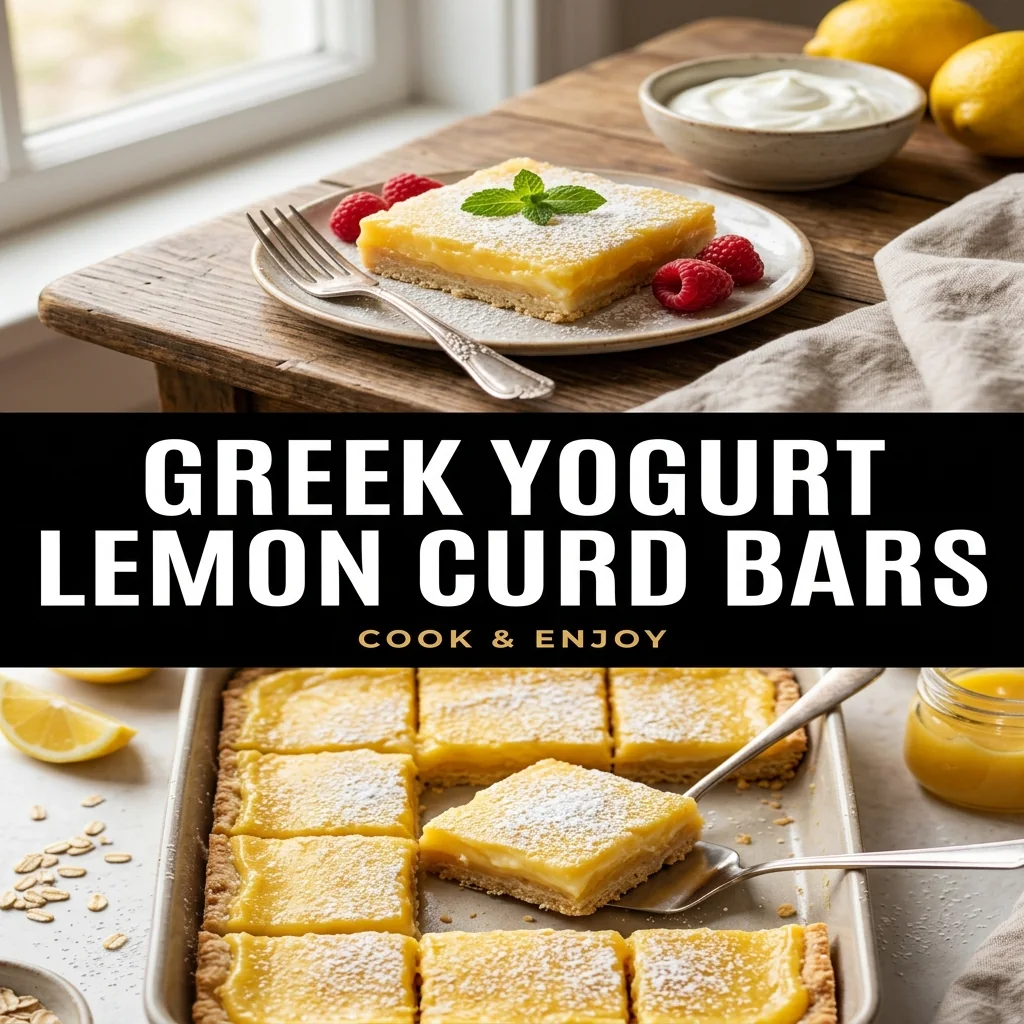
Greek yogurt lemon curd bars offer a velvety, sophisticated twist on the classic American bakery square. Traditional lemon bars rely solely on eggs and sugar to thicken freshly squeezed citrus juice, which can occasionally lean overly sweet or jelly-like. By folding strained whole-milk Greek yogurt into the filling, this recipe introduces a pleasant dairy tang, luscious creaminess, and a softer, custard-like texture that complements bright lemon juice. The filling rests atop a traditional par-baked shortbread foundation crafted from butter, flour, and powdered sugar, delivering a crumbly, melt-in-your-mouth contrast. Baked gently until the custard reaches food-safe temperatures, then chilled thoroughly, these elegant squares slice cleanly into vibrant, sunny portions finished with a delicate veil of powdered sugar.
The Shortbread Foundation
A successful citrus bar requires a robust yet tender shortbread base capable of supporting a moist custard without becoming soggy. Using sifted powdered sugar instead of granulated sugar in the dough yields a fine, delicate crumb structure that melts on the tongue. Par-baking the shortbread crust at 350 F (175 C) for twenty minutes before adding the wet filling allows the butter and flour starches to gelatinize and form a sealed, golden barrier. Pouring the custard over the warm crust ensures immediate adhesion between layers, preventing separation when the chilled bars are sliced.
Enriching Curd with Greek Yogurt
Incorporating thick, strained Greek yogurt into lemon curd requires careful technique to prevent curdling. Citrus juice contains citric acid, which can destabilize dairy proteins if the emulsion is handled roughly or heated aggressively. Whisking the eggs and sugar together thoroughly creates a protective matrix that buffers the dairy proteins when the lemon juice and yogurt are incorporated. Whole-milk Greek yogurt adds essential milk fats that temper the sharp acidity of two-thirds of a cup of fresh lemon juice, resulting in a rounded, creamy citrus flavor profile.
Baking and Chilling Custards Safely
Egg-based custards require gentle, controlled heat to set properly without turning rubbery or weeping liquid. Baking the curd layer until it registers 160 F (71 C) ensures the eggs are thoroughly cooked and safe while preventing the yogurt emulsion from breaking under excessive heat. Once baked, the bars must cool gradually at room temperature for thirty minutes before entering the refrigerator. A mandatory two-hour chill allows the fats in the butter and the proteins in the yogurt-egg matrix to firm up completely, ensuring crisp, professional slices.
Before you start
Ensure your Greek yogurt and eggs are at true room temperature before whisking them into the citrus mixture. Cold dairy introduced to acidic lemon juice can curdle slightly or cause the eggs to cook unevenly during baking. If your Greek yogurt has excess liquid whey sitting in the container, drain it through a fine-mesh sieve lined with a paper towel for 10 minutes before measuring to keep the custard thick and stable.
THE RECIPE
Greek Yogurt Lemon Curd Bars
16 servings · 25 minutes preparation · 35 minutes cooking · 150 minutes cooling, chilling or resting
Ingredients
Step-by-step instructions
- Preheat your oven to 350 F (175 C) and line an 8x8-inch metal baking pan with parchment paper, leaving a 2-inch overhang on opposite sides.
- In a medium bowl, beat 1 cup softened unsalted butter and 1/2 cup sifted powdered sugar with a handheld mixer on medium speed for 2 minutes until smooth and creamy.
- Add 1 3/4 cups all-purpose flour and 1/4 teaspoon fine sea salt to the butter mixture, mixing on low speed just until a soft, crumbly shortbread dough forms without overworking.
- Transfer the dough to the prepared 8x8-inch pan, press it firmly and evenly across the bottom with floured fingers, and bake at 350 F (175 C) for 20 minutes until the edges are light golden; remove from the oven and set aside.
- While the crust bakes, whisk 4 large eggs and 1 cup granulated sugar in a large bowl for 1 minute until pale and slightly frothy.
- Whisk in 2 tablespoons lemon zest, 2/3 cup fresh lemon juice, 1/2 cup room-temperature plain Greek yogurt, 1 teaspoon alcohol-free vanilla extract, the remaining 1/4 cup all-purpose flour, and the remaining 1/4 teaspoon fine sea salt until silky and homogeneous.
- Pour the lemon-yogurt mixture directly over the warm par-baked shortbread crust, spreading evenly to the corners.
- Return the pan to the 350 F (175 C) oven and bake for 15 minutes until the custard center reaches 160 F (71 C) on an instant-read thermometer and is set with a slight gentle jiggle in the center.
- Cool the pan completely on a wire rack at room temperature for 30 minutes, then refrigerate for at least 120 minutes until fully chilled and firm; use the parchment handles to lift the slab out, slice into 16 squares, and dust with 2 tablespoons powdered sugar before serving.
Kitchen notes
Ensure your Greek yogurt and eggs are at true room temperature before whisking them into the citrus mixture. Cold dairy introduced to acidic lemon juice can curdle slightly or cause the eggs to cook unevenly during baking. If your Greek yogurt has excess liquid whey sitting in the container, drain it through a fine-mesh sieve lined with a paper towel for 10 minutes before measuring to keep the custard thick and stable.
Storage & make-ahead
Promptly refrigerate leftover lemon bars in an airtight container within 2 hours of serving; keep chilled for up to 4 days. Because of the delicate yogurt custard, do not leave these bars at room temperature for extended periods. Slices can be frozen between wax paper sheets in an airtight container for up to 1 month; thaw overnight in the refrigerator. Dust with fresh powdered sugar immediately before serving.
An original recipe guide inspired by themes in our Pinterest research. Recipe has not been independently kitchen-tested. AI-generated image is illustrative; your finished dish may look different.
Frequently asked questions
Can I use bottled lemon juice instead of fresh lemons?
Freshly squeezed lemon juice is strongly recommended. Bottled lemon juice contains chemical preservatives and lacks the floral, aromatic citrus oils provided by fresh lemon zest, which is crucial for balancing the rich Greek yogurt filling.
Why did my lemon curd layer separate or curdle?
Separation occurs if the yogurt was cold when mixed with the citrus juice, or if the oven temperature exceeded 350 F (175 C), causing the egg and dairy proteins to overcook. Use room-temperature ingredients and monitor the internal temperature carefully.
Can I make these bars with low-fat or nonfat Greek yogurt?
Whole-milk Greek yogurt is best because its fat content stabilizes the custard emulsion and provides a smooth texture. Nonfat yogurt contains higher water content and lower fat, which can make the lemon filling watery and prone to cracking.