WHY MAKE IT
A little comfort, a lot of flavor.
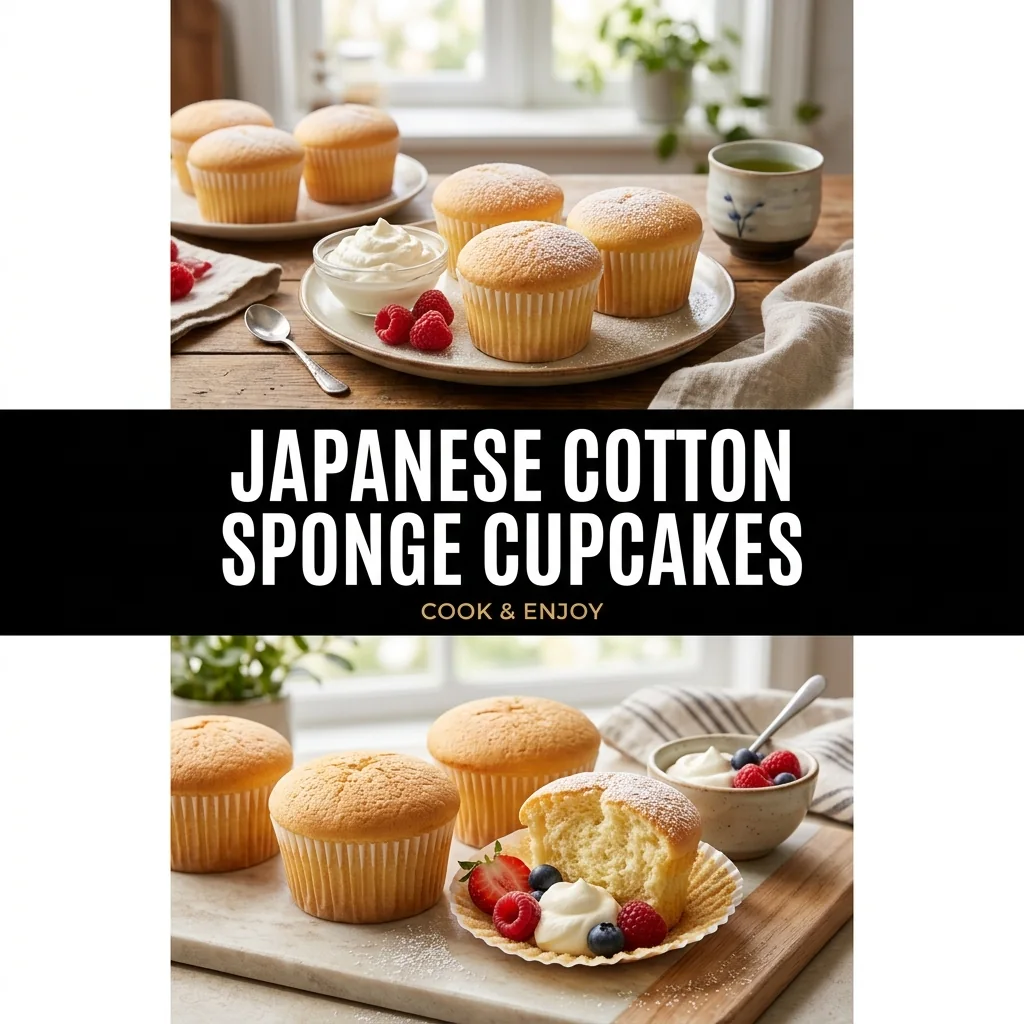
Japanese Cotton Sponge Cupcakes, often celebrated for their cloud-like delicacy, bridge the gap between a traditional sponge cake and a gentle French soufflé. The secret to their unique crumb lies in the tangzhong-adjacent method of whisking sifted cake flour directly into hot melted butter, lightly gelatinizing the starches before the batter is hydrated with milk and egg yolks. This prevents excessive gluten formation and creates an exceptionally tender network capable of holding moisture. When combined with a stable, glossy French meringue and baked in a gentle water bath, the cakes rise softly and evenly without forming a tough exterior crust. The result is a pillowy, delicately sweet pastry that melts instantly on the tongue.
The Cooked Flour Emulsion
Heating the butter to approximately 150°F (65°C) before whisking in the cake flour is the cornerstone of cotton sponge texture. This mild thermal application cooks the starches slightly, reducing their ability to develop gluten when liquids are introduced. The paste emulsifies seamlessly with warm milk and egg yolks, yielding an elastic base with substantial moisture retention. It is essential that the milk and yolks are at room temperature or slightly warmed; adding cold dairy to the warm flour-butter paste can cause the butter to solidify and create small lumps that ruin the uniform texture.
Whipping the Meringue to Firm Peaks
The structure of these cupcakes relies almost entirely on aerated egg whites rather than chemical leaveners like baking powder. Whipping the whites with cream of tartar stabilizes the albumen protein matrix, allowing it to hold trapped air under heat. Superfine sugar should be added only after the whites are foamy and opaque. Aim for firm peaks that bend slightly at the tip like an eagle's beak. Over-whipped, dry meringue will clump when folded, forcing you to overmix and deflate the batter, which causes the cupcakes to collapse upon cooling.
Baking in a Gentle Water Bath
A gentle water bath, or bain-marie, provides consistent, humid heat that surrounds the cupcakes throughout the baking cycle. By capping the surrounding temperature at the boiling point of water, the delicate egg proteins set gradually rather than seizing quickly. This prevents the cupcakes from doming aggressively and splitting open. Allowing the cupcakes to rest in the turned-off oven with the door propped open lets the delicate interior sponge adjust gradually to the ambient air pressure, substantially reducing shrinkage as the steam cools.
Before you start
Use superfine sugar rather than regular granulated sugar because its tiny crystals dissolve completely into the egg whites, producing a sturdy, silky meringue that will not weep. Do not whip the egg whites to stiff, dry peaks; stopping at firm peaks with a slight hook ensures the cupcakes expand smoothly without cracking open across the tops. Ensure the hot water for the bath is around 140°F to 150°F (60°C to 65°C), not boiling, to prevent premature puffing.
THE RECIPE
Japanese Cotton Sponge Cupcakes
8 servings · 25 minutes preparation · 35 minutes cooking · 30 minutes cooling, chilling or resting
Ingredients
Step-by-step instructions
- Preheat the oven to 300°F (150°C) and line an 8-cup silicone muffin pan or metal cupcake pan with 8 sturdy paper baking cups.
- Melt the unsalted butter in a small saucepan over medium-low heat just until it begins to bubble gently, reaching approximately 150°F (65°C), then remove from heat immediately.
- Pour the hot melted butter into a heatproof bowl, add the sifted cake flour, and whisk briskly until a smooth, cooked paste forms.
- Whisk the warm whole milk into the cooked flour paste until fully incorporated and smooth.
- Whisk the 4 room-temperature egg yolks and alcohol-free vanilla extract together in a small bowl, then whisk them into the batter until smooth and glossy.
- In a separate clean, grease-free mixing bowl, beat the 3 egg whites with an electric mixer on medium-low speed until frothy, add the cream of tartar, and beat until soft peaks begin to form.
- Gradually stream in the superfine granulated sugar while beating on medium-high speed, continuing until firm, glossy peaks with gently curving tips develop.
- Gently fold one-third of the whipped meringue into the egg yolk batter with a silicone spatula to lighten it, then fold in the remaining meringue in two additions until no white streaks remain.
- Divide the batter evenly among the 8 prepared cupcake liners, filling each nearly to the rim, and place the muffin pan inside a large, deep roasting pan.
- Pour the 3 cups of hot water into the roasting pan around the cupcake pan to create a 1/2-inch deep water bath.
- Bake at 300°F (150°C) for 35 minutes until the tops are golden brown, spring back lightly to the touch, and do not wobble.
- Turn off the oven, prop the oven door open slightly with a wooden spoon, and let the cupcakes rest in the water bath inside the oven for 10 minutes.
- Carefully remove the cupcakes from the water bath and transfer them to a wire rack to cool for 20 minutes before serving.
Kitchen notes
Use superfine sugar rather than regular granulated sugar because its tiny crystals dissolve completely into the egg whites, producing a sturdy, silky meringue that will not weep. Do not whip the egg whites to stiff, dry peaks; stopping at firm peaks with a slight hook ensures the cupcakes expand smoothly without cracking open across the tops. Ensure the hot water for the bath is around 140°F to 150°F (60°C to 65°C), not boiling, to prevent premature puffing.
Storage & make-ahead
Store leftover cotton sponge cupcakes in an airtight container lined with a paper towel in the refrigerator for up to 3 days. These delicate cakes are best enjoyed slightly cool or at room temperature. Do not freeze, as the freezing and thawing process breaks down the delicate cell structure of the cooked egg white foam, resulting in a damp, shrunken sponge.
An original recipe guide inspired by themes in our Pinterest research. Recipe has not been independently kitchen-tested. AI-generated image is illustrative; your finished dish may look different.
Frequently asked questions
Why did my cupcakes sink dramatically as they cooled?
Slight shrinkage is normal, but significant collapse usually indicates underbaking or over-whipped egg whites. Ensure the cupcakes bake for the full 35 minutes and rest briefly in the propped-open oven before removal.
Can I bake these without a water bath?
A water bath is necessary for cotton sponge cakes. Without the gentle steam and moderated temperature of the water bath, the edges will bake too rapidly and dry out, losing the characteristic pillowy texture.
Why did my cupcake tops crack in the oven?
Cracking happens when the oven temperature is too high, the water bath is boiling vigorously, or the meringue was whipped to stiff, dry peaks, causing rapid, uneven expansion before the crumb sets.