WHY MAKE IT
A little comfort, a lot of flavor.
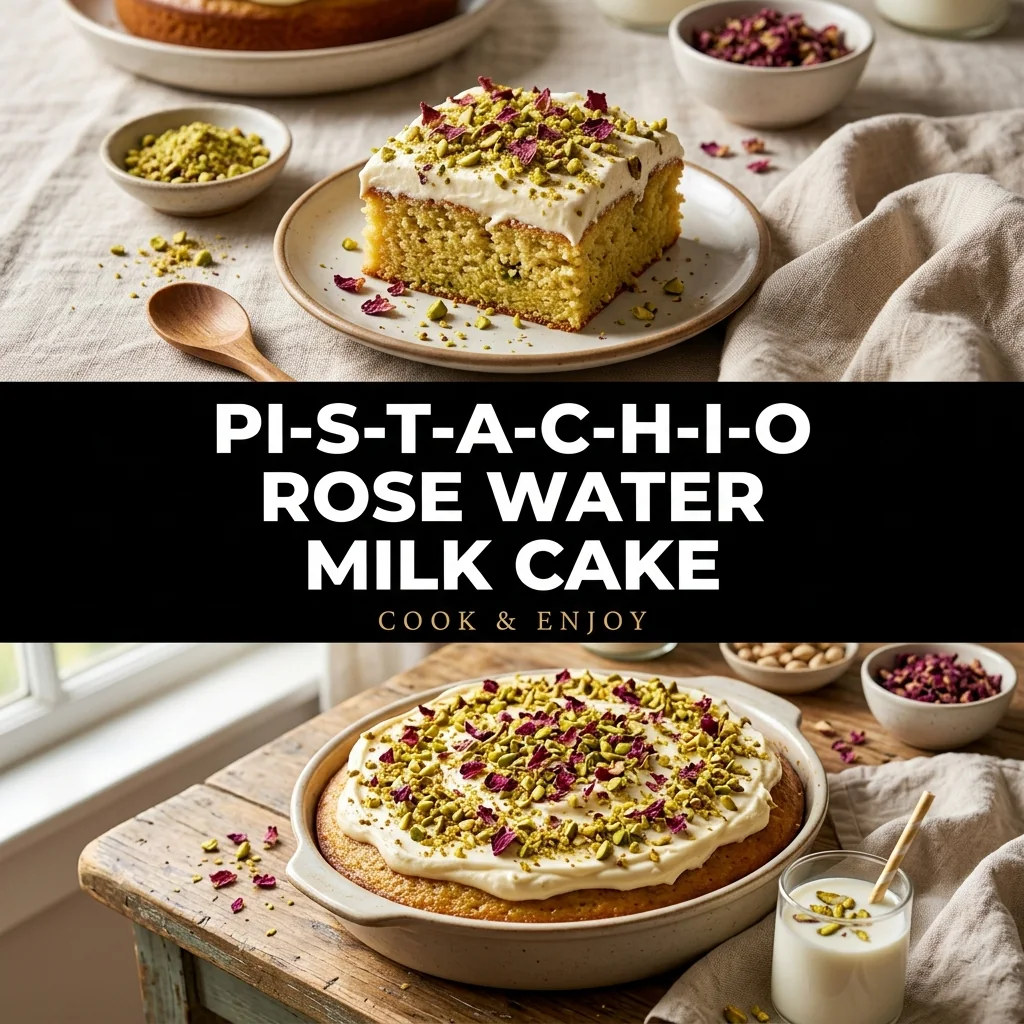
Inspired by the luscious soak of classic tres leches and the timeless aromatics of traditional Middle Eastern and South Asian confectionery, this milk cake is an elegant centerpiece dessert. The sponge relies entirely on whipped egg aeration, utilizing separated whites whipped to stiff peaks to create a dry, open-crumb matrix capable of absorbing nearly a liter of infused dairy without collapsing into paste. A three-milk blend of evaporated milk, sweetened condensed milk, and heavy cream is steeped with culinary rose water and pulverized emerald pistachios. As the cake chills, the sponge draws every drop of liquid deep into its structure. Finished with cloud-like whipped cream and ruby rose petals, each forkful is cool, fragrant, and exquisitely moist.
Egg Aeration for Maximum Liquid Absorption
Unlike standard butter cakes that become heavy when saturated, an unshortened sponge cake possesses an open, honeycomb crumb ideal for soaking. Separating the eggs and whipping the whites with sugar forms a stable protein foam. When gently folded with the emulsified yolk mixture and low-protein cake flour, the batter traps millions of tiny air cells. Once baked, these void spaces act like miniature sponges. Slicing through the finished dessert reveals a cake that holds its structural integrity without leaking pools of liquid or dissolving into mush.
Balancing Floral and Nutty Infusions
Rose water can easily overwhelm delicate dairy if unmeasured. Pure culinary rose water should provide a gentle background floral note that enhances the rich creaminess of condensed milk rather than competing with it. Finely pulverizing raw pistachios into the milk soak releases essential nut oils and pleasant earthy tones, tempering the floral brightness. Garnishing the topping with chopped toasted pistachios introduces a welcome crunch, contrasting the tender, milk-saturated crumb beneath the velvety chantilly layer.
Chilling Requirements and Food Safety
Because this cake contains a substantial volume of fresh dairy, evaporated milk, and whipped eggs, temperature control is critical. After soaking the warm cake, prompt refrigeration allows the crumb to hydrate evenly while inhibiting bacterial growth. The cake must chill for a minimum of four hours—or ideally overnight—reaching a consistent internal temperature below 40°F (4°C). Keep the finished cake chilled right up until serving, and promptly return leftovers to refrigeration within two hours to preserve dairy safety and peak textural quality.
Before you start
Culinary rose water varies significantly in strength depending on whether it is distilled once or double-concentrated. Always check the label for 'food grade' or 'culinary' and start with the specified one and a half tablespoons; excess rose water quickly imparts a soapy flavor rather than an elegant floral aroma. For the sponge, ensure no yolk contaminates the egg whites, as any trace of fat prevents the whites from expanding into the voluminous structure needed to absorb the soaking liquid.
THE RECIPE
Pistachio Rose Water Milk Cake
12 servings · 30 minutes preparation · 25 minutes cooking · 240 minutes cooling, chilling or resting
Ingredients
Step-by-step instructions
- Preheat the oven to 350°F (177°C). Lightly grease a 9x13-inch ceramic or glass baking dish with neutral cooking spray or butter; do not line with paper.
- In a medium bowl, sift together 150 g cake flour, 1 tsp baking powder, and 1/4 tsp fine sea salt.
- In a large bowl, beat 5 egg yolks with 100 g granulated sugar using an electric hand mixer on medium-high speed for 3 minutes until thick, pale yellow, and falling in ribbons; mix in 1 tsp alcohol-free vanilla extract and 60 ml whole milk.
- In a separate, spotless bowl with clean beaters, whip 5 egg whites on medium speed until foamy; gradually stream in remaining 50 g granulated sugar and whip on high speed until stiff, glossy peaks form.
- Gently fold one-third of the beaten egg whites into the yolk mixture to loosen it, then gently fold in half the flour mixture, followed by another third of whites, remaining flour, and final whites using a silicone spatula until no streaks remain.
- Pour batter into the baking dish, smooth the top, and bake at 350°F (177°C) for 22 to 25 minutes until the cake springs back when gently pressed and a wooden skewer inserted in the center registers 200°F (93°C) and emerges clean.
- While baking, whisk together 354 ml evaporated milk, 300 ml sweetened condensed milk, 120 ml heavy cream, 1 1/2 tbsp rose water, and 60 g finely ground pistachios in a pitcher until thoroughly blended.
- Pierce the warm cake across its entire surface with a thin skewer at 1/2-inch intervals; slowly pour the pistachio-rose milk evenly over the cake in three stages, allowing each pour to soak in. Cover and refrigerate for at least 4 hours (240 minutes) or overnight.
- Whip 360 ml cold heavy cream and 30 g powdered sugar in a chilled bowl until medium-stiff peaks form. Spread evenly over the chilled cake, then scatter 30 g chopped pistachios and 1 tbsp edible rose petals on top before slicing into 12 portions.
Kitchen notes
Culinary rose water varies significantly in strength depending on whether it is distilled once or double-concentrated. Always check the label for 'food grade' or 'culinary' and start with the specified one and a half tablespoons; excess rose water quickly imparts a soapy flavor rather than an elegant floral aroma. For the sponge, ensure no yolk contaminates the egg whites, as any trace of fat prevents the whites from expanding into the voluminous structure needed to absorb the soaking liquid.
Storage & make-ahead
Cover the cake tightly with plastic wrap or a fitted lid and store in the refrigerator at or below 40°F (4°C). Consume within 3 to 4 days for optimal texture and freshness. Do not leave the dairy-soaked cake at room temperature for more than 2 hours. Freezing this fully soaked cake is not recommended, as freezing alters the emulsion of the milk mixture and turns the delicate sponge mushy upon thawing.
An original recipe guide inspired by themes in our Pinterest research. Recipe has not been independently kitchen-tested. AI-generated image is illustrative; your finished dish may look different.
Frequently asked questions
Can I use all-purpose flour instead of cake flour?
Cake flour produces the tenderest crumb due to its low protein content. If substituting all-purpose flour, replace two tablespoons of every cup of flour with cornstarch, sifted three times.
Why is my cake floating in excess liquid?
The sponge needs adequate chilling time to fully drink up the milk mixture. If liquid remains after four hours, let it chill longer; ensure skewer holes pierce through to the bottom.
How do I ensure the vanilla extract used is halal?
Standard vanilla contains ethanol. Use explicitly labeled alcohol-free vanilla extract, which uses food-grade vegetable glycerin or propylene glycol as the carrier to remain fully halal-compliant.