WHY MAKE IT
A little comfort, a lot of flavor.
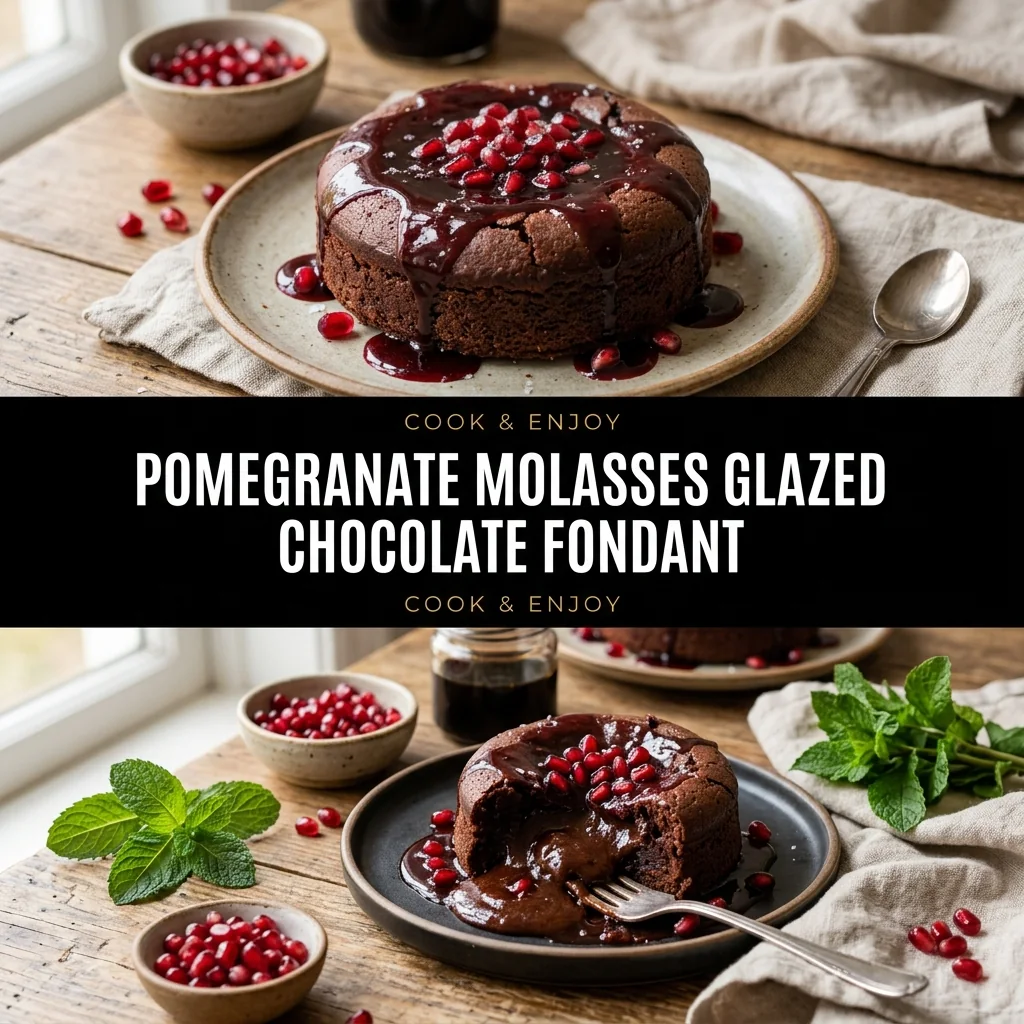
Pomegranate molasses glazed chocolate fondant brings together deeply roasted cocoa and sharp Middle Eastern fruit notes. While classic fondants lean heavily on rich dairy fat and sugar, the addition of a concentrated pomegranate reduction cuts cleanly through the unctuous melted core. Pure pomegranate molasses contains naturally concentrated fruit sugars and sharp malic acidity that counterbalance the bittersweet bite of seventy percent chocolate. Baked in individual ceramic ramekins, these cakes require careful timing to balance a delicate, cake-like outer perimeter with an intensely fluid center. The recipe relies on pantry-accessible staples combined with deliberate technique, delivering an elegant dessert that transitions from crisp edges to a rich interior, punctuated by the tart crunch of fresh jewel-toned pomegranate arils.
Chocolate Selection and Molasses Balance
Selecting a quality bittersweet dark chocolate around 70% cocoa solids ensures the fondant holds structural firmness without becoming cloying. Lower percentage milk chocolates introduce excessive dairy fats that disrupt the ratio, leaving the center oily rather than velvety. For the glaze, choose pure pomegranate molasses with no added corn syrups or commercial thickeners; its natural pectin and acid yield an authentic viscosity when simmered gently with brown sugar. This balance provides a bright, sharp foil to the cake's dark cocoa richness.
Mastering the Molten Center
The magic of a true fondant lies in rapid heat transfer. High heat at 400°F (200°C) quickly sets the egg proteins and flour along the hot ceramic surface while the dense inner core lags behind in temperature. Whisking whole eggs with yolks introduces structure and emulsifying lecithin, keeping the liquid center smooth rather than curdled. Do not overmix after folding in the flour, as excess gluten development will turn the outer wall tough instead of tender and crumbly.
Ramekin Prep and Clean Inversion
To guarantee your fondant releases cleanly onto the serving plate, grease the ramekins with softened butter using upward vertical strokes, which guide the cake's rise. Dusting with Dutch-process cocoa powder rather than flour maintains an appetizing dark exterior without unsightly white patches. After baking, an exact five-minute rest allows the exterior crumb to pull slightly away from the walls while retaining internal heat. A quick slide of an offset spatula around the rim ensures a flawless inversion.
Before you start
For a guaranteed molten interior, rely on visual cues rather than timer bells alone. The top ring of the cake should appear matte and firm to a very light touch, while the exact center should retain a slight wobble and a faint gloss. Ovens vary significantly, so begin checking at minute 10. If the center rises into a domed, cracked surface, the cake has transitioned into a standard sponge; pull them out just before full ascension.
THE RECIPE
Pomegranate Molasses Glazed Chocolate Fondant
4 servings · 20 minutes preparation · 18 minutes cooking · 5 minutes cooling, chilling or resting
Ingredients
Step-by-step instructions
- Thoroughly brush the interiors of four 175 ml (6 oz) oven-safe ceramic ramekins with 10 g of softened unsalted butter using upward vertical strokes, dust the interiors evenly with the 15 g of cocoa powder, tap out any loose excess, and arrange the ramekins on a heavy baking sheet.
- Place 150 g of chopped bittersweet chocolate and 115 g of cubed unsalted butter into a heatproof bowl set over a saucepan of gently simmering water over low heat, stirring occasionally with a silicone spatula until completely melted and glossy, then remove the bowl from the heat and set aside to cool for 3 minutes.
- In a medium mixing bowl, combine 2 large pasteurized eggs, 2 large egg yolks, 65 g of granulated sugar, and 1 tsp of alcohol-free vanilla extract; whisk vigorously by hand for 2 to 3 minutes until the mixture turns pale, aerated, and ribbons softly off the whisk.
- Slowly stream the melted chocolate and butter mixture into the whipped eggs, whisking constantly to incorporate the ingredients smoothly without cooking the eggs.
- Gently fold in 30 g of sifted all-purpose flour and 1/4 tsp of fine sea salt using a rubber spatula just until the dry streaks disappear, taking care not to deflate the batter, and divide the mixture equally among the four prepared ramekins (roughly 85 g each).
- Place the baking sheet with the ramekins into an oven preheated to 400°F (200°C) and bake for 11 to 12 minutes, until the cake perimeters are set, matte, and gently pulling away from the edges while the central 1-inch core remains soft and slightly concave.
- While the fondants bake, prepare the glaze by whisking 80 ml of pure pomegranate molasses, 30 ml of water, and 15 g of light brown sugar in a small saucepan over medium heat; bring to a gentle simmer and reduce for 5 to 6 minutes until glossy and thick enough to coat the back of a spoon.
- Remove the ramekins from the oven and let them rest undisturbed for 5 minutes; carefully run a thin, flexible palette knife around the circumference of each cake, invert onto warm dessert plates, generously drizzle the warm pomegranate glaze across each top, scatter with 30 g of fresh pomegranate arils, and serve immediately.
Kitchen notes
For a guaranteed molten interior, rely on visual cues rather than timer bells alone. The top ring of the cake should appear matte and firm to a very light touch, while the exact center should retain a slight wobble and a faint gloss. Ovens vary significantly, so begin checking at minute 10. If the center rises into a domed, cracked surface, the cake has transitioned into a standard sponge; pull them out just before full ascension.
Storage & make-ahead
Unbaked ramekins filled with batter can be tightly wrapped in plastic film and refrigerated for up to 24 hours; add 2 minutes to the baking time directly from the fridge. Baked leftovers should be refrigerated within 2 hours in an airtight container for up to 2 days. Reheat gently in a 325°F (165°C) oven for 8 to 10 minutes until warmed through to 165°F (74°C), though the molten center will be firmer upon reheating.
An original recipe guide inspired by themes in our Pinterest research. Recipe has not been independently kitchen-tested. AI-generated image is illustrative; your finished dish may look different.
Frequently asked questions
Can I prepare these chocolate fondants ahead of time?
Yes. Pour the batter into the greased, cocoa-dusted ramekins, cover tightly with plastic wrap, and refrigerate for up to 24 hours. When ready to serve, bake directly from the refrigerator at 400°F (200°C), adding approximately 2 extra minutes to the total bake time.
Why did my fondant collapse completely when unmolded?
A total collapse indicates the cake was underbaked by just one or two minutes, meaning the outer cake walls were too fragile to support the liquid core. Ensure the outer perimeter is matte and set before removing the ramekins from the oven.
What if my pomegranate molasses glaze becomes too thick?
Pomegranate molasses thickens quickly as water evaporates. If your reduction becomes sticky or hard, simply whisk in an additional tablespoon of warm water over low heat until it returns to a smooth, pourable, ribbon-like consistency.