WHY MAKE IT
A little comfort, a lot of flavor.
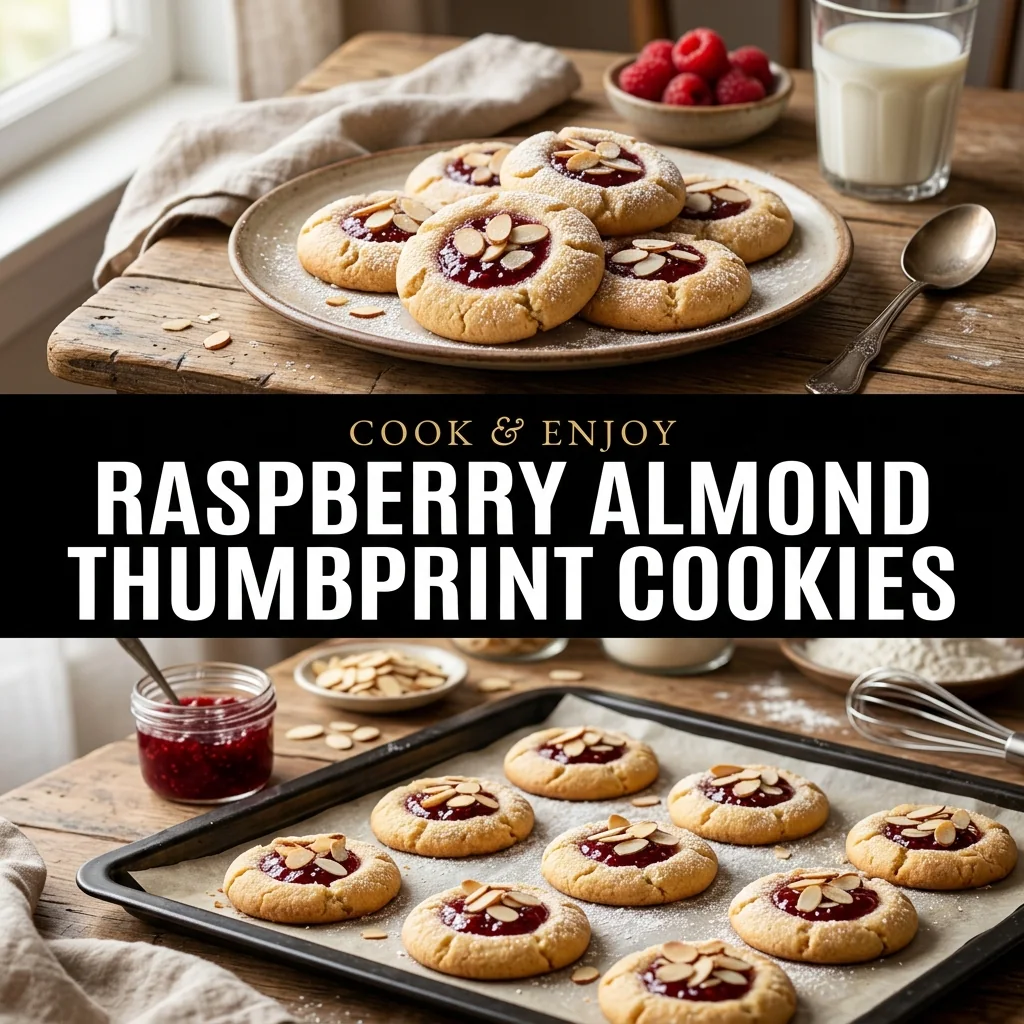
Raspberry Almond Thumbprint Cookies showcase the timeless culinary partnership of stone fruit and nutty pastry. The dough is modeled after traditional butter sablé, enriched with finely milled almond flour to provide a tender crumb that melts on the tongue. Rolling each dough sphere in egg white and sliced almonds creates a crunchy, toasted outer crust that contrasts with the soft cookie core and jewel-like center of tart raspberry preserves. Baking the jam inside the cookie cavity concentrates the fruit sugars, creating a glossy, chewy reservoir that adheres firmly to the shortbread. These jewel-toned cookies bring refined color, balanced sweetness, and textural contrast to holiday dessert assortments.
The Role of Nut Flour in Cookie Structure
Blending blanched almond flour with conventional wheat flour fundamentally alters cookie dough dynamics. Almond flour introduces natural oils and lacks gluten-forming proteins, which tenderizes the crumb and prevents the shortbread from baking into a hard, dense biscuit. However, excessive nut flour can cause the dough to crumble apart when handled. The ratio used here ensures sufficient wheat gluten development to support the structural walls of the thumbprint cavity while infusing every bite with distinct, authentic nutty depth without relying entirely on flavor extracts.
Managing Jam Consistency for Baking
Not all fruit preserves perform equally inside a hot oven. High-pectin, seedless jams maintain their body when exposed to heat, whereas thin fruit spreads or preserves with excess water will boil violently, creating steam pockets that spill over the cookie rims and burn against the pan. Stirring the jam vigorously in a small bowl prior to filling breaks up any gelatinous clumps, making it easy to spoon cleanly into the indentations without leaving messy trails across the sliced almond crust.
Preventing Cracking During Shaping
Thumbprint dough often develops deep radial cracks when depressed if the dough lacks adequate moisture or has cooled excessively before shaping. Rolling the portions between warm hands softens the outer surface, allowing the fat to become supple. Pressing gently with the rounded bowl of a metal measuring spoon exerts uniform downward and outward pressure, distributing the dough evenly. Should minor cracks appear, gently smoothing them with warm fingertips before applying the egg white wash seals the perimeter.
Before you start
Chilling the shaped thumbprints for thirty minutes before baking is critical; if the butter is too warm, the cookies will spread excessively, flattening out the center well and allowing the jam to boil over onto the parchment paper. If deep fissures appear while indenting the dough balls, lightly moisten your thumb with water to smooth the perimeter before coating with egg white and nuts.
THE RECIPE
Raspberry Almond Thumbprint Cookies
20 servings · 30 minutes preparation · 28 minutes cooking · 45 minutes cooling, chilling or resting
Ingredients
Step-by-step instructions
- Line two large baking sheets with parchment paper. In a wide, shallow bowl, lightly beat the reserved egg white with a fork until frothy, and place the crushed sliced almonds in a second shallow bowl.
- Beat the softened unsalted butter and granulated sugar in a stand mixer fitted with the paddle attachment on medium speed for 2 minutes until creamy and pale, scraping down the sides of the bowl with a spatula.
- Add the single egg yolk, vanilla extract, and almond extract to the butter mixture, beating on medium-low speed for 1 minute until fully incorporated and smooth.
- In a separate bowl, whisk together the all-purpose flour, almond flour, and fine sea salt, then add the dry ingredients to the mixer bowl and mix on low speed just until a cohesive dough forms.
- Divide the dough into 20 equal portions, roughly 24 grams each, and roll each piece between your palms into a smooth, crack-free sphere.
- Dip each dough ball into the frothed egg white, roll it in the crushed sliced almonds to coat the exterior thoroughly, and arrange the balls 2 inches apart on the prepared baking sheets.
- Using the rounded back of a 1/2-teaspoon measuring spoon or a lightly floured thumb, gently press an indentation into the center of each ball, smoothing any significant edge cracks with your fingertips.
- Transfer the baking sheets to the refrigerator to chill for 30 minutes, keeping the shaped dough firm so it maintains its shape and cavity during baking.
- While chilling, preheat the oven to 350°F (177°C), then fill each indentation with 1/2 teaspoon of seedless raspberry jam, and bake one sheet at a time for 12 to 14 minutes per sheet until the almond coating is lightly toasted and cookie bases are pale golden; cool on sheets for 15 minutes before glazing with whisked powdered sugar and milk.
Kitchen notes
Chilling the shaped thumbprints for thirty minutes before baking is critical; if the butter is too warm, the cookies will spread excessively, flattening out the center well and allowing the jam to boil over onto the parchment paper. If deep fissures appear while indenting the dough balls, lightly moisten your thumb with water to smooth the perimeter before coating with egg white and nuts.
Storage & make-ahead
Store unglazed cookies airtight at room temperature for up to 4 days. Refrigerate milk-glazed cookies within 2 hours and keep for up to 4 days. Freeze unglazed cookies for up to 2 months; thaw before adding fresh glaze.
An original recipe guide inspired by themes in our Pinterest research. Recipe has not been independently kitchen-tested. AI-generated image is illustrative; your finished dish may look different.
Frequently asked questions
Why did my cookies spread flat and lose their indentation?
The dough was likely too warm when it entered the oven. Skipping the 30-minute refrigeration step allows the butter to melt before the flour structure sets, causing the walls of the cavity to collapse outward.
Can I use seeded raspberry jam instead?
Yes, seeded raspberry jam works equally well in terms of bake stability. Seedless jam is generally chosen for a smooth, jewel-like aesthetic, but seeded varieties offer an appealing, rustic texture.
Can I substitute other nuts for the sliced almonds?
Finely chopped pecans, walnuts, or toasted hazelnuts can be substituted directly for the sliced almonds. Ensure they are chopped finely so they adhere cleanly to the egg-white-coated dough spheres.