WHY MAKE IT
A little comfort, a lot of flavor.
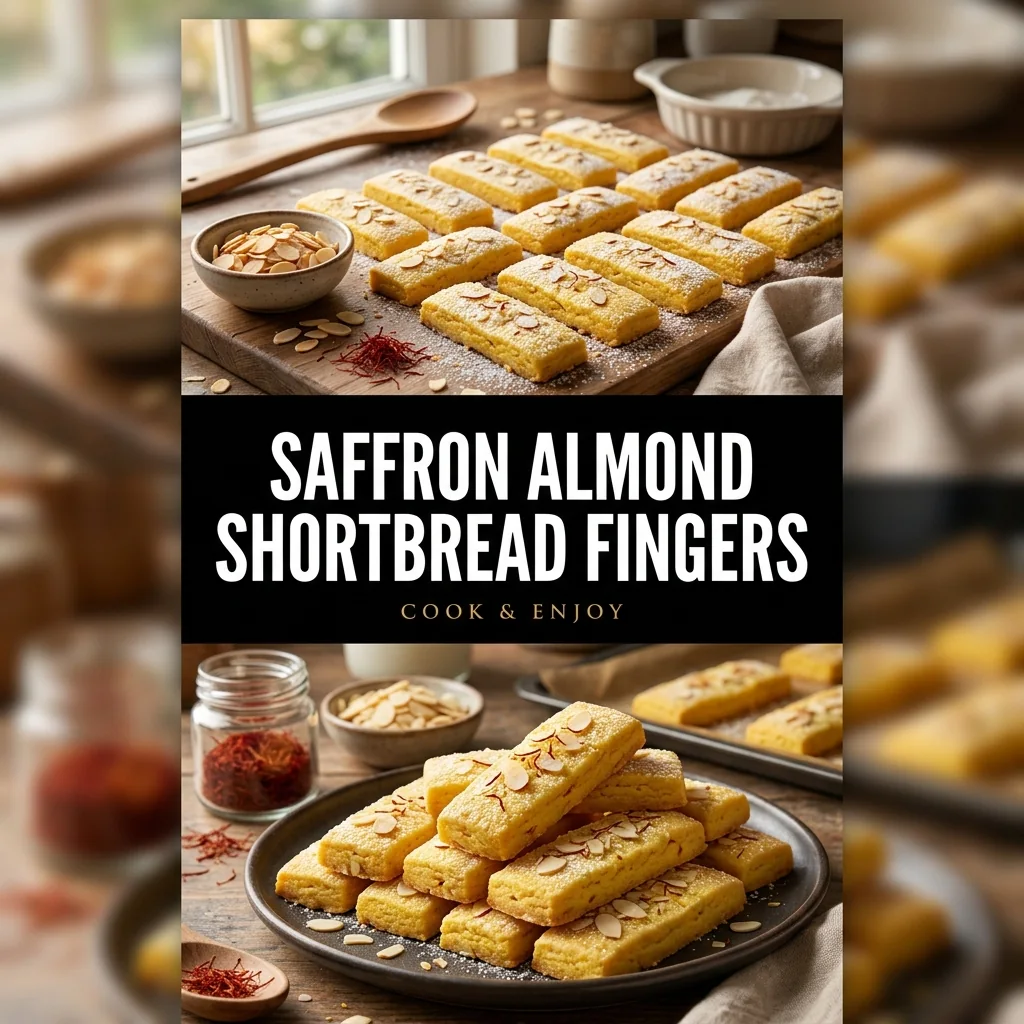
Saffron Almond Shortbread Fingers elevate a timeless, minimalist tea biscuit with rich aromatics inspired by traditional Middle Eastern and South Asian confectionery. Natural saffron imparts an unmistakable bright sunshine hue and a delicate, earthy-floral aroma that blossoms in the presence of pure cultured dairy butter. The inclusion of cornstarch alongside unbleached all-purpose flour creates a fine-grained, delicate crumb that shatters crisply before melting smoothly on the palate. Topped with slivers of sweet blanched almonds and a light crystalline dusting of granulated sugar, each finger offers a textural contrast against the rich crumb. They provide a refined, fragrant accompaniment to spiced cardamom tea or rich Arabic coffee.
The Role of Saffron Extraction
Saffron is composed of water-soluble pigments and delicate aromatic compounds that require moisture to distribute evenly throughout a dense fat matrix like shortbread. Directly mixing dry saffron threads into butter traps the flavor within small clusters, resulting in speckles rather than an all-over golden glow. Steeping finely crushed saffron in a minimal volume of warm water allows the potent carotenoids to disperse completely. When this vibrant liquid is beaten into creamed butter, the entire dough transforms into a luminous canary yellow while diffusing its warm, earthy perfume uniformly throughout every bite.
Achieving the Perfect Shortbread Crumb
Authentic shortbread relies on a delicate balance between butter and flour without relying on chemical leaveners like baking soda or powder. Replacing a modest portion of the all-purpose flour with pure cornstarch lowers the overall protein percentage of the dry blend. This prevents excess gluten formation, yielding a biscuit that holds sharp, elegant edges during baking yet dissolves tenderly upon chewing. It is vital to avoid overworking the dough once the flour mixture is incorporated; mix strictly until the sandy crumbs pull together, ensuring maximum tenderness.
Scoring and Slicing Protocol
Because classic shortbread contains a significant volume of butter, attempting to cut it once cold can cause the crisp fingers to crumble and break erratically. The two-stage slicing method avoids this frustration completely. Score the surface gently before the pan enters the oven to establish guidelines and vent steam evenly. As soon as the pan emerges from the oven, while the butter starches remain pliable, slice firmly through the pre-scored lines with a sharp, thin blade. Allow the fingers to cool completely undisturbed to lock in clean lines.
Before you start
Crushing your saffron threads finely between your fingers or with a small pestle before steeping releases the maximum crocin pigment and safranal aroma. Do not skip steeping the threads in warm water; blending dry saffron straight into butter produces uneven streaks of color and muted flavor. The addition of cornstarch breaks up the gluten network of the flour, creating that coveted tender, snap-then-melt shortbread texture.
THE RECIPE
Saffron Almond Shortbread Fingers
18 servings · 25 minutes preparation · 28 minutes cooking · 50 minutes cooling, chilling or resting
Ingredients
Step-by-step instructions
- Crush the saffron threads finely in a small mortar, combine with 1 tablespoon of warm water in a small ramekin, and allow to steep for 15 minutes until deep amber in color.
- Preheat the oven to 325°F (165°C) and line a 9-inch square baking pan with parchment paper, leaving generous overhang on opposite sides.
- In a large bowl, beat the softened unsalted butter and sifted powdered sugar on medium speed for 2 minutes until creamy, pale, and thoroughly smooth.
- Pour the steeped saffron liquid and its dissolved solids into the creamed butter along with the alcohol-free vanilla extract and fine sea salt, beating briefly until the pale butter turns a uniform vibrant golden hue.
- Whisk together the all-purpose flour and cornstarch in a separate bowl, then add to the butter mixture, blending on low speed just until a cohesive, crumbly dough forms.
- Press the dough evenly into the bottom of the prepared 9-inch pan using an offset spatula or the flat bottom of a measuring cup to compact it firmly.
- Scatter the blanched slivered almonds evenly across the surface and press them lightly into the dough so they adhere, then sprinkle evenly with the granulated white sugar.
- Score the dough lightly with a sharp knife into 18 equal finger-shaped rectangles, prick each finger twice with a fork, and bake at 325°F (165°C) for 26 to 28 minutes until lightly firm and pale golden at the edges.
- Transfer the pan to a wire rack to rest for 10 minutes, re-cut along the scored lines while still warm using a sharp chef's knife, then let the shortbread fingers cool completely in the pan for 40 minutes before serving.
Kitchen notes
Crushing your saffron threads finely between your fingers or with a small pestle before steeping releases the maximum crocin pigment and safranal aroma. Do not skip steeping the threads in warm water; blending dry saffron straight into butter produces uneven streaks of color and muted flavor. The addition of cornstarch breaks up the gluten network of the flour, creating that coveted tender, snap-then-melt shortbread texture.
Storage & make-ahead
Keep shortbread fingers in an airtight tin or glass jar at room temperature for up to 2 weeks; tins help preserve their crispness better than plastic containers. To make ahead, press dough into the pan, wrap well, and refrigerate for up to 24 hours before baking. Frozen baked fingers stay fresh for up to 3 months when packed securely.
An original recipe guide inspired by themes in our Pinterest research. Recipe has not been independently kitchen-tested. AI-generated image is illustrative; your finished dish may look different.
Frequently asked questions
Why do I need to score the shortbread before and immediately after baking?
Scoring prior to baking guides where steam releases and maps out neat portions. Cutting completely through while the biscuit base is hot and pliable prevents the brittle, fully baked shortbread from cracking haphazardly once it cools and sets into its final firm structure.
Can I substitute granulated sugar for the powdered sugar in the dough?
Powdered sugar dissolves far more readily into softened butter without requiring excessive creaming, which helps maintain a fine, melt-in-the-mouth texture. Granulated sugar creates a coarser, crunchier crumb and can cause the shortbread to spread or lose its scored shape during baking.
How do I know when the shortbread is fully baked?
Shortbread should not brown heavily. Look for firm, dry surfaces with only a faint golden tint along the pan's perimeter. The center should feel set to a gentle touch. Overbaking ruins the fragile floral nuances of the saffron.