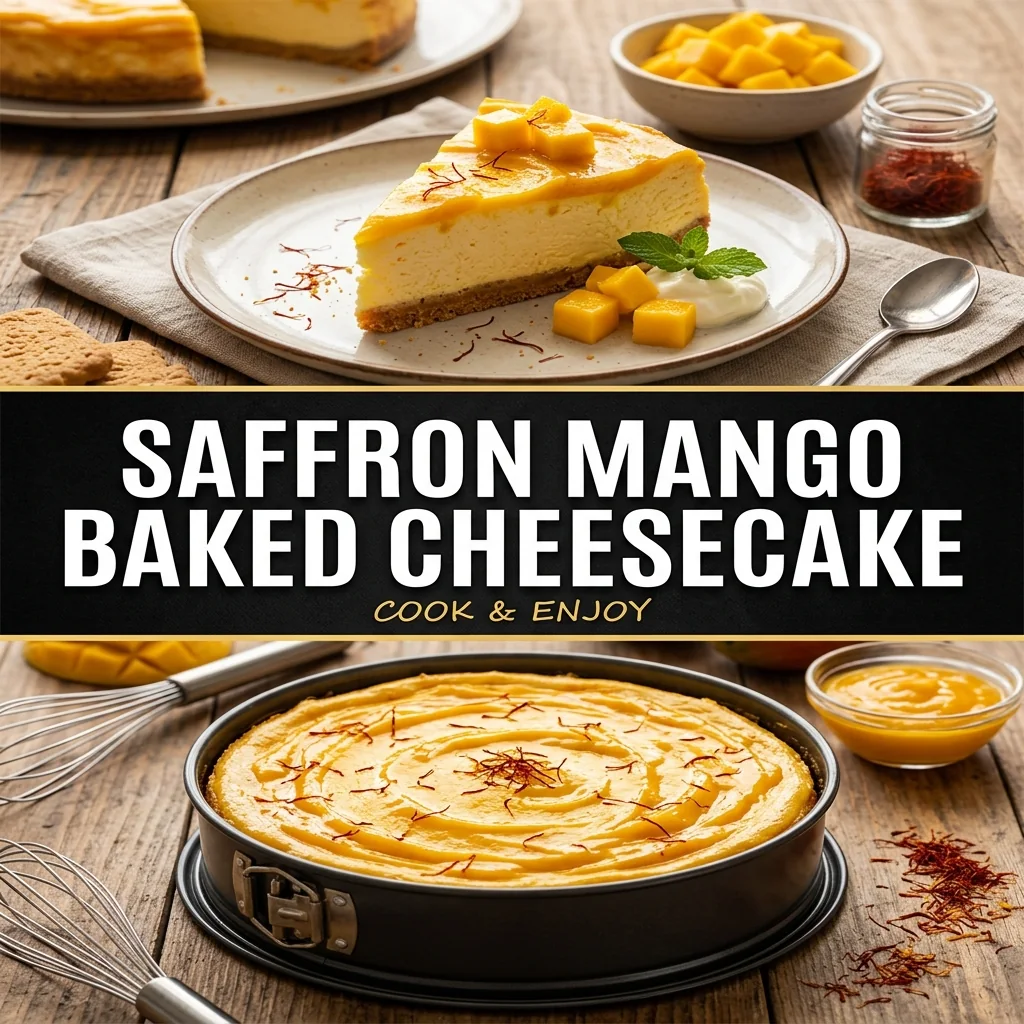
WHY MAKE IT
A little comfort, a lot of flavor.
Few flavor combinations convey luxury and celebration quite like mango paired with saffron. Widely cherished across South Asian and Middle Eastern culinary heritage, this union brings together the honeyed, tropical perfume of prime Alphonso mangoes and the earthy, floral complexity of crimson saffron stigmas. Translating these ingredients into a dense baked cheesecake creates an opulent dessert boasting an all-natural sunset hue. The creamy richness of cultured cream cheese cushions the sweet fruit purée, while subtle ground ginger in the crumb crust provides a crisp, grounding counterpoint. Baked slowly in a water bath to achieve a silken custard consistency, this showstopper embodies refined warmth, exceptional balance, and timeless indulgence.
Unlocking Saffron Potential
Saffron requires gentle warmth and time to release its signature water-soluble pigments (crocin) and complex aroma compounds (safranal). Lightly crushing the dried threads between your fingers before submerging them in warm milk accelerates this extraction. Avoid heating beyond a gentle simmer, as high heat degrades the volatile aromatic oils, leaving behind an overly bitter profile. Steeping for at least 15 minutes ensures the golden liquid distributes evenly through the dense cream cheese batter, imparting both color and refined herbal depth without artificial coloring agents.
Selecting Alphonso Mango Purée
Alphonso mangoes are renowned globally for their non-fibrous pulp, vibrant saffron-orange interior, and concentrated sweetness. Using canned 100% Alphonso pulp ensures year-round consistency in moisture and sugar levels, which is critical when formulating custard emulsions. If substituting other mango varieties such as Ataulfo or Kesar, ensure the fruit is fully ripe, puréed thoroughly in a high-speed blender, and strained through a fine sieve. Excess water in watery mango varieties can destabilize the cheesecake structure, which makes starch stabilization with cornstarch indispensable.
Gradual Cooling for Flawless Surfaces
Sudden temperature drops cause baked cheesecakes to contract faster than their delicate egg structures can handle, leading to unsightly surface fissures. Leaving the baked cheesecake in the turned-off oven with the door propped open for an hour cushions this transition. The residual heat finishes setting the center gently to 160°F (71°C) while letting the moisture equilibrate. Following this with a room-temperature cooling phase before the mandatory six-hour refrigeration guarantees a smooth, satin-like surface ready to showcase your glossy mango glaze.
Before you start
Steeping the saffron in warm milk is vital to unlock its floral aroma and vivid natural color. Never rush this step or use boiling milk, which can scorch the delicate threads and yield a medicinal taste. Alphonso mango purée is preferred because of its lower fiber content and intense natural sweetness. If using fresh mangoes, strain the purée through a fine-mesh sieve to remove fibrous strands before measuring.
THE RECIPE
Saffron Mango Baked Cheesecake
12 servings · 30 minutes preparation · 75 minutes cooking · 480 minutes cooling, chilling or resting
Ingredients
Step-by-step instructions
- Preheat the oven to 325°F (165°C). Lightly grease a 9-inch (23 cm) springform pan and line the base with parchment paper.
- Combine 200 g biscuit crumbs, 75 g melted butter, and 1/2 tsp ground ginger in a bowl, then firmly press the mixture into an even layer along the bottom of the prepared springform pan.
- Bake the crust at 325°F (165°C) for 10 minutes until lightly browned, then transfer to a wire rack to cool while lowering the oven temperature to 300°F (150°C).
- In a small saucepan over low heat, warm 60 ml whole milk to 110°F (43°C), crumble in 0.5 g saffron threads, and let steep off the heat for 15 minutes until a deep golden hue develops.
- In a stand mixer fitted with the paddle attachment, beat 900 g room-temperature cream cheese, 180 g granulated sugar, and 25 g cornstarch on low speed for 2 to 3 minutes until smooth and completely lump-free.
- Mix in the saffron milk infusion, 180 g of the Alphonso mango purée (reserving the remaining 70 g for topping), 120 g sour cream, and 1 tsp alcohol-free vanilla extract on low speed until uniformly yellow.
- Incorporate the 4 large eggs one at a time on low speed, mixing just until blended after each egg and scraping down the bowl to avoid unmixed pockets.
- Wrap the exterior of the pan in heavy foil, place it in a large roasting pan, pour the batter over the crust, and carefully add boiling water to the roasting pan to a depth of 1 inch.
- Bake at 300°F (150°C) for 65 minutes until the edges are firm and the center reads 160°F (71°C); turn off the oven, prop the door open slightly, and leave the cheesecake inside for 60 minutes, then cool on a counter for 60 minutes before chilling in the refrigerator for 360 minutes (6 hours). Spread the reserved70 g mango puree over the fully chilled cake just before serving.
Kitchen notes
Steeping the saffron in warm milk is vital to unlock its floral aroma and vivid natural color. Never rush this step or use boiling milk, which can scorch the delicate threads and yield a medicinal taste. Alphonso mango purée is preferred because of its lower fiber content and intense natural sweetness. If using fresh mangoes, strain the purée through a fine-mesh sieve to remove fibrous strands before measuring.
Storage & make-ahead
Store chilled in the refrigerator, covered with a cake dome or wrapped tightly in foil, at or below 40°F (4°C). Consume within 4 days for optimal flavor and texture. Never allow the cheesecake to sit at room temperature for longer than 2 hours. If preparing ahead, bake the cake completely up to 2 days before serving and spread the reserved mango purée over the top just prior to slicing.
An original recipe guide inspired by themes in our Pinterest research. Recipe has not been independently kitchen-tested. AI-generated image is illustrative; your finished dish may look different.
Frequently asked questions
Can I use frozen mango chunks instead of canned Alphonso purée?
Yes, but thaw the frozen chunks completely and drain off any pooled surface liquid first. Blend the fruit until completely smooth, then pass it through a fine-mesh sieve to eliminate stringy fibers before measuring the 250 grams called for in the recipe.
Why does this recipe require a water bath?
A water bath buffers the cheesecake from the intense direct radiant heat of the oven walls. Water cannot exceed 212°F (100°C), creating a gentle, humid environment that bakes the egg-based custard uniformly from outer perimeter to core without burning the crust.
Can I garnish this cake with whipped cream?
Yes. Pipe stabilized sweetened whipped cream around the border after the cake has chilled for the full 6 hours. Garnish with crushed raw pistachios and a few reserved dry saffron threads for an elegant contrast of color and texture.


