WHY MAKE IT
A little comfort, a lot of flavor.
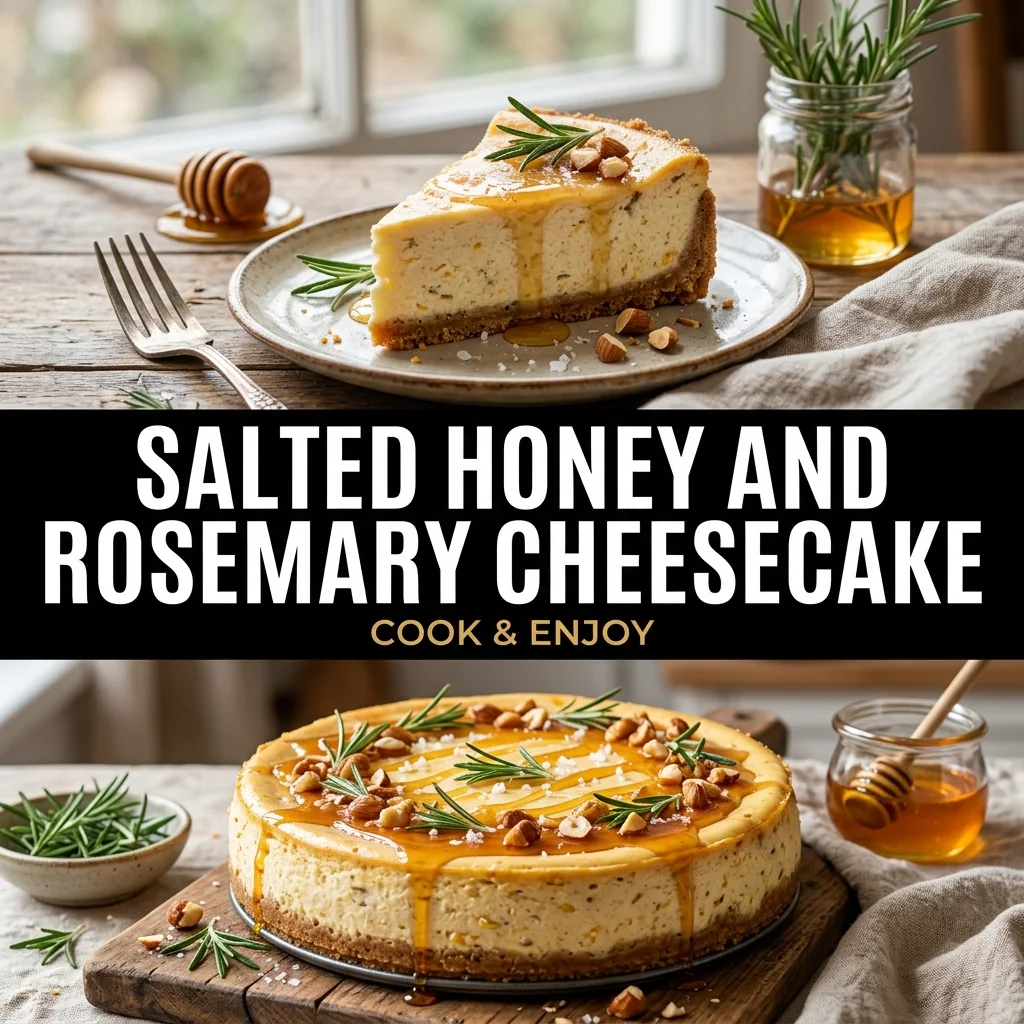
Salted Honey and Rosemary Cheesecake elevates rustic pantry staples into a harmonious, aromatic dessert. By infusing fresh rosemary sprigs into heavy whipping cream before blending, the herbal essence permeates the custard subtly without leaving fibrous bits behind. Wildflower honey lends a floral sweetness that tempers the tang of block cream cheese, replacing part of the standard refined sugar. A classic graham cracker crust offers an earthy, wheaty foundation that grounds the botanical profile. Finished with an amber brush of warm honey and delicate flakes of sea salt, every forkful balances sweet, savory, and herbal notes with a silky custard finish.
Herbal Cream Infusion Technique
Fat serves as an exceptional carrier for fat-soluble botanical compounds found in woody herbs like rosemary. Heating heavy cream gently softens the piney needle structure and extracts delicate pinene and floral aromatics without drawing out astringent tannins. Straining the warm cream thoroughly ensures that the cheesecake batter remains completely silky. If the liquid volume decreases slightly during the steeping stage, topping it back up with fresh cream maintains the exact moisture balance required for the custard.
Selecting Honey and Salt
The choice of honey directly impacts the aromatic profile of this recipe. A quality wildflower or clover honey provides floral balance without overpowering the dairy notes, whereas stronger varieties like buckwheat honey can dominate the delicate herb profile. Pairing the natural sweetness of honey with mineral-rich flaky sea salt enhances flavor perception on the tongue, transforming what could be an overly sweet custard into a nuanced, multi-layered confection.
Ensuring Proper Custard Texture
Cheesecakes baked with honey retain moisture effectively because honey acts as an inverted sugar and humectant. However, excess moisture can hinder clean slicing if the cake is underbaked or insufficiently chilled. The gentle heat of the water bath coagulates the egg matrix uniformly from perimeter to core. Adhering to the complete five-hour refrigeration timeline guarantees that milk fats crystallize firmly, yielding razor-sharp slices when cut with a warmed knife.
Before you start
Do not let the cream boil rapidly while steeping the rosemary, as boiling can scorch the dairy and turn the herb flavor resinous and bitter. A gentle simmer followed by an off-heat steep extracts the pine-like floral notes smoothly. Apply the final honey glaze and flaky sea salt right before presenting, because the salt crystals will dissolve into the moisture of the honey if refrigerated for long periods.
THE RECIPE
Salted Honey and Rosemary Cheesecake
12 servings · 30 minutes preparation · 70 minutes cooking · 420 minutes cooling, chilling or resting
Ingredients
Step-by-step instructions
- Combine 120 milliliters of heavy whipping cream and 6 grams of fresh rosemary sprigs in a small saucepan over medium heat. Bring to a gentle simmer for 3 minutes, remove from heat, cover with a lid, and let steep for 20 minutes to infuse the herb oils into the dairy.
- Preheat the oven to 350°F (175°C). Line the bottom of a 9-inch (23-centimeter) springform pan with parchment paper and lightly butter the interior sides.
- Mix 180 grams of graham cracker crumbs, 50 grams of melted unsalted butter, and 15 grams of granulated sugar in a bowl. Press the mixture firmly into the bottom of the pan and bake at 350°F (175°C) for 10 minutes. Cool on a wire rack for 20 minutes, then lower the oven temperature to 325°F (163°C).
- Strain the warm cream through a fine-mesh sieve into a measuring cup, discarding the rosemary sprigs. If evaporation reduced the volume below 100 milliliters, add fresh cream to reach 100 milliliters; allow to cool to room temperature.
- Wrap the springform pan securely with two layers of heavy aluminum foil around the exterior bottom and sides.
- Beat 680 grams of room-temperature cream cheese, 100 grams of granulated sugar, 80 grams of wildflower honey, 15 milliliters of alcohol-free vanilla extract, and 2 grams of fine sea salt on low speed for 3 minutes until smooth and lump-free.
- Pour in the cooled rosemary-infused cream and mix on low speed until combined. Add 3 large eggs one at a time, mixing just until each egg is integrated into the batter.
- Pour the batter over the crust and place the springform pan in a large roasting pan. Pour boiling water into the roasting pan until it reaches halfway up the side of the cake pan.
- Bake at 325°F (163°C) for 55 minutes until the perimeter is firm and the center gives a gentle wobble. Turn off the oven, prop the door open slightly with a wooden spoon, and rest the cake in the water bath for 60 minutes. Transfer to a wire rack to cool for 40 minutes at room temperature, then refrigerate for 5 hours (300 minutes). Warm 60 grams of honey slightly, brush over the chilled cheesecake, and sprinkle with 2 grams of flaky sea salt before serving.
Kitchen notes
Do not let the cream boil rapidly while steeping the rosemary, as boiling can scorch the dairy and turn the herb flavor resinous and bitter. A gentle simmer followed by an off-heat steep extracts the pine-like floral notes smoothly. Apply the final honey glaze and flaky sea salt right before presenting, because the salt crystals will dissolve into the moisture of the honey if refrigerated for long periods.
Storage & make-ahead
Store the cooled, unglazed or glazed cheesecake in an airtight container in the refrigerator within 2 hours of chilling. It keeps fresh and flavorful for up to 4 days. If storing slices for several days, reserve the flaky salt topping and apply it fresh right before eating to preserve its crisp crunch. Freezing is not advised once glazed with pure honey.
An original recipe guide inspired by themes in our Pinterest research. Recipe has not been independently kitchen-tested. AI-generated image is illustrative; your finished dish may look different.
Frequently asked questions
Can I use dried rosemary instead of fresh?
Fresh rosemary is strongly recommended. Dried rosemary has concentrated volatile oils that can impart an aggressive, medicinal taste to the cream infusion and may leave bitter undertones in the finished cheesecake.
Why did my honey glaze sink into the cake?
If the cheesecake is not fully cold when glazed, or if the glaze honey is too hot, it will absorb into the upper layer rather than sitting as a glossy sheen. Ensure the cake is thoroughly chilled.
Can I substitute table salt for the flaky sea salt?
In the batter, fine table salt works well, but for the topping, flaky sea salt is essential. Fine salt will taste overly harsh and dissolve instantly, losing the pleasant textural crunch.


