WHY MAKE IT
A little comfort, a lot of flavor.
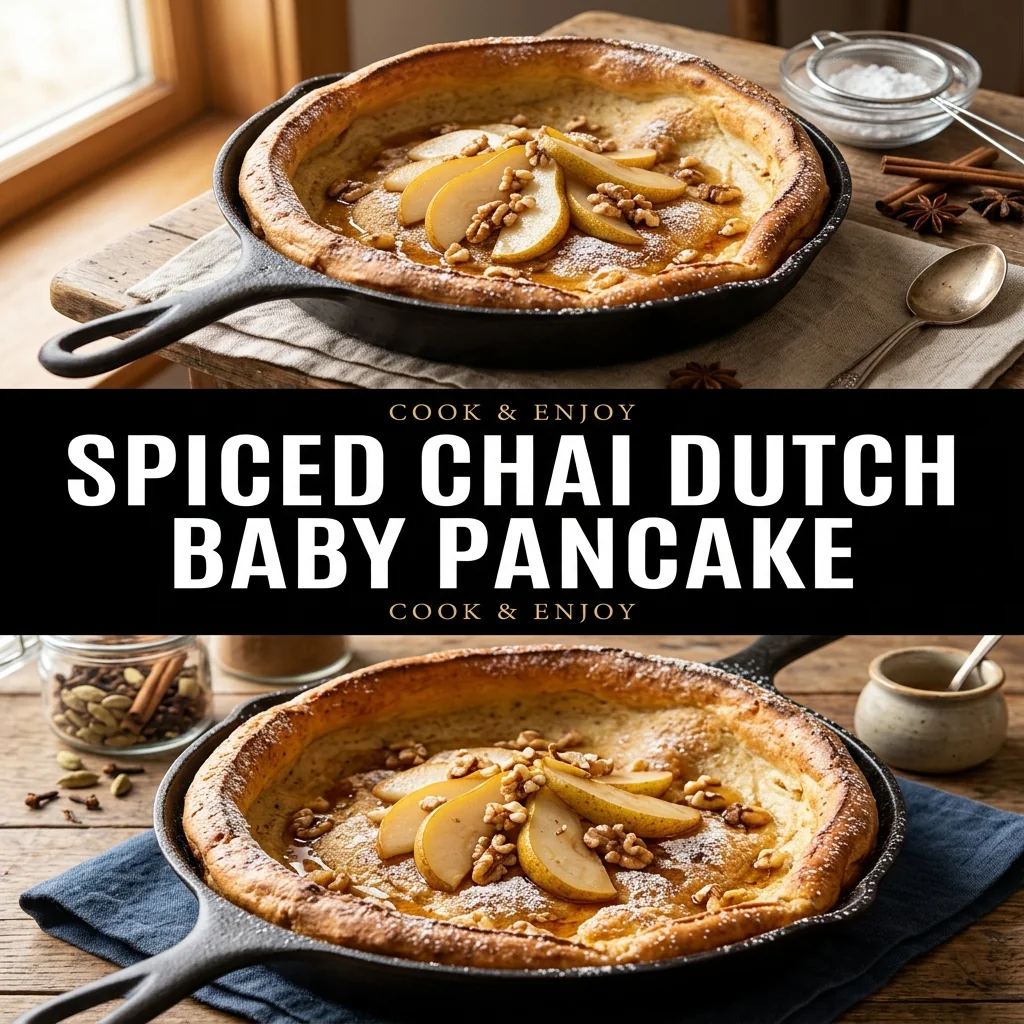
The spiced chai Dutch baby pancake is an aromatic twist on the traditional German oven pancake, celebrated for its theatrical puff and crisp, crinkled edges. Blended into a crepe-like batter and poured into a sizzling, butter-slicked cast-iron skillet, this dessert pancake relies entirely on trapped steam rather than chemical leaveners to climb dramatically up the hot pan walls. In this variation, a fragrant medley of ground cinnamon, fiery ginger, floral cardamom, allspice, and pungent cloves perfumes the custard-like center with warm chai flavors. Finished with a heavy snowfall of powdered sugar and a sharp spritz of fresh lemon juice, this dessert delivers a delightful interplay of warmth, spice, richness, and citrus brightness.
The Physics of the Dramatic Rise
Unlike standard American pancakes that rely on baking powder or baking soda, a Dutch baby rises purely via steam and egg protein structure. When thin, aerated batter hits a scorching 425°F (220°C) cast-iron skillet, the water in the milk and eggs flashes instantly into steam. This sudden expansion pushes the batter up the sloped sides of the skillet. The high proportion of eggs establishes an elastic network that traps expanding steam bubbles, allowing the pancake to billow high above the pan edges before setting into an airy, golden, crisp-edged crown in the oven.
Balancing the Warm Chai Spice Blend
Chai spices possess powerful essential oils that can easily overwhelm delicate egg custards if not carefully measured. Cinnamon forms the warm, sweet foundation, while ground ginger introduces gentle heat on the palate. Crushed cardamom lends an unmistakable floral brightness, backed by minute pinches of ground cloves and allspice for earthy depth. Blending the dry spices directly with the milk and eggs ensures they disperse homogeneously throughout the batter. This even suspension prevents bitter spice clumps from settling on the skillet bottom, producing a warm, amber-tinted pancake with uniform spice notes.
Cast Iron Heat Retention and Serving
Heavy cast iron is the ultimate baking vessel for a Dutch baby due to its superior heat retention. Preheating the empty skillet in a 425°F (220°C) oven guarantees that the butter browns swiftly upon contact without scorching. Once the pancake finishes baking, serve it immediately at the table straight from the skillet. The dramatic puffed dome will settle naturally within minutes into a bowl-like center. Squeezing fresh lemon juice over the warm, sugar-dusted surface creates an instant sweet-tart glaze that cuts through the buttery richness of the spiced custard.
Before you start
Room temperature ingredients are essential for achieving the dramatic, billowing rise that defines a classic Dutch baby. Cold milk and chilled eggs straight from the refrigerator will cool down the preheated cast-iron skillet prematurely, stunting steam production and yielding a flat, dense pancake. If you forget to set eggs out beforehand, place them in a bowl of warm tap water for 8 minutes to bring them quickly to room temperature.
THE RECIPE
Spiced Chai Dutch Baby Pancake
4 servings · 15 minutes preparation · 22 minutes cooking · 15 minutes cooling, chilling or resting
Ingredients
Step-by-step instructions
- Set a 10-inch heavy cast-iron skillet on the center rack of the oven and preheat the oven to 425°F (220°C).
- In a high-speed blender, combine 3 large pasteurized eggs, 2/3 cup whole milk, 2/3 cup all-purpose flour, 2 tablespoons granulated sugar, 1 teaspoon ground cinnamon, 1/2 teaspoon ground ginger, 1/4 teaspoon ground cardamom, 1/8 teaspoon ground cloves, 1/4 teaspoon ground allspice, 1/4 teaspoon kosher salt, and 1 teaspoon alcohol-free vanilla extract.
- Blend the ingredients on high speed for 40 seconds until completely smooth, frothy, and aerated, scraping down any stray flour clinging to the blender walls.
- Let the blended batter rest inside the blender jar on the counter for 10 minutes at room temperature to allow the starch granules to hydrate and relax.
- Using heavy oven mitts, carefully pull the preheated skillet from the oven, drop in 3 tablespoons unsalted butter, and swirl the pan for 2 minutes on the stovetop until the butter melts completely, foams, and coats the skillet bottom and sides.
- Immediately pour the rested batter directly into the center of the sizzling buttered skillet without stirring.
- Return the cast-iron skillet to the 425°F (220°C) oven immediately and bake undisturbed for 20 minutes until the pancake edges billow high above the rim, turn deep golden brown, and the center is set to 160°F (71°C).
- Carefully transfer the skillet to a heatproof surface, allow the pancake to rest for 5 minutes as the puffed center deflates slightly, dust generously with 2 tablespoons confectioners' sugar, and serve immediately with fresh lemon wedges.
Kitchen notes
Room temperature ingredients are essential for achieving the dramatic, billowing rise that defines a classic Dutch baby. Cold milk and chilled eggs straight from the refrigerator will cool down the preheated cast-iron skillet prematurely, stunting steam production and yielding a flat, dense pancake. If you forget to set eggs out beforehand, place them in a bowl of warm tap water for 8 minutes to bring them quickly to room temperature.
Storage & make-ahead
Dutch baby pancakes are best consumed immediately out of the oven while the edges are crispy and the center is soft. Refrigerate any leftovers in a sealed container within 2 hours. Chilled leftovers will keep for up to 2 days. Reheat in a 350°F (175°C) oven or toaster oven for 6 to 8 minutes until thoroughly warmed through to 165°F (74°C); do not microwave, as microwaving turns the crust unpleasantly rubbery.
An original recipe guide inspired by themes in our Pinterest research. Recipe has not been independently kitchen-tested. AI-generated image is illustrative; your finished dish may look different.
Frequently asked questions
Why did my Dutch baby pancake fail to puff up?
A failure to puff usually stems from cold ingredients, an insufficiently preheated skillet, or opening the oven door during baking. Use room-temperature eggs and milk, preheat the cast-iron skillet thoroughly at 425°F (220°C), and keep the oven door closed during the 20-minute bake.
Can I prepare the pancake batter the night before?
Yes, you can blend the batter the night before and store it refrigerated in an airtight jar. However, you must let the chilled batter sit on the counter for 30 minutes to return to room temperature before pouring it into the hot skillet.
Can I bake this in a regular baking dish if I lack cast iron?
You can use a heavy 10-inch stainless steel ovenproof skillet or an enameled ceramic baking dish. Ensure the dish is rated for 425°F (220°C) and preheat it thoroughly so the butter sizzles when added.