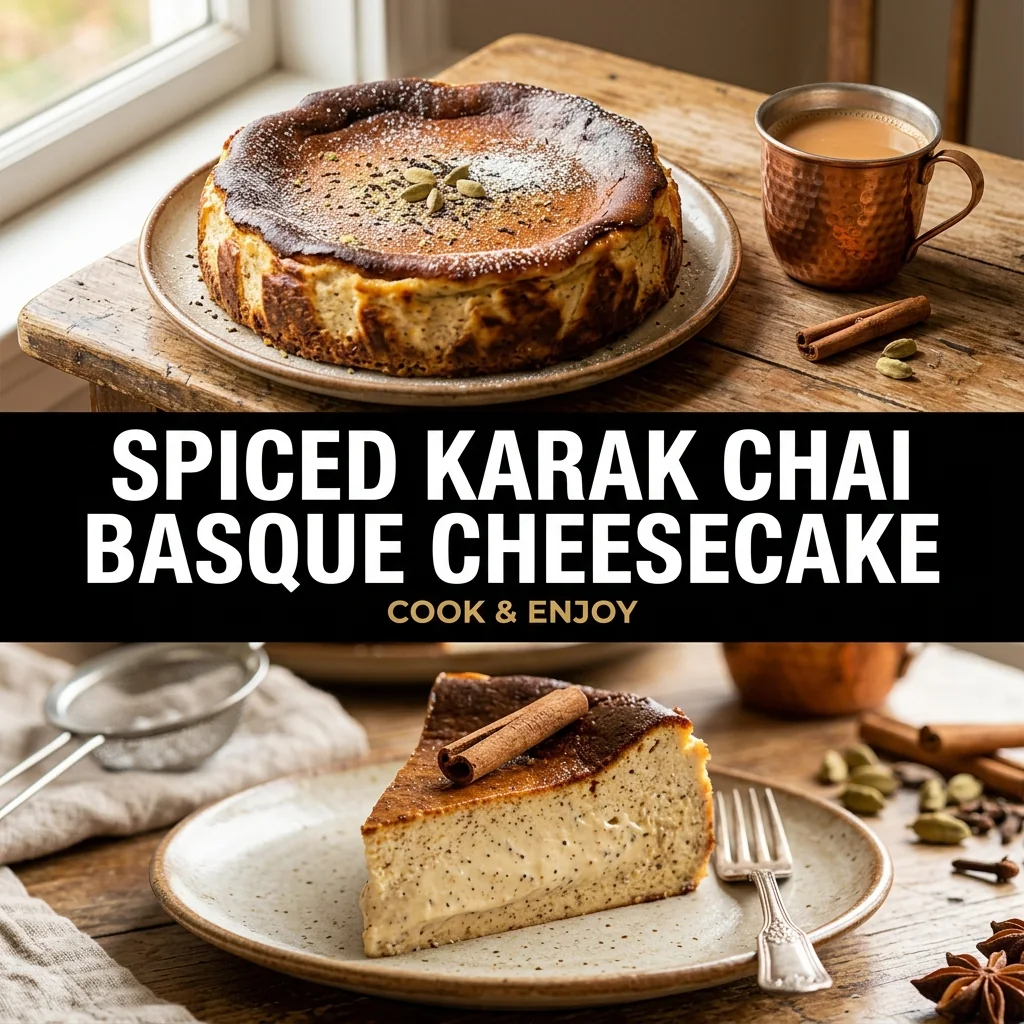
WHY MAKE IT
A little comfort, a lot of flavor.
Spiced karak chai Basque cheesecake brings together the aromatic intensity of Gulf-style milk tea and the scorched, creamy architecture of northern Spain's classic tarta de queso. By gently simmering loose black tea leaves with bruised green cardamom pods and cinnamon in evaporated milk, the liquid develops concentrated caramel undertones and herbal warmth. The high oven temperature deliberately scorches the exterior batter, developing deep bitter-sweet notes that balance the heavy cream cheese. Unlike standard dense baked cheesecakes, this hybrid relies on eggs and minimal flour to yield a center that settles into a velvety custard after thorough cooling. It delivers complex spice aromatics in an elegant, rustic presentation without needing a traditional pastry crust.
Tea Selection and Infusion Control
Using a robust, CTC (crush, tear, curl) or strong Assam black tea provides the tannic backbone required to cut through dense cream cheese and heavy cream. Simmering the spices directly in evaporated milk mimics authentic street-side karak preparation, drawing out fat-soluble essential oils from the cracked cardamom husks and seeds. Pressing the spent leaves firmly through a fine sieve extracts the maximum color and flavor. If the reduction yields slightly less than 180 ml, supplement with a splash of fresh evaporated milk to keep liquid ratios accurate.
Managing the High-Heat Bake
Basque cheesecakes demand fierce heat to blister the surface before the interior overcooks. Baking at 220 C (425 F) allows the exterior sugars and milk solids to undergo rapid Maillard browning and caramelization. The parchment paper collar buffers the batter from metal pan edges, ensuring the edges set firmly while the center rises into an airy souffle before collapsing softly upon cooling. Never rely on a toothpick test for this style; judge readiness by a pronounced, loose jiggle in the center 8 centimeters.
Resting and Custard Setting
A full two-hour room-temperature resting period is essential to prevent thermal shock, which causes the delicate emulsion to weep liquid. Once cooled, four hours of refrigeration allows the butterfat and egg proteins to stabilize, creating a sliceable structure that remains soft and creamy on the tongue. Avoid cutting into the cake while lukewarm, as the molten core will run across the serving plate rather than holding its distinctive softly slumping shape alongside a hot cup of black tea.
Before you start
Ensure the strained spiced milk is cooled to room temperature before adding it to the cream cheese base. Pouring warm liquid into the batter will melt the dairy fat and cause the batter to thin excessively, leading to an uneven bake. Basque cheesecakes rely on deliberate browning; do not cover the pan with foil when the top darkens. For neat slices, run a thin chef's knife under hot tap water, wipe it dry between cuts, and slice while the cake is chilled.
THE RECIPE
Spiced Karak Chai Basque Cheesecake
10 servings · 25 minutes preparation · 55 minutes cooking · 360 minutes cooling, chilling or resting
Ingredients
Step-by-step instructions
- Combine 240 ml evaporated milk, 15 g loose black tea, 8 crushed cardamom pods, and 1 cinnamon stick in a small saucepan over medium-low heat; bring to a bare simmer for 5 minutes, remove from heat, cover, and steep for 15 minutes, then strain through a fine-mesh sieve pressing solids firmly to yield 180 ml of infused milk, and cool completely.
- Preheat your oven to 220 C (425 F). Crumple two large sheets of parchment paper, moisten them lightly with water, shake off excess moisture, and line a 23 cm (9-inch) springform pan, overlapping the sheets so they extend at least 5 cm above the rim.
- In a large mixing bowl, beat 800 g room-temperature cream cheese and 220 g granulated sugar with a paddle attachment on medium-low speed for 3 to 4 minutes until smooth, scraping the bowl thoroughly.
- Add 4 large eggs and 2 large egg yolks one at a time, beating on low speed until each is incorporated before adding the next, preventing excess air from entering the batter.
- Pour in the 180 ml cooled tea-infused milk, 200 ml heavy cream, 1.5 teaspoons alcohol-free vanilla extract, and 0.5 teaspoon fine sea salt, mixing on low speed until combined.
- Sift 25 g all-purpose flour over the batter and gently fold with a silicone spatula until no dry pockets remain.
- Pour the batter into the prepared springform pan, tap the pan once gently on the counter to release large air bubbles, and bake at 220 C (425 F) for 50 minutes until the top is dark mahogany brown and puffed, while the center still wobbles noticeably. Confirm the center reaches160 F (71 C) before cooling.
- Cool the pan completely on a wire rack at room temperature for 2 hours, then refrigerate uncovered for 4 hours to set the custard core while maintaining a tender texture before slicing with a hot, clean knife.
Kitchen notes
Ensure the strained spiced milk is cooled to room temperature before adding it to the cream cheese base. Pouring warm liquid into the batter will melt the dairy fat and cause the batter to thin excessively, leading to an uneven bake. Basque cheesecakes rely on deliberate browning; do not cover the pan with foil when the top darkens. For neat slices, run a thin chef's knife under hot tap water, wipe it dry between cuts, and slice while the cake is chilled.
Storage & make-ahead
Refrigerate leftovers promptly within 2 hours of serving, tightly wrapped in parchment and foil or in an airtight container, for up to 4 days. Serve chilled or let slices rest at room temperature for 20 minutes before serving. Freezing whole or sliced cake wrapped double in plastic wrap and aluminum foil is safe for up to 1 month; thaw completely in the refrigerator overnight.
An original recipe guide inspired by themes in our Pinterest research. Recipe has not been independently kitchen-tested. AI-generated image is illustrative; your finished dish may look different.
Frequently asked questions
Why is evaporated milk used instead of whole milk?
Evaporated milk has roughly sixty percent of its water removed, concentrating dairy solids and lending subtle cooked-milk notes. This richness mirrors authentic karak chai and prevents introducing excess water, which could dilute the cheesecake batter and cause a loose, watery custard.
Can I use tea bags instead of loose leaf tea?
Yes, you can substitute four standard strong black tea bags for the loose leaf tea. Cut the bags open to steep loose, or steep them whole in the simmering milk, pressing firmly against the pan side before removing to capture the strong color and tannins.
Why did my cheesecake crack open deeply across the surface?
Cracking usually occurs when eggs are beaten at high speed, incorporating trapped air that expands rapidly in the hot oven. Mix the batter strictly on low speed and tap the filled pan once against the counter before baking to release excess air bubbles.


