WHY MAKE IT
A little comfort, a lot of flavor.
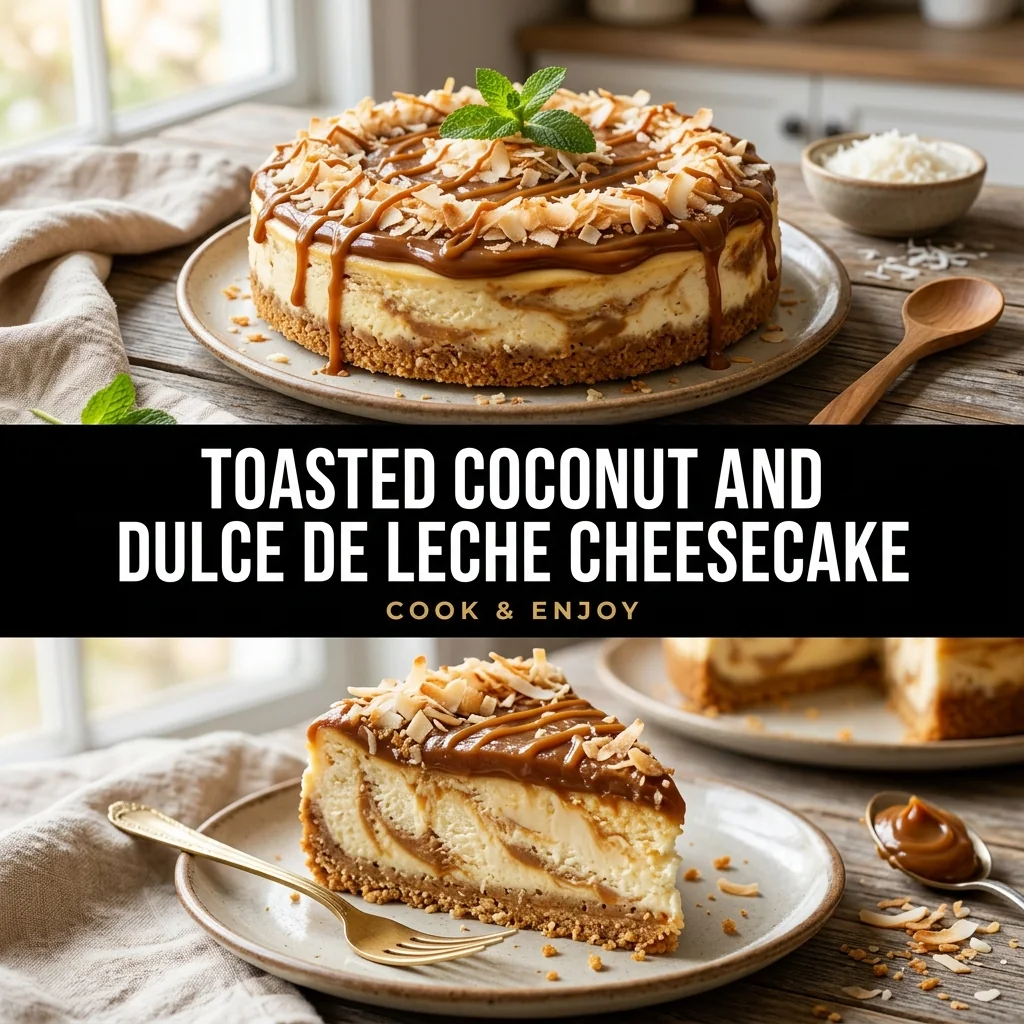
Toasted coconut and dulce de leche cheesecake pairs the nutty crunch of tropical shredded coconut with the deep, slow-cooked dairy sugars of Latin-style milk caramel. The base layers graham crumbs with butter and oven-toasted coconut, providing a sturdy, fragrant foundation that remains crisp beneath creamy filling. Inside the custard, cultured sour cream introduces gentle acidity that cuts through the rich full-fat cream cheese. Thick swirls of dulce de leche run throughout the cake, softening into silky veins during the gentle bake. Finished with warm caramel drizzles and an abundant layer of toasted coconut, this dessert balances contrasting textures—crunchy, unctuous, and airy—making it a centerpiece suitable for celebratory gatherings.
Crust Assembly and Coconut Toasting
Dry coconut shreds contain high natural oil concentrations that burn swiftly if neglected. Toasting at 160 C (325 F) guarantees uniform moisture evaporation and golden coloring without the bitter edges caused by stovetop skillet browning. Combining cooled toasted shreds directly with graham cracker crumbs and melted butter provides structural cohesion. Compacting the crust firmly ensures that the sweet buttery fat binds the particles together during the pre-bake, establishing a moisture-resistant barrier that stays crisp after the batter is added.
Working with Dulce de Leche Swirls
Dulce de leche possesses significant density, which poses a risk of sinking directly through raw cream cheese batter to scorch against the crust. Thinning the caramel slightly with warm heavy cream adjusts its viscosity, allowing it to suspend evenly between the batter layers. When running a knife through the layers, employ a shallow figure-eight pattern. Over-swirling will blend the caramel completely into the batter, muddying the clean color contrast and muting the distinct pockets of concentrated caramelized milk.
Gentle Baking and Stepwise Cooling
Dense cheesecakes with high dairy-fat contents shrink significantly if subjected to rapid temperature drops. Baking until the outer ring is stable while the core retains a subtle wobble indicates the eggs have reached a safe setting point of 71 C (160 F). Turning off the oven and propping the door open allows heat to dissipate gradually over an hour, equalizing internal tension and preventing central surface fractures before the mandatory room-temperature and refrigerated resting cycles.
Before you start
Ensure the dulce de leche used for swirling inside the batter is fluid but not hot. If it is too cold and stiff, it will sink heavily to the bottom crust during baking; if it is piping hot, it will disrupt the egg emulsion. Toasting the coconut slowly in a moderate oven ensures even color without scorched bitter flakes. Always use a water bath or prop-open oven cooling technique to prevent center cracks.
THE RECIPE
Toasted Coconut and Dulce de Leche Cheesecake
12 servings · 30 minutes preparation · 75 minutes cooking · 420 minutes cooling, chilling or resting
Ingredients
Step-by-step instructions
- Preheat your oven to 160 C (325 F). Spread 120 g unsweetened shredded coconut over a rimmed baking sheet and toast for 7 to 9 minutes, stirring twice, until fragrant and golden amber; remove and cool completely, dividing into 50 g for the crust and 70 g for topping.
- In a medium bowl, combine 160 g graham cracker crumbs, 50 g toasted coconut, and 90 g melted butter until the mixture resembles wet sand.
- Press the crumb mixture firmly into the bottom and 2 cm up the sides of a 23 cm (9-inch) springform pan using the flat bottom of a glass, then bake at 160 C (325 F) for 10 minutes; set on a wire rack to cool.
- In a large bowl, beat 900 g cream cheese and 200 g granulated sugar on medium-low speed for 3 minutes until smooth and lump-free.
- Add 180 g sour cream, 1 tablespoon alcohol-free vanilla extract, and 0.5 teaspoon salt, mixing on low speed until evenly blended.
- Add 4 large eggs one at a time, mixing on lowest speed just until each yolk disappears to avoid incorporating excess air into the dense custard.
- In a small microwave-safe bowl, warm 200 g dulce de leche with 2 tablespoons heavy cream for 20 seconds to make it pourable; pour half the cheesecake batter over the crust, drizzle half the warmed caramel over it, top with remaining batter, and spoon the remaining warmed caramel on top, swirling gently with a butter knife.
- Bake at 160 C (325 F) for 55 to 60 minutes until the edges are set and puffy but the center 5 cm jiggles slightly and the center reaches160 F (71 C); turn off the oven, prop the door open 10 cm with a wooden spoon, and leave the cheesecake inside for 60 minutes.
- Transfer pan to a wire rack to cool completely for 1 hour at room temperature, warm the remaining 80 g dulce de leche slightly to drizzle over the surface, scatter the reserved 70 g toasted coconut across the top, and refrigerate for 5 hours before unclamping and slicing.
Kitchen notes
Ensure the dulce de leche used for swirling inside the batter is fluid but not hot. If it is too cold and stiff, it will sink heavily to the bottom crust during baking; if it is piping hot, it will disrupt the egg emulsion. Toasting the coconut slowly in a moderate oven ensures even color without scorched bitter flakes. Always use a water bath or prop-open oven cooling technique to prevent center cracks.
Storage & make-ahead
Store the finished cheesecake in an airtight container or under a cake dome in the refrigerator promptly within 2 hours. It stays fresh and sliceable for up to 5 days. For freezing, chill the plain baked cheesecake thoroughly before adding top garnishes, wrap in two layers of plastic wrap and foil, and freeze for up to 2 months. Thaw completely in the refrigerator for 12 hours.
An original recipe guide inspired by themes in our Pinterest research. Recipe has not been independently kitchen-tested. AI-generated image is illustrative; your finished dish may look different.
Frequently asked questions
What makes dulce de leche halal-certified?
Authentic dulce de leche is made simply by reducing milk and sugar. A halal-certified variety confirms that no nonhalal animal-derived thickeners, unverified enzymes, or alcohol-based flavoring extracts were introduced during manufacturing, ensuring strict adherence to purity standards.
Can I substitute sweetened flaked coconut for unsweetened shreds?
Using sweetened flaked coconut will make the crust and topping significantly sweeter and may cause the coconut to brown too rapidly in the oven due to added sucrose. If using sweetened coconut, reduce toasting time by 2 to 3 minutes and monitor closely.
Why did my caramel sink to the bottom of the pan?
If the dulce de leche was too cold, thick, and heavy, its density would overcome the raw batter and pull it downward. Loosening the caramel with a splash of cream and drizzling it across an established half-layer of batter prevents it from settling on the bottom crust.


