WHY MAKE IT
A little comfort, a lot of flavor.
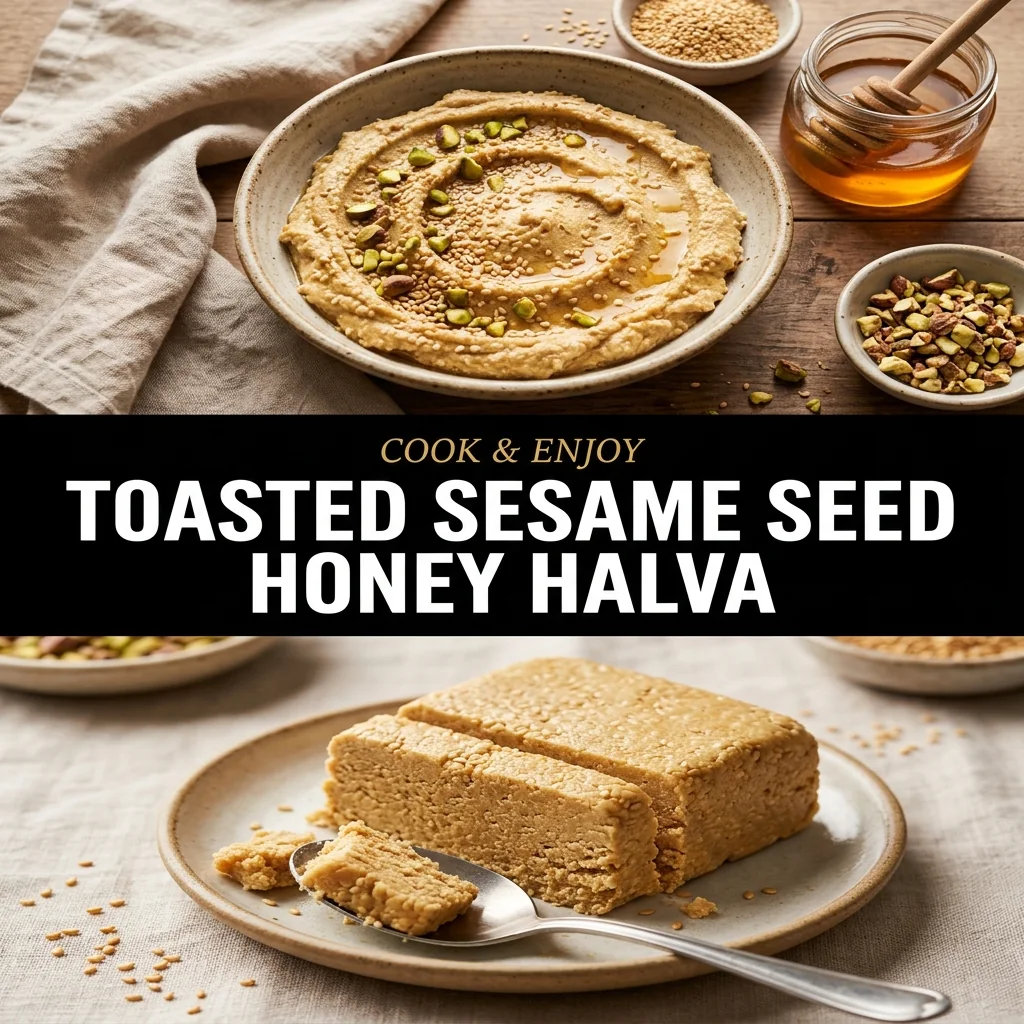
Toasted Sesame Seed Honey Halva is a time-honored confection celebrated throughout the Middle East and Eastern Mediterranean for its unique balance of earthy richness and delicate sweetness. Unlike modern industrial versions built upon refined corn syrups, this traditional recipe relies on pure honey boiled to the hard ball stage, which provides structural integrity without cloying artificiality. The process requires gentle folding rather than intense beating, allowing micro-crystalline threads of honey to suspend the ground sesame solids into a distinctly flaky, crumbly crumb. Lightly scented with green cardamom and pure alcohol-free vanilla extract, each slice yields a brittle snap followed by a melting, nutty richness on the tongue that pairs exceptionally well with unsweetened black tea.
Sesame Paste Selection
The foundation of superior halva lies in the quality of the tahini paste. Look for a jarred product made solely from 100 percent roasted or hulled sesame seeds without added emulsifiers, starches, or vegetable oils. Natural tahini tends to separate during storage, leaving dense solids at the base beneath a pool of clear oil. Before measuring, warm the sealed jar in a warm water bath to loosen the oils, then stir thoroughly until completely homogenous. Choosing lightly roasted sesame paste imparts a mellow, nutty backbone that balances the intense sweetness of cooked floral honey.
The Science of Honey Crystallization
Cooking honey requires attentiveness because its natural fructose and glucose blend burns faster than sucrose syrups. Using a reliable digital candy thermometer ensures you reach precisely 250 F / 121 C, which drives off enough moisture to yield a stable, sliceable confection upon cooling. Heating below this mark results in an overly soft, sticky paste, while exceeding it creates a hard, bitter brittle. Folding the warmed tahini into the hot honey initiates controlled crystallization, creating the iconic friable ribbons that define high-grade artisanal halva.
Slicing and Presentation
Do not attempt to slice halva immediately after cooling to room temperature. The structure requires a prolonged resting window of at least 24 hours under refrigeration so the sugar crystals fully knit together around the sesame fats. Run a thin offset spatula around the edges, invert the pan, and peel back the parchment liner. Using a long, sharp chef's knife warmed in hot water and wiped completely dry, cut the block into 1/2-inch slices. Halva exhibits a delicate, crumbly edge that looks best served rustic on flat ceramic plates.
Before you start
Controlling temperature and agitation is essential when folding tahini into boiled honey. If you stir too vigorously or for too long, the natural sesame oils will separate completely from the paste, resulting in an oily, greasy block instead of tender, distinct sugary shards. Warm the tahini gently before combining so it does not prematurely seize the hot honey syrup. Stop folding the second the mass pulls cleanly from the pan wall.
THE RECIPE
Toasted Sesame Seed Honey Halva
12 servings · 20 minutes preparation · 15 minutes cooking · 1440 minutes cooling, chilling or resting
Ingredients
Step-by-step instructions
- Grease an 8.5 x 4.5-inch metal loaf pan with 1 teaspoon vegetable oil, then line the bottom and long sides with parchment paper, leaving a 2-inch overhang on both sides for easy removal.
- Toast the 60 grams of hulled sesame seeds in a dry skillet over medium-low heat for 4 to 5 minutes, shaking frequently until fragrant and pale golden; set aside 2 tablespoons for garnish.
- Gently warm the 480 grams of tahini paste in a heatproof bowl set over a pot of steaming water until it reaches approximately 115 F / 46 C, ensuring the oil does not separate.
- Stir the fine sea salt, alcohol-free vanilla extract, ground cardamom, and remaining toasted sesame seeds directly into the warmed tahini paste until thoroughly combined.
- Combine the 340 grams of honey in a heavy 2-quart saucepan over medium heat; bring to a rolling boil and cook without stirring until a digital candy thermometer registers 250 F / 121 C (hard ball stage), which takes approximately 8 to 10 minutes.
- Remove the boiled honey immediately from the heat and allow the rapid bubbling to subside for 30 seconds.
- Pour the warm tahini mixture into the hot honey syrup; fold gently with a heatproof silicone spatula in long, deliberate strokes for about 30 to 45 seconds, stopping immediately when the mixture pulls away from the pan sides and turns matte to preserve its crystalline thread texture.
- Scrape the warm halva into the prepared loaf pan, press the surface gently into an even layer, scatter the chopped pistachios and reserved toasted sesame seeds over the top, and press them lightly into the surface.
- Cool completely at room temperature for 2 hours, then wrap tightly in plastic film and transfer to the refrigerator for at least 22 hours to allow the dense, crumbly structure to mature fully.
Kitchen notes
Controlling temperature and agitation is essential when folding tahini into boiled honey. If you stir too vigorously or for too long, the natural sesame oils will separate completely from the paste, resulting in an oily, greasy block instead of tender, distinct sugary shards. Warm the tahini gently before combining so it does not prematurely seize the hot honey syrup. Stop folding the second the mass pulls cleanly from the pan wall.
Storage & make-ahead
Store the cured halva wrapped tightly in parchment paper and placed inside an airtight container in the refrigerator for up to 3 weeks, or freeze for up to 2 months. Halva softens quickly at warm ambient room temperatures; bring it out of the refrigerator roughly 15 minutes before slicing with a warm, dry chef's knife for clean cuts.
An original recipe guide inspired by themes in our Pinterest research. Recipe has not been independently kitchen-tested. AI-generated image is illustrative; your finished dish may look different.
Frequently asked questions
Why did my halva release a large pool of oil while setting?
Oil separation occurs when the tahini is folded too aggressively or for too long into the hot honey. Excessive agitation breaks the natural sesame emulsion, forcing the oil out. Next time, fold only 20 to 30 strokes until combined, then immediately transfer the paste to the loaf pan.
Can I use unhulled raw black tahini instead?
Unhulled tahini possesses a markedly bitter, mineral-heavy flavor and a coarser texture that can overwhelm the delicate honey notes. While technically possible, classic golden or hulled white sesame tahini delivers the correct sweet, nutty profile and the traditional crumbly consistency.
Why is my halva chewy rather than crumbly?
Chewiness indicates that the honey syrup did not reach the required 250 F / 121 C before combining with the tahini, leaving excess water in the confection. A digital candy thermometer helps ensure the moisture cooks off accurately to produce a firm, crumbly structure.