WHY MAKE IT
A little comfort, a lot of flavor.
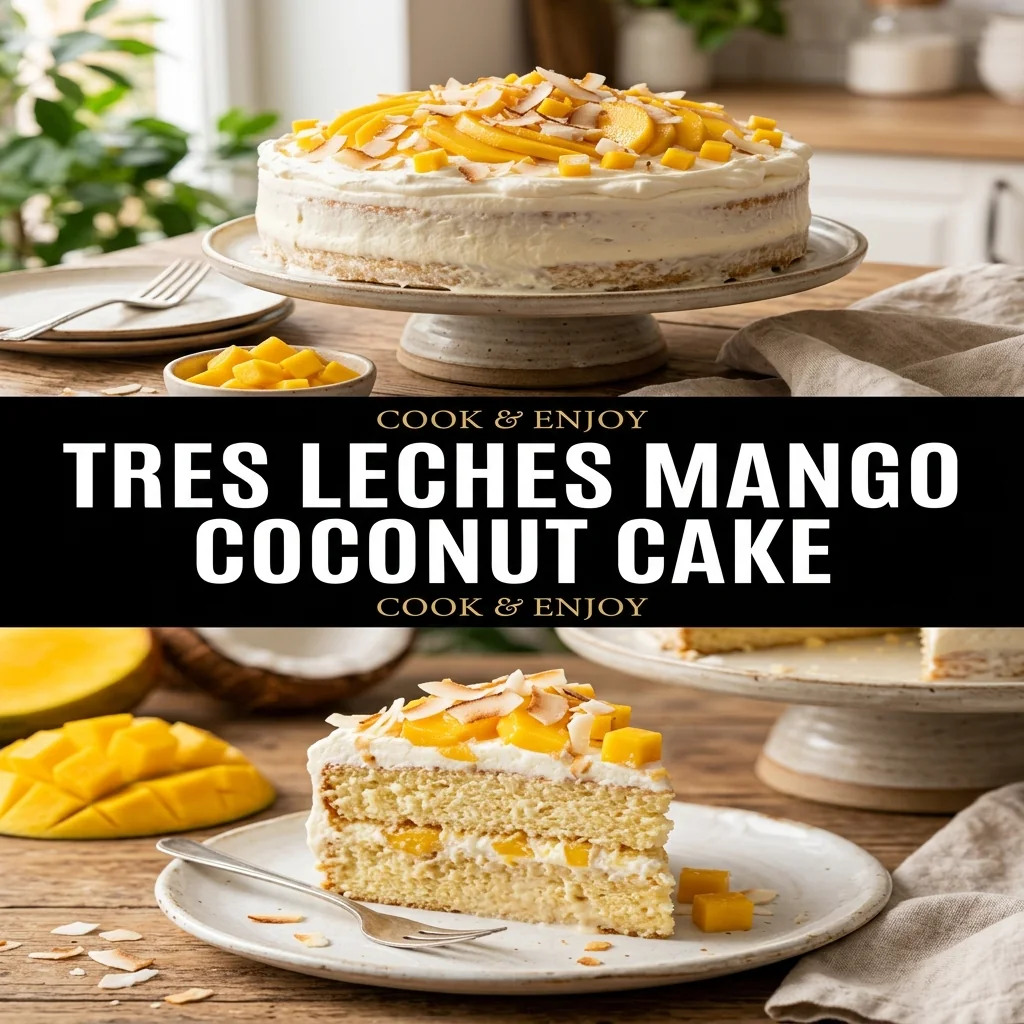
Tres Leches Mango Coconut Cake offers a tropical adaptation of the classic Latin American soaked sponge. Traditional tres leches relies on an airy, unbuttered sponge that functions like an edible lattice, designed specifically to capture liquid without dissolving into mush. In this version, standard dairy milk is paired with rich canned coconut milk, evaporated milk, and sweetened condensed milk to establish a decadent, fragrant base. The sweet, creamy crumb is balanced by the brightness of freshly diced ripe mango cubes layered across the summit alongside lightly toasted coconut flakes. Because this cake requires thorough refrigeration to allow the liquid to permeate the interior evenly, it serves as an exceptional make-ahead centerpiece for gatherings and celebratory dinners.
Sponge Structure and Aeration
The sponge relies on physical aeration rather than heavy fat additions. By separating the egg whites and whipping them to stiff peaks with granulated sugar, you introduce stable micro-air bubbles into the batter. Folding these whipped whites into the flour and yolk base must be done gently with sweeping strokes from the bottom of the bowl upward. If overmixed, the sponge collapses, yielding a dense, rubbery cake that repels the soaking liquid rather than absorbing it. A properly aerated crumb guarantees the three-milk coconut blend penetrates from edge to center.
Balancing the Coconut Milk Soak
Full-fat coconut milk provides natural fats and aromatic oils, which temper the high sugar level of sweetened condensed milk. Combining canned coconut milk, evaporated milk, and condensed milk produces a pourable syrup with balanced viscosity. If the mixture is too thick, it sits on the surface of the sponge; if too thin, it puddles at the pan base. Pricking the baked cake deeply across its entire surface with a wooden skewer establishes vertical channels, drawing the coconut milk blend deep into the crumb for a uniform texture throughout.
Topping Selection and Assembly
Because the soaked sponge carries significant sweetness, the whipped cream topping is kept moderately low in sugar. Heavy cream whipped with a hint of alcohol-free coconut extract provides a clean, stable buffer between the soaked base and the fruit. Choose sweet, fiberless mangoes such as honey or Ataulfo varieties. Dice the fruit into uniform half-inch pieces to ensure that slices stay intact when portioned. Scatter the fruit and toasted coconut flakes shortly before serving to maintain crisp texture and vivid visual contrast.
Before you start
For maximum liquid absorption without creating a soggy paste, wait until the cake has cooled down from piping hot to lukewarm (about 30 minutes) before pouring the three-milk blend. Pouring the mixture slowly around the perimeter first, then moving toward the center, prevents dry pockets. Use ripe Ataulfo or Alphonso mangoes for their tender texture and lack of stringy fibers, dicing them evenly so every slice cuts cleanly with an intact crumb layer underneath.
THE RECIPE
Tres Leches Mango Coconut Cake
12 servings · 35 minutes preparation · 30 minutes cooking · 270 minutes cooling, chilling or resting
Ingredients
Step-by-step instructions
- Preheat the oven to 350°F (175°C) and grease a 9x13-inch ceramic or glass baking dish with neutral oil.
- In a medium bowl, whisk together 1 cup all-purpose flour, 1 1/2 teaspoons baking powder, and 1/4 teaspoon fine salt until combined.
- In a stand mixer fitted with the whisk attachment, beat 5 egg yolks with 1/2 cup granulated sugar on medium-high speed for 3 minutes until pale and thick, then beat in 1/3 cup whole milk and 1 teaspoon alcohol-free vanilla extract.
- In a clean bowl with clean beaters, whip 5 egg whites on medium speed until soft peaks form, then gradually add the remaining 1/4 cup granulated sugar, whipping until stiff, glossy peaks develop.
- Gently fold the dry flour mixture and the whipped egg whites alternately into the yolk mixture in three additions using a silicone spatula, working carefully to retain aeration.
- Spread the batter evenly into the prepared baking dish and bake at 350°F (175°C) for 28 to 30 minutes, or until a wooden toothpick inserted into the center emerges clean.
- Cool the cake in the pan on a wire rack for 30 minutes, then thoroughly pierce the entire surface with a skewer or fork; whisk together the coconut milk, sweetened condensed milk, and evaporated milk in a pitcher and pour slowly over the warm cake.
- Cover and refrigerate the soaked cake for at least 4 hours (or up to overnight) until the liquids are fully absorbed into the crumb.
- Whip 1 1/2 cups cold heavy cream with 3 tablespoons powdered sugar and 1/2 teaspoon alcohol-free coconut extract to medium peaks, spread over the chilled cake, and scatter 2 cups diced ripe mango and 1/4 cup toasted coconut flakes on top before slicing.
Kitchen notes
For maximum liquid absorption without creating a soggy paste, wait until the cake has cooled down from piping hot to lukewarm (about 30 minutes) before pouring the three-milk blend. Pouring the mixture slowly around the perimeter first, then moving toward the center, prevents dry pockets. Use ripe Ataulfo or Alphonso mangoes for their tender texture and lack of stringy fibers, dicing them evenly so every slice cuts cleanly with an intact crumb layer underneath.
Storage & make-ahead
Store the finished cake covered in the refrigerator at or below 40°F (4°C) for up to 3 days. Do not leave the dairy-soaked cake at room temperature for more than 2 hours. This recipe is not suitable for freezing due to dairy separation. Mangoes can be added just prior to service if preparing the soaked sponge a day in advance.
An original recipe guide inspired by themes in our Pinterest research. Recipe has not been independently kitchen-tested. AI-generated image is illustrative; your finished dish may look different.
Frequently asked questions
Why did liquid puddle around the bottom of the pan?
A slight pooling of milk at the base is normal for authentic tres leches cakes. However, if excess liquid remains unabsorbed, either the cake was under-pierced or it needs additional resting time in the refrigerator to allow the internal crumb structure to draw in the moisture fully.
Can I use light coconut milk instead of full-fat?
Full-fat canned coconut milk is recommended because its fat content provides body and prevents the soaking liquid from becoming overly watery. Light coconut milk has higher water content, which can cause the sponge to soften excessively and lose its distinct cake structure.
Can I assemble this cake a day ahead?
Yes, the soaked sponge improves after resting overnight in the refrigerator. For the best presentation, whip the cream and arrange the freshly diced mangoes and toasted coconut flakes on top a few hours before serving so the fruit remains fresh and vibrant.