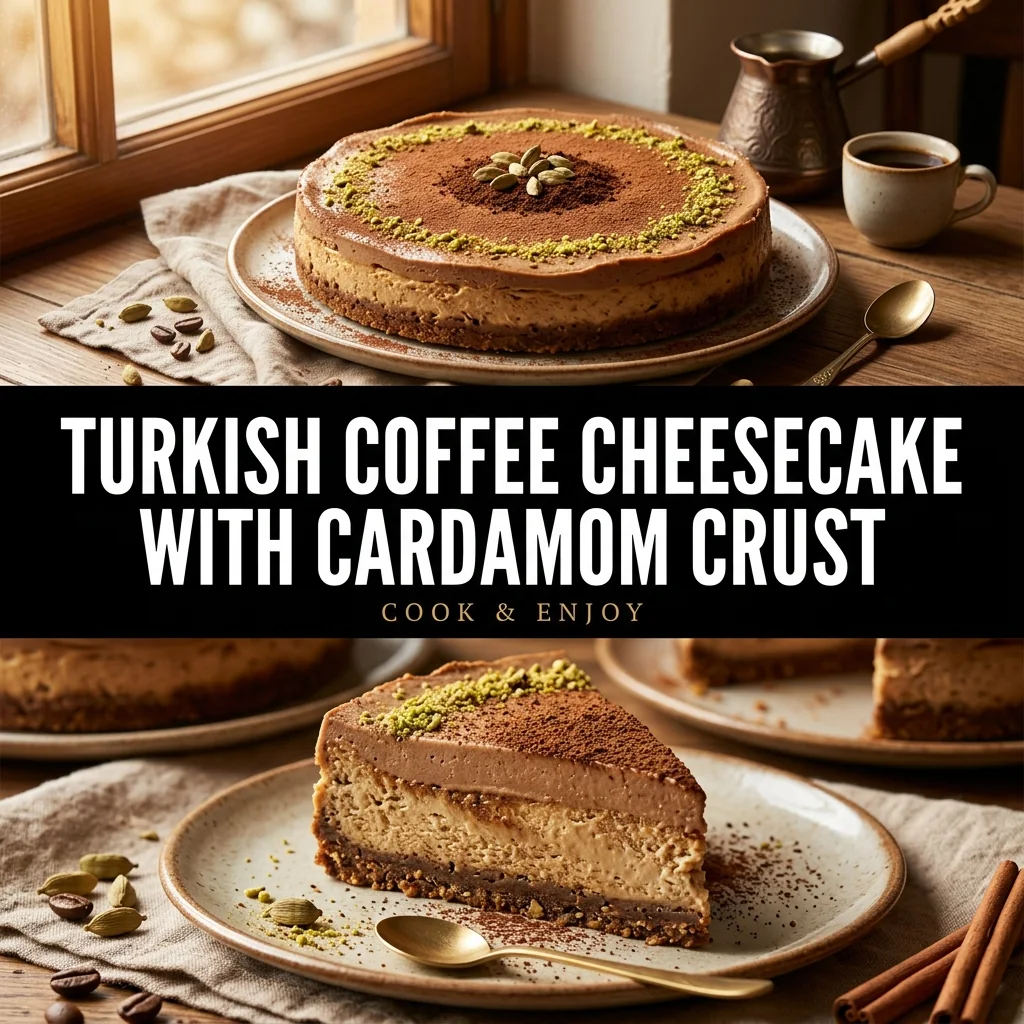
WHY MAKE IT
A little comfort, a lot of flavor.
Turkish coffee holds a revered place across Middle Eastern and Mediterranean hospitality, celebrated for its intense aroma, dense foam, and customary whisper of green cardamom. This baked cheesecake adapts those historic flavors into a contemporary, sliceable format that balances assertive dark roast bitterness against luscious dairy fat. Utilizing an extra-fine powder allows the roasted coffee to permeate the cream cheese base smoothly without imparting an astringent aftertaste. Paired with a crumbly digestive biscuit foundation scented with freshly ground cardamom seed, each bite bridges crisp sweetness and grounded depth. It serves as a striking centerpiece for celebratory gatherings, evening dessert courses, or shared teatimes where rich, aromatic notes are warmly embraced.
Selecting the Right Coffee Grind
Traditional Turkish coffee requires beans roasted to a medium-dark or dark level and pulverized into a microscopic, flour-like powder. Standard espresso or drip grinds remain coarse in suspension and create an unpleasant grainy residue on the tongue. By heating this specialty micro-fine grind directly within warm heavy cream, the natural oils dissolve into the dairy fat, distributing balanced bitterness and roasted nuance across every slice. Source freshly sealed tins of unflavored Turkish coffee or grind beans at home using a dedicated burr grinder capable of an ultra-fine setting.
Mastering the Water Bath Method
Baking dense custards requires gradual, indirect heat to avoid curdling eggs or blistering the cheesecake surface. A bain-marie, or hot water bath, insulates the springform pan so the edges bake at the same steady rate as the deep center. Double-wrapping the exterior with heavy-duty foil prevents moisture from seeping into the cardamom biscuit crust. Maintaining an oven temperature of 300°F (150°C) produces a flat, velvety top without doming. When the center reaches 160°F (71°C), the protein matrix has coagulated safely while preserving a silky consistency.
Serving and Flavor Balance
Due to the potent concentration of dark coffee and aromatic cardamom, this cheesecake thrives when paired with subtle dairy elements that cleanse the palate. Serve chilled wedges unadorned, or top with a dollop of unsweetened whipped cream dusted lightly with cocoa powder. The natural acidity of room-temperature full-fat sour cream in the batter cuts through the heavy cream cheese, ensuring the dessert feels rich rather than cloying. For formal presentations, accompany each portion with roasted pistachios or candied orange peel to echo regional dessert customs.
Before you start
For the smoothest texture, ensure the Turkish coffee is pulverized to a flour-like grind rather than a standard espresso grind. This powdery texture suspends evenly into the heavy cream without yielding a gritty mouthfeel. Avoid opening the oven door during the first 45 minutes of baking, as sudden temperature fluctuations can cause the delicate custard top to crack. Always slice with a sharp knife warmed under hot running water and wiped completely dry between cuts.
THE RECIPE
Turkish Coffee Cheesecake with Cardamom Crust
12 servings · 25 minutes preparation · 65 minutes cooking · 420 minutes cooling, chilling or resting
Ingredients
Step-by-step instructions
- Preheat the oven to 350°F (175°C). Grease a 9-inch (23 cm) springform pan and line the bottom with parchment paper.
- In a medium bowl, combine 220 g crushed digestive biscuits, 85 g melted butter, and 3/4 tsp ground cardamom until evenly moistened, then press firmly into the bottom of the prepared springform pan.
- Bake the crust at 350°F (175°C) for 10 minutes until lightly golden and set, then transfer to a wire rack to cool completely while reducing the oven temperature to 300°F (150°C).
- In a small saucepan over low heat, gently warm 120 ml heavy cream with 25 g Turkish coffee powder and the remaining 1/4 tsp ground cardamom for 3 minutes until steaming and well incorporated, then remove from heat to cool slightly.
- In a large mixing bowl using a stand mixer fitted with the paddle attachment on low speed, beat 900 g room-temperature cream cheese, 200 g granulated sugar, and 30 g cornstarch for 2 minutes until smooth and free of lumps, avoiding high speeds that introduce excess air.
- Blend in 180 g sour cream, 1 1/2 tsp alcohol-free vanilla extract, and the warm coffee-cream mixture until fully homogenous.
- Add the 4 large eggs one at a time, beating on low speed just until each yolk and white is incorporated, scraping the sides and bottom of the bowl thoroughly between additions.
- Wrap the exterior base and sides of the springform pan securely with two layers of heavy-duty aluminum foil, pour the batter over the cooled crust, and place the springform inside a large roasting pan.
- Pour boiling water into the roasting pan until it reaches halfway up the sides of the springform pan, then bake at 300°F (150°C) for 52 to 55 minutes until the outer edges are set and the center registers 160°F (71°C) with a gentle jiggle; cool on a wire rack for 60 minutes, then chill in the refrigerator for at least 360 minutes (6 hours).
Kitchen notes
For the smoothest texture, ensure the Turkish coffee is pulverized to a flour-like grind rather than a standard espresso grind. This powdery texture suspends evenly into the heavy cream without yielding a gritty mouthfeel. Avoid opening the oven door during the first 45 minutes of baking, as sudden temperature fluctuations can cause the delicate custard top to crack. Always slice with a sharp knife warmed under hot running water and wiped completely dry between cuts.
Storage & make-ahead
Cover the cheesecake loosely with aluminum foil or transfer individual slices into airtight containers. Refrigerate promptly within 2 hours of serving at or below 40°F (4°C) for up to 4 days. For advance preparation, prepare and chill the cheesecake 24 hours ahead. Do not freeze whole with cream garnishes. Slices may be frozen individually wrapped in parchment and heavy foil for up to 1 month; thaw completely in the refrigerator overnight before slicing.
An original recipe guide inspired by themes in our Pinterest research. Recipe has not been independently kitchen-tested. AI-generated image is illustrative; your finished dish may look different.
Frequently asked questions
Can I use instant espresso powder instead of Turkish coffee?
While instant espresso dissolves readily, it lacks the deep, smoky undertones and subtle texture characteristic of Turkish coffee. If substituted, reduce the measurement to 15 grams to avoid excessive bitterness, as instant granules are highly concentrated extracts compared to ground whole roasted beans.
Why did my cardamom crust become soggy after baking?
A soggy crust occurs if water leaks through the springform pan during the water bath stage or if the crust was underbaked during blind baking. Always use wide heavy-duty foil without seams beneath the base, and let the crust cool fully before adding the liquid filling.
How do I know the cheesecake is done without a thermometer?
Gently tap the side of the pan with a wooden spoon. The outer 2 to 3 inches should appear firm and set, while the very center circle (about 2 inches across) should wobble slightly like set gelatin. It will finish firming up during the cooling phase.


