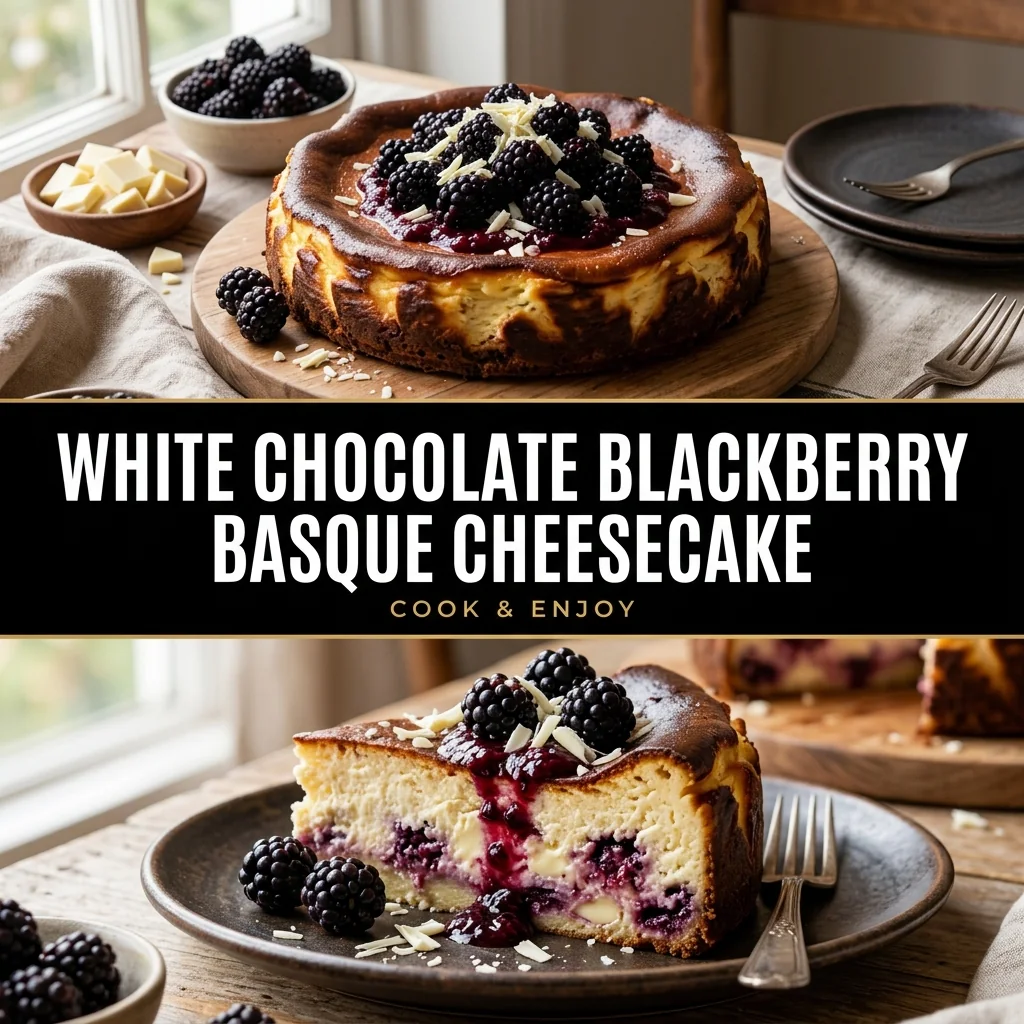
WHY MAKE IT
A little comfort, a lot of flavor.
The white chocolate blackberry Basque cheesecake reimagines the famed burnt cheesecake of San Sebastián by contrasting deep, caramelized bitterness with rich cocoa butter and sharp woodland fruit. Unlike traditional New York styles that demand water baths and pale, crack-free surfaces, the Basque cheesecake thrives on high convection heat that chars the exterior while retaining an ultra-soft, almost spoonable custard core. Halal-certified white chocolate introduces a velvety richness that offsets the natural tang of the cream cheese, while tart whole blackberries provide juicy acidic bursts that cut through the decadence. Baked in crinkled parchment paper, this rustic, crustless showpiece delivers complex flavor dimensions ranging from nutty browned milk solids to sweet berry compote in every bite.
Handling White Chocolate in Custard
White chocolate requires delicate temperature control when incorporated into cold dairy. Melt the white chocolate gently in a heatproof bowl set over a pot of barely simmering water, ensuring no steam enters the bowl, or in 20-second microwave bursts. Allow the melted chocolate to cool to lukewarm (about 95°F / 35°C) before streaming it into the room-temperature cream cheese. If the chocolate is excessively hot, it will melt the cheese fat and curdle the mixture; if it is too cold, it will seize into hard, granular bits upon contact.
The Purpose of the High-Heat Bake
Baking at an assertive 400°F (204°C) without a water bath produces the hallmark scorched surface of Basque pastry. The Maillard reaction and sugar caramelization generate complex flavors reminiscent of toasted marshmallow, bitter caramel, and browned butter. The high heat sets the exterior custard quickly, trapping steam and allowing the interior to heat gradually until the eggs safely reach the food-safe threshold without solidifying into a firm cake. A dramatic center jiggle upon removal is the exact textural benchmark indicating a soft, melt-in-the-mouth center.
Suspension of Fresh Blackberries
Fresh blackberries contain significant juice that can create wet pockets or sink completely to the bottom parchment lining if not managed properly. Lightly tossing the berries in dry cornstarch binds free surface moisture and provides grip within the heavy batter. Layering the fruit evenly between two pours of batter ensures balanced distribution throughout the cake height. Avoid frozen blackberries for this preparation, as their ruptured cell structures release substantial water during the short, intense bake, which dilutes the rich custard and causes excessive sogginess.
Before you start
Basque cheesecakes rely on deliberate browning, but white chocolate contains milk solids that brown much faster than standard sugar. Keep a watchful eye during the final 10 minutes of baking. The center must remain noticeably wobbly when taken out of the oven; overbaking will eliminate the signature molten, luscious core and turn the cheesecake dry. Always pat the blackberries completely dry before tossing in cornstarch to prevent bleeding excess moisture into the batter.
THE RECIPE
White Chocolate Blackberry Basque Cheesecake
10 servings · 20 minutes preparation · 45 minutes cooking · 480 minutes cooling, chilling or resting
Ingredients
Step-by-step instructions
- Preheat the oven to 400°F (204°C). Cut two large 12x16-inch sheets of parchment paper, press them overlapping into a 9-inch (23 cm) springform pan, creasing the paper to fit the corners and leaving roughly 2 inches of parchment extending above the rim.
- Toss 170 g dry blackberries with 10 g cornstarch in a small bowl until evenly coated, then set aside.
- In a large bowl using an electric stand mixer fitted with the paddle attachment, beat 800 g softened cream cheese and 180 g granulated sugar on medium-low speed for 3 minutes until completely smooth and the sugar is dissolved.
- Slowly stream in 180 g melted and cooled white chocolate while mixing on low speed until seamlessly integrated into the cream cheese base.
- Add the 5 room-temperature eggs one at a time, mixing on low speed just until each egg disappears before incorporating the next.
- Whisk together 300 ml heavy whipping cream, 25 g all-purpose flour, 5 ml alcohol-free vanilla extract, and 2 g fine sea salt in a small bowl until no flour lumps remain, then pour this mixture into the batter and mix for 30 seconds on low.
- Pour half of the batter into the prepared parchment-lined pan, scatter two-thirds of the starched blackberries across the surface, pour the remaining batter over the fruit, and gently press the remaining blackberries onto the surface.
- Bake at 400°F (204°C) on the center oven rack for 45 minutes until the top is deeply caramelized, nearly dark brown, and the center displays a pronounced, loose jiggle when the pan is gently nudged. Check the center reaches160 F (71 C); continue baking gently if needed.
- Remove the pan from the oven and cool completely at room temperature on a wire rack for 120 minutes, then transfer to the refrigerator to chill for at least 6 hours (360 minutes) to allow the custardy center to firm up before unlatching the springform and peeling back the parchment paper.
Kitchen notes
Basque cheesecakes rely on deliberate browning, but white chocolate contains milk solids that brown much faster than standard sugar. Keep a watchful eye during the final 10 minutes of baking. The center must remain noticeably wobbly when taken out of the oven; overbaking will eliminate the signature molten, luscious core and turn the cheesecake dry. Always pat the blackberries completely dry before tossing in cornstarch to prevent bleeding excess moisture into the batter.
Storage & make-ahead
Store the cooled, chilled cheesecake in an airtight container or cover the pan tightly with foil in the refrigerator at or below 40°F (4°C) for up to 4 days. Perishable dairy items must be returned to refrigeration within 2 hours. Basque cheesecake may be prepared up to 2 days ahead of serving. Freezing is not advised for this style, as the delicate high-moisture custard center tends to weep and separate upon thawing.
An original recipe guide inspired by themes in our Pinterest research. Recipe has not been independently kitchen-tested. AI-generated image is illustrative; your finished dish may look different.
Frequently asked questions
Why is the top of the cheesecake so dark?
The scorched, deeply mahogany surface is intentional for Basque cheesecakes. The caramelization of milk solids from the cream and white chocolate provides a pleasant, bitter-sweet contrast that cuts through the intense richness of the soft cheese center.
Can I serve this cheesecake warm?
While Basque cheesecakes can be eaten at room temperature, chilling for at least 6 hours is necessary first to allow the white chocolate and dairy fats to set structurally. If sliced hot, the molten center will simply spill across the plate.
How do I verify the white chocolate is halal?
Check the product packaging for recognized halal certification. Ensure the ingredient panel contains pure cocoa butter, milk solids, and sugar without animal fats, non-halal emulsifiers, or vanilla extracts derived from alcohol extraction processes.


