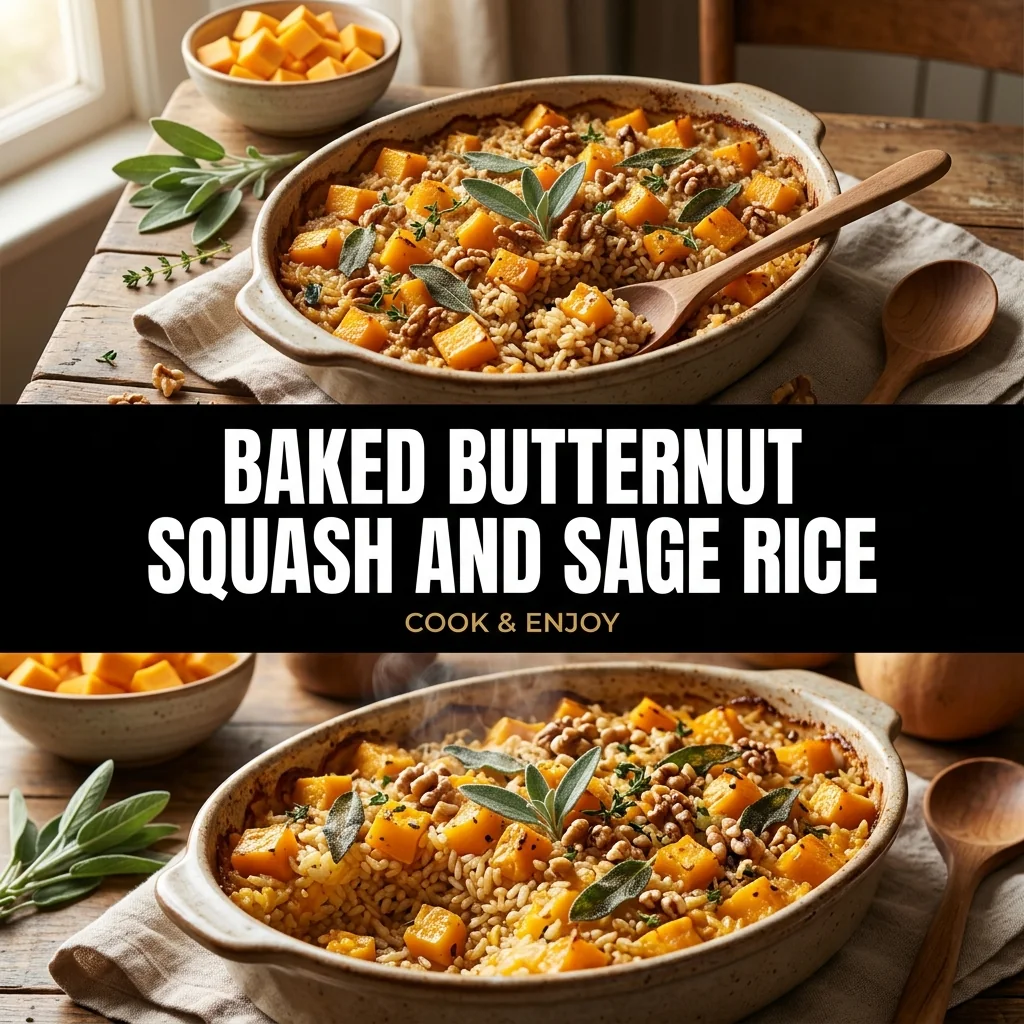
WHY MAKE IT
A little comfort, a lot of flavor.
Baked Butternut Squash and Sage Rice transforms humble autumnal staples into an elegant, hands-off side dish that fills the kitchen with savory warmth. By baking jasmine rice directly in hot seasoned vegetable stock, the grains slowly absorb moisture alongside sweet butternut squash cubes. Frying fresh sage leaves in pure butter produces two exceptional flavor elements: delicate, crispy herb garnishes and a rich, nutty brown butter base that coats the aromatics. Grated cheese crafted with halal-suitable microbial rennet adds subtle sharpness and savory depth, rounding out the inherent sweetness of winter squash. This dependable oven casserole eliminates constant stovetop stirring while delivering creamy, fully cooked grains and tender squash in every portion.
Brown Butter and Sage Chemistry
Browning butter involves toasting milk solids until they undergo the Maillard reaction, developing rich hazelnut and toffee aromas. Frying whole sage leaves in this bubbling butter accomplishes a dual purpose. It dehydrates the leaves into delicate, crispy wafers while infusing the fat with essential sage terpenes like thujone and cineole. Swirling diced onions and squash through this infused butter distributes those earthy notes throughout the dish. The butterfat coats individual rice grains, preventing excessive starch leaching and ensuring a tender yet distinct grain structure after baking.
Baking Dish Dynamics
Baking rice in an oven differs fundamentally from stovetop absorption because ambient heat surrounds the vessel on all sides. Ceramic baking dishes heat slowly and retain thermal energy evenly, which protects the bottom of the casserole from scorching. Pouring simmering stock over the rice before sealing accelerates the thermal transfer, bringing the grains quickly to starch gelatinization temperature. Doubling the foil seal traps every drop of escaping moisture, mimicking the internal pressure of a closed Dutch oven while permitting broad, even distribution of the squash cubes.
Halal Cheese Selection and Balance
Parmesan adds an indispensable layer of savory glutamate to balance the natural sweetness of caramelized squash and sweet onions. Traditional European cheeses often utilize calf rennet of unspecified origin; therefore, selecting varieties certified halal or explicitly made with microbial or vegetarian enzymes guarantees compliance. Incorporating the cheese right before serving preserves its sharp, salty edge without risking oil separation, which can happen if aged hard cheeses are subjected to prolonged, high-heat oven baking.
Before you start
Sealing the baking dish securely with foil is the most critical step for success. If steam escapes during the 35-minute bake, the top grains of rice will dry out and remain hard while the bottom absorbs all the broth. Crimp two layers of foil firmly beneath the rim of the dish to create an airtight seal that forces the hot stock vapor down through the starch.
THE RECIPE
Baked Butternut Squash and Sage Rice
5 servings · 20 minutes preparation · 50 minutes cooking · 10 minutes cooling, chilling or resting
Ingredients
Step-by-step instructions
- Preheat the oven to 375 F (190 C) and lightly coat a 9x13-inch ceramic baking dish with 1 tablespoon of olive oil.
- Melt 4 tablespoons of unsalted butter in a wide skillet over medium heat, add 15 whole sage leaves, and fry for 3 minutes until crisp, then lift out onto paper towels.
- Continue heating the remaining butter in the skillet for 3 minutes until golden brown specks form, then add 1 finely diced onion and 3 minced garlic cloves, cooking for 4 minutes until soft.
- Toss 3 cups of cubed butternut squash into the skillet along with 1 teaspoon of sea salt, 1/2 teaspoon of black pepper, and 1/4 teaspoon of nutmeg, searing for 5 minutes until lightly colored.
- Pour 2 3/4 cups of halal-certified vegetable stock into the skillet, bring to a gentle simmer over medium heat, and scrape up any browned fond from the base.
- Spread 1 1/2 cups of drained jasmine rice across the bottom of the prepared ceramic dish, then pour the hot squash and stock mixture evenly over the grains.
- Cover the baking dish tightly with two layers of heavy-duty aluminum foil to prevent steam escape, transfer to the middle oven rack, and bake at 375 F (190 C) for 35 minutes.
- Remove the dish from the oven and allow it to rest undisturbed on the counter, still tightly covered in foil, for 10 minutes.
- Carefully uncover the dish, gently fluff the rice with a fork to integrate the tender squash cubes, crumble the fried sage leaves over top, and scatter with 1/3 cup of halal-suitable Parmesan.
Kitchen notes
Sealing the baking dish securely with foil is the most critical step for success. If steam escapes during the 35-minute bake, the top grains of rice will dry out and remain hard while the bottom absorbs all the broth. Crimp two layers of foil firmly beneath the rim of the dish to create an airtight seal that forces the hot stock vapor down through the starch.
Storage & make-ahead
Store cooled leftovers in a shallow airtight glass container in the refrigerator within 2 hours. Keep chilled for up to 3 days. To reheat, sprinkle with 1 tablespoon of water or vegetable stock per serving, cover loosely with foil or a microwave lid, and heat until steaming and the core reaches 165 F (74 C).
An original recipe guide inspired by themes in our Pinterest research. Recipe has not been independently kitchen-tested. AI-generated image is illustrative; your finished dish may look different.
Frequently asked questions
Can I use frozen butternut squash instead of fresh?
Yes, but thaw it completely and pat it dry with paper towels before searing. Frozen squash releases extra water, so decrease the vegetable stock by 2 tablespoons to avoid making the baked rice soggy.
What if the rice is still crunchy after 35 minutes?
A crunchy texture indicates steam escaped during baking. Re-crimp the foil tightly, return the dish to the 375 F (190 C) oven for an additional 7 to 10 minutes, and let it rest covered for 10 minutes before fluffing.
Can I substitute brown rice for jasmine rice?
Brown rice requires substantially more moisture and a longer bake time. If using brown rice, increase the vegetable stock to 3 1/4 cups and extend the baking time to 55 minutes at 375 F (190 C).


