WHY MAKE IT
A little comfort, a lot of flavor.
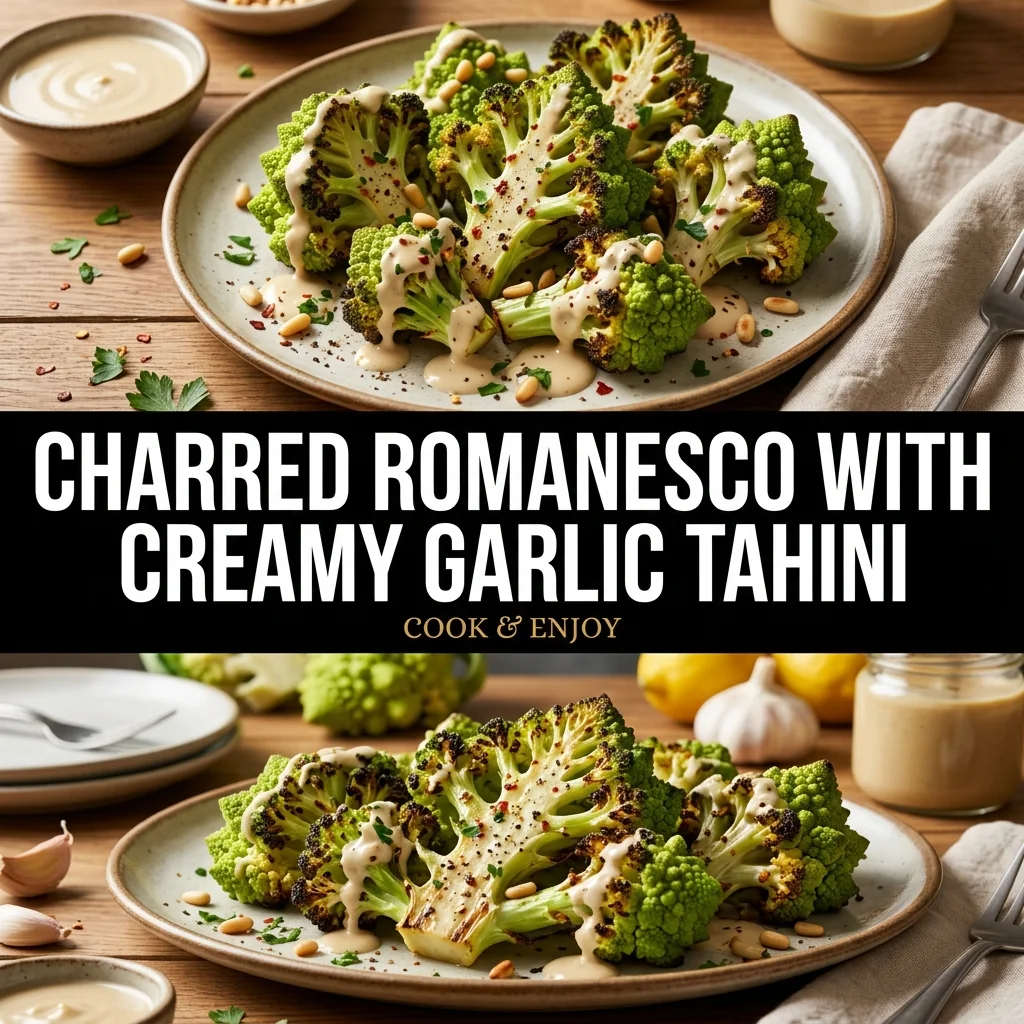
Romanesco is renowned for its logarithmic spiral florets, offering a flavor profile that marries the sweetness of cauliflower with the mineral earthiness of broccoli. When subjected to intense dry heat, those intricate geometric ridges catch the flame-like heat of a hot oven, developing deeply caramelized, nutty edges while keeping the inner stems pleasantly firm to the bite. Pairing this concentrated, smoky vegetable with a chilled, velvety garlic tahini balances the plate through dynamic contrasts of temperature, acidity, and texture. The creamy sesame base, brightened with freshly squeezed lemon juice and raw garlic, acts as a luxurious foundation that coats every roasted furrow, creating a visually striking side dish fit for family dinner tables.
Mastering High-Heat Brassica Roasting
Achieving deep color on Romanesco without reducing its fractal peaks to mush requires an oven preheated to 450°F (232°C). High convective heat drives off surface moisture rapidly, initiating the Maillard reaction along the pointed tips while leaving the core structural integrity sound. Always position the largest cut, flat surfaces directly against the hot metal of the sheet pan. Do not overcrowd the pan; if the florets touch closely, divide them between two baking sheets. Crowding traps evaporated steam, resulting in a drab, pale vegetable with an overly soft texture rather than crisp, blistered contours.
The Science of a Smooth Tahini Emulsion
Tahini is made of finely ground sesame seeds rich in fats and solids. When first combined with an acidic liquid like lemon juice, the proteins bind aggressively, causing the mixture to stiffen into a paste that looks broken. Adding cold water gradually while whisking vigorously unlocks the emulsion, relaxing the proteins and incorporating microscopic air pockets. The result is a luminous, pale, and pourable sauce. Taste the tahini beforehand; quality jars should taste nutty with mild, pleasant bitterness rather than sharp, rancid oxidation.
Plating Dynamics and Flavor Accents
To showcase the distinctive structural beauty of Romanesco, avoid tossing the roasted vegetable directly into the tahini bowl, which muddies the presentation. Instead, sweep the ivory garlic sauce across the bottom of a wide ceramic platter and arrange the warm charred florets on top. This technique preserves the crisp exterior of the florets while allowing diners to gather the desired amount of sauce with each forkful. Finishing with fresh mint leaves and toasted sesame seeds adds herbal brightness and a textural crunch that mirrors the sesame foundation.
Before you start
Surface moisture is the enemy of blistered, nutty brassicas. After washing the Romanesco, spin the florets in a salad spinner or dry them completely on a clean lint-free towel before adding oil. If the florets enter the oven wet, they will boil in their own steam, losing their crisp peaks and firm texture. For the smoothest tahini sauce, use ice-cold water; whisking cold water into pure sesame paste produces a stable, pale emulsion that resists curdling or separating.
THE RECIPE
Charred Romanesco with Creamy Garlic Tahini
4 servings · 20 minutes preparation · 25 minutes cooking · 5 minutes cooling, chilling or resting
Ingredients
Step-by-step instructions
- Preheat the oven to 450°F (232°C) with an oven rack set in the lower-third position.
- Line a heavy, large rimmed baking sheet with aluminum foil or parchment paper.
- Thoroughly pat the 2 pounds of cut Romanesco florets dry with clean kitchen towels to ensure efficient browning.
- Tumble the florets onto the baking sheet, drizzle with 2 1/2 tablespoons of the extra-virgin olive oil, and season with 3/4 teaspoon kosher salt and 1/2 teaspoon cracked black pepper; toss until every geometric edge is evenly coated.
- Spread the florets across the pan in a single layer with flat cut sides pressed directly against the baking surface, ensuring space between pieces to roast rather than steam.
- Roast at 450°F (232°C) for 22 to 25 minutes, flipping the florets once at the 15-minute mark, until the edges are deep golden brown, charred on the ridges, and the stems are tender when pierced with a fork.
- While the Romanesco roasts, whisk together the 1/2 cup tahini paste, 1/3 cup cold water, 2 tablespoons lemon juice, finely grated garlic clove, ground cumin, and remaining 1/4 teaspoon kosher salt in a medium bowl until the sauce seizes, thins, and becomes pale, silky, and pourable.
- Spoon the garlic tahini sauce across the base of a wide, shallow serving platter, smoothing it with the back of a spoon.
- Transfer the hot charred Romanesco onto the bed of tahini, let rest for 5 minutes, then drizzle with the remaining 1/2 tablespoon extra-virgin olive oil.
- Garnish with the 1 tablespoon toasted sesame seeds, 1 tablespoon chopped mint, and 1/4 teaspoon Aleppo pepper flakes, and serve immediately.
Kitchen notes
Surface moisture is the enemy of blistered, nutty brassicas. After washing the Romanesco, spin the florets in a salad spinner or dry them completely on a clean lint-free towel before adding oil. If the florets enter the oven wet, they will boil in their own steam, losing their crisp peaks and firm texture. For the smoothest tahini sauce, use ice-cold water; whisking cold water into pure sesame paste produces a stable, pale emulsion that resists curdling or separating.
Storage & make-ahead
Store leftover charred Romanesco and tahini sauce separately in airtight glass containers in the refrigerator within two hours of preparation. The roasted Romanesco remains good for up to 3 days, while the tahini keeps up to 5 days. Reheat the Romanesco on a baking sheet in a 400°F (204°C) oven for 7 to 10 minutes until heated through to 165°F (74°C). Serve over chilled or room-temperature tahini; avoid boiling the tahini sauce directly, as excess heat can cause sesame paste to separate.
An original recipe guide inspired by themes in our Pinterest research. Recipe has not been independently kitchen-tested. AI-generated image is illustrative; your finished dish may look different.
Frequently asked questions
Can I substitute regular cauliflower or broccoli?
Yes, white cauliflower or broccoli crowns can be cut into similar florets and roasted using the exact same temperature and timing. Romanesco has a slightly denser structure and nuttier flavor, but standard brassicas caramelize beautifully against the garlic tahini.
My tahini sauce seized into a thick paste. How do I fix it?
Tahini naturally seizes when liquid is first introduced. Do not discard it; simply continue whisking while adding an extra tablespoon of cold water at a time. Within thirty seconds of steady whisking, the paste will release, turn pale, and become silky smooth.
Is Romanesco available year-round?
Romanesco is a cool-weather brassica typically harvested from late autumn through early spring. If unavailable at local markets, look for vibrant green Romanesco heads in specialty grocers, or select a firm head of purple or golden cauliflower as a close alternative.