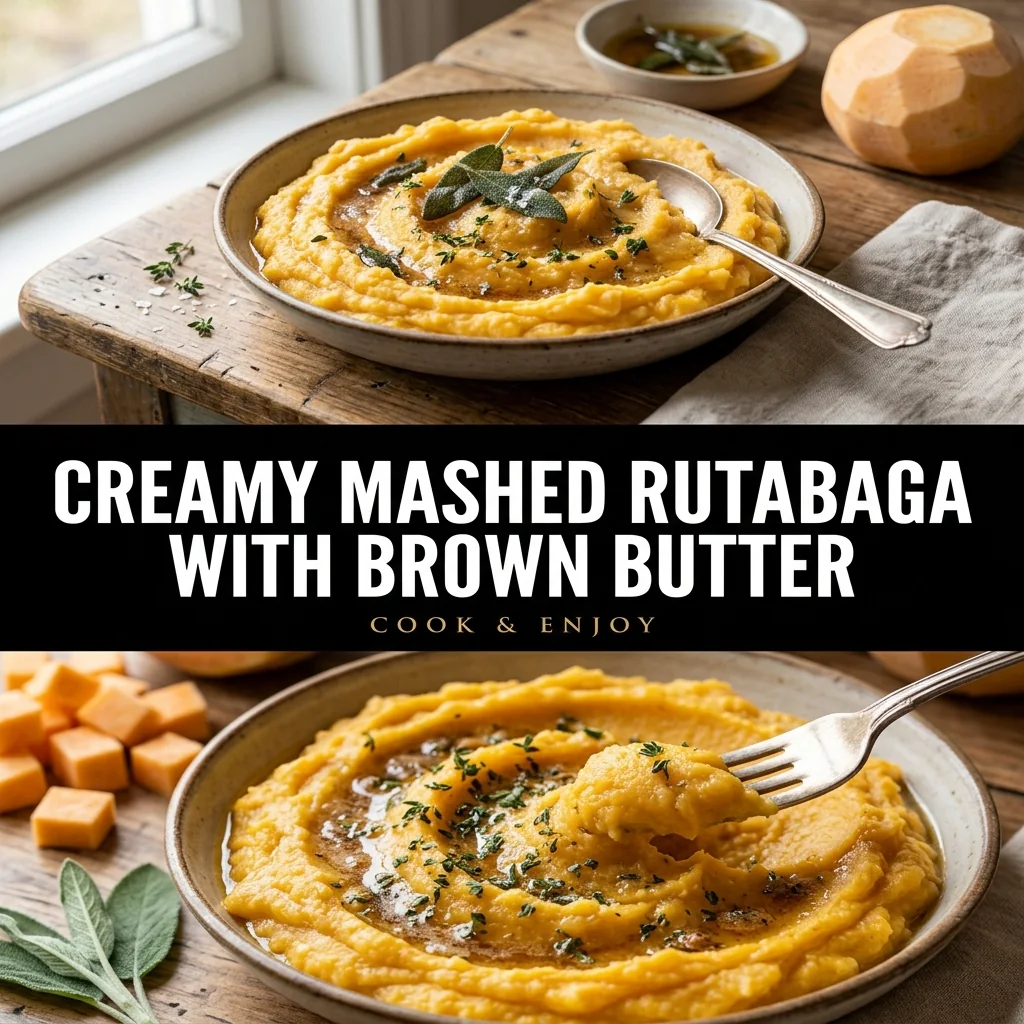
WHY MAKE IT
A little comfort, a lot of flavor.
Creamy Mashed Rutabaga with Brown Butter offers a satisfying, deeply aromatic alternative to standard mashed potatoes. Rutabaga carries a gentle sweetness balanced by a mild, turnip-like earthiness that mellows remarkably when simmered to complete tenderness. Folding nutty, caramelized butter directly into the steaming root vegetable adds immense depth, counteracting the natural bitterness that some palates detect in brassica roots. A gentle touch of freshly grated nutmeg and smooth heavy cream ties the profile together, producing a luxurious side dish that pairs effortlessly with roasted meats, grilled poultry, or hearty vegetarian lentils. This simple preparation transforms an often overlooked winter root into an elegant centerpiece accompaniment with minimal effort and dependable technique.
Selecting and Prepping Fresh Rutabagas
Rutabagas are typically coated in food-grade paraffin wax by commercial distributors to prevent moisture loss during storage and transit. To prepare the root vegetable safely, trim a thin slice from both the stem and root ends using a sharp chef's knife to establish stable cutting surfaces. Stand the rutabaga upright on a heavy wooden cutting board and strip away the waxy outer rind using a heavy-duty Y-peeler or a paring knife. Cut the firm flesh into consistent one-inch cubes to guarantee even cooking throughout the simmering process in your saucepan.
The Science of Developing Brown Butter
Brown butter, or beurre noisette, relies on the thermal transformation of dairy solids suspended in butterfat. When unsalted butter is heated gently in a shallow skillet, water evaporates first, causing vigorous bubbling. Once the water content dissipates, the milk proteins sink and brown through the Maillard reaction. Using medium-low heat and a pale stainless skillet ensures you observe the exact transition from golden yellow to speckled amber. The resulting toasted sediment delivers rich, nutty notes that enhance the subtle natural sugars present in properly boiled rutabagas.
Texture Control and Troubleshooting
Achieving an ultra-smooth consistency with rutabaga requires thorough cooking and effective moisture reduction. If you pierce a cube and encounter any central resistance, continue simmering for another five minutes; undercooked rutabaga remains gritty when processed. For a rustic, textured presentation with pleasant body, use a conventional potato masher. For a silky, restaurant-quality emulsion, use an immersion blender or pass the hot drained root through a fine-mesh food mill. If the mash ever seems overly stiff, blend in an extra tablespoon of warm whole milk.
Before you start
Rutabaga holds substantially more water than starchy russet potatoes, so letting the drained cubes steam in the colander for a full two minutes is crucial. Skipping this drainage window can result in a loose, soupy puree rather than a velvety side dish. When browning your butter, keep a close eye on the pan; light-colored stainless steel allows you to monitor the milk solids as they turn from pale yellow to amber, preventing unwanted burning.
THE RECIPE
Creamy Mashed Rutabaga with Brown Butter
4 servings · 15 minutes preparation · 35 minutes cooking · 5 minutes cooling, chilling or resting
Ingredients
Step-by-step instructions
- Place 2.5 pounds peeled and cubed rutabaga into a heavy 4-quart saucepan, cover with cold tap water by at least 1 inch, and stir in 1 teaspoon fine sea salt.
- Set the saucepan over high heat and bring to a rolling boil, then lower the heat to medium and simmer uncovered for 25 to 30 minutes until the cubes are completely tender when pierced with a fork.
- While the rutabaga boils, melt 5 tablespoons unsalted butter in a small light-colored skillet over medium-low heat, swirling the pan frequently for 4 to 6 minutes until the milk solids turn a rich golden brown and yield a hazelnut aroma.
- Remove the browned butter immediately from the heat source and let it sit undisturbed for 5 minutes off the burner to halt further browning.
- Drain the cooked rutabaga thoroughly in a large colander, leaving the cubes to steam dry in the colander for 2 minutes to eliminate excess moisture.
- Return the hot rutabaga to the warm saucepan, add the browned butter with its golden sediment, 0.25 cup warm whole milk, 2 tablespoons warm heavy cream, remaining 0.5 teaspoon sea salt, 0.125 teaspoon freshly grated nutmeg, and 0.25 teaspoon ground black pepper.
- Puree the mixture with an immersion blender or mash vigorously with a sturdy potato masher for 2 to 3 minutes until smooth, glossy, and evenly aerated.
- Spoon the warm mash into a shallow serving bowl and garnish the surface with 1 tablespoon finely chopped fresh chives before serving immediately.
Kitchen notes
Rutabaga holds substantially more water than starchy russet potatoes, so letting the drained cubes steam in the colander for a full two minutes is crucial. Skipping this drainage window can result in a loose, soupy puree rather than a velvety side dish. When browning your butter, keep a close eye on the pan; light-colored stainless steel allows you to monitor the milk solids as they turn from pale yellow to amber, preventing unwanted burning.
Storage & make-ahead
Allow any remaining mashed rutabaga to cool down before transferring it to an airtight container, and place it in the refrigerator within 2 hours of cooking. Kept cold, it remains fresh for up to 3 days. When ready to reheat, warm the mash in a saucepan over medium-low heat, stirring frequently with a splash of milk to restore consistency until the internal temperature registers at least 165 F (74 C).
An original recipe guide inspired by themes in our Pinterest research. Recipe has not been independently kitchen-tested. AI-generated image is illustrative; your finished dish may look different.
Frequently asked questions
Can I make this mashed rutabaga in advance?
Yes, you can prepare the entire mash up to 24 hours ahead. Cool and refrigerate within two hours. Reheat gently in a covered saucepan over medium-low heat with an extra splash of milk, stirring continuously until heated through to 165 F (74 C).
Why did my rutabaga mash turn watery?
Rutabaga retains significant surface moisture after boiling. If the cubes are not thoroughly drained and allowed to steam dry in the colander for a couple of minutes, that excess water dilutes the dairy emulsion. Simmering the drained mash briefly over low heat can evaporate excess liquid.
Can I substitute half of the rutabaga with potatoes?
You can substitute up to half of the rutabaga with peeled Yukon Gold potatoes cut to the same size. Boil them together in the salted water until tender; the additional potato starch yields a denser, fluffier mash while retaining the distinctive rutabaga flavor.