WHY MAKE IT
A little comfort, a lot of flavor.
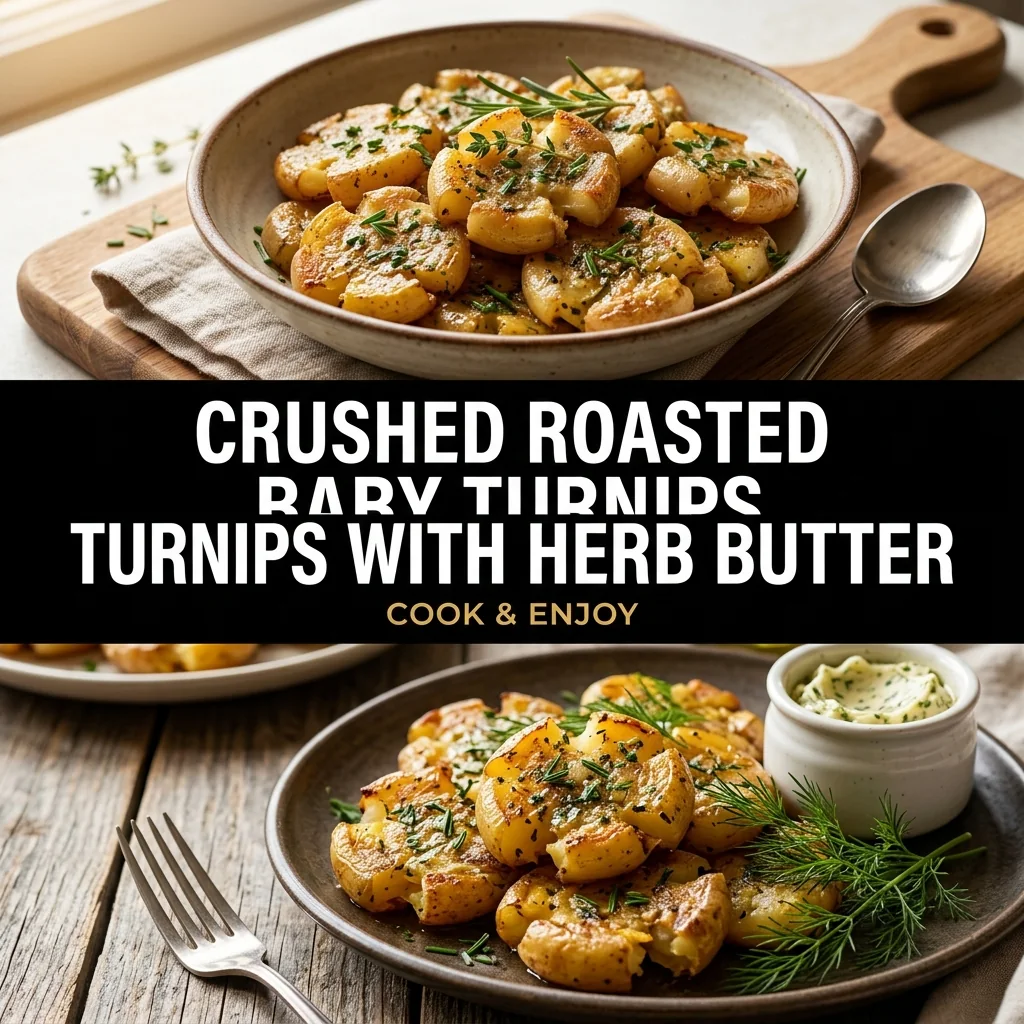
Baby white turnips possess a natural sweetness and delicate peppery bite that changes completely when tenderized and seared. Unlike mature storage turnips, which can lean bitter and fibrous, young roots turn creamy inside while maintaining a firm cell structure that holds up well to gentle parboiling. Crushing them expands their surface area dramatically, providing irregular edges and crevices that catch hot fat in a heavy skillet. Pairing the mild roots with fresh tarragon introduces a subtle anise warmth, balanced by flat-leaf parsley, rich dairy butter, and a final squeeze of lemon juice. This vegetable side delivers textural contrast alongside grilled meats or hearty grain dishes, turning an often-overlooked root crop into an elegant centerpiece.
Selecting and Preparing Baby Turnips
Look for baby turnips that measure no larger than golf balls, with smooth, unblemished skin and firm flesh. Peel them thinly with a standard swivel peeler to remove any exterior bitterness, keeping the spherical shape intact. Uniform size ensures even boiling so no pieces turn mushy while others remain raw in the core. If using turnips of slightly differing sizes, pierce the larger ones with a fork to verify tenderness before draining. Steaming off the excess moisture after boiling is essential for proper skillet browning.
The Crushing Technique
Crushing boiled turnips requires a measured hand to fracture the flesh without pulverizing it. Using a flat-bottomed measuring cup or heavy tumbler allows you to distribute downward force evenly across the root. Stop pressing as soon as the root expands outward to roughly half an inch thick with distinct fissures around its perimeter. These fractures provide additional crisping points during pan-roasting. If a turnip breaks into two large pieces, keep them together in the pan; they will brown crisp and rebind in the herb butter.
Butter Basting and Temperature Control
Cast-iron retains high heat, making it the preferred vessel for searing root vegetables. The initial sear relies on high-smoke-point olive oil, allowing the turnip crust to set before introducing milk solids. The herb butter is added during the final minutes of cooking to coat the crust without scorching the garlic or herbs. Tilting the pan and spooning the foaming butter over the craggy surfaces drives aromatic herb oils into every crevice, producing a rich glaze with a clean, savory finish.
Before you start
Ensure the boiled turnips are completely dry on the outside before pan-roasting. Lingering water creates excess steam in the cast-iron skillet, which prevents the flat surfaces from developing a golden, crisp crust. When crushing, apply slow, even pressure with the glass base so the root spreads without disintegrating into loose chunks. If the pan browns too quickly, reduce the heat to medium to avoid scorching the delicate tarragon and garlic before the undersides become deeply browned.
THE RECIPE
Crushed Roasted Baby Turnips with Herb Butter
4 servings · 15 minutes preparation · 28 minutes cooking · 5 minutes cooling, chilling or resting
Ingredients
Step-by-step instructions
- Bring 3 quarts of water to a rolling boil in a 4-quart saucepan over high heat, then season the water with 1 teaspoon fine sea salt.
- Add 1 1/2 pounds peeled white baby turnips to the boiling water and cook uncovered for 12 to 14 minutes, or until a paring knife glides through the thickest part without resistance.
- Drain the turnips thoroughly in a colander set in the sink and allow them to steam-dry untouched for 5 minutes so surface moisture dissipates.
- Transfer the warm turnips onto a sturdy cutting board and gently press down on each turnip using the flat bottom of a heavy drinking glass until flattened to approximately 1/2-inch thickness without breaking entirely apart.
- In a small bowl, stir together 3 tablespoons softened unsalted butter, 1 1/2 tablespoons minced flat-leaf parsley, 1 tablespoon minced fresh tarragon, 1 finely grated garlic clove, the remaining 1/2 teaspoon fine sea salt, and 1/4 teaspoon ground black pepper.
- Heat 1 tablespoon extra-virgin olive oil in a heavy 12-inch cast-iron skillet over medium-high heat until shimmering.
- Arrange the crushed turnips in a single layer in the hot skillet and cook undisturbed for 5 to 6 minutes, until the bottom crust is deeply browned and crisp.
- Carefully flip each turnip with a thin metal spatula, then spoon the prepared herb butter mixture evenly over the turnips, cooking for an additional 4 to 5 minutes while tilting the pan and basting continuously.
- Remove the skillet from the heat, drizzle with 1 teaspoon fresh lemon juice, and transfer the crushed turnips to a warm serving platter immediately.
Kitchen notes
Ensure the boiled turnips are completely dry on the outside before pan-roasting. Lingering water creates excess steam in the cast-iron skillet, which prevents the flat surfaces from developing a golden, crisp crust. When crushing, apply slow, even pressure with the glass base so the root spreads without disintegrating into loose chunks. If the pan browns too quickly, reduce the heat to medium to avoid scorching the delicate tarragon and garlic before the undersides become deeply browned.
Storage & make-ahead
Allow leftovers to cool slightly, then transfer to an airtight glass container and refrigerate within 2 hours. Store refrigerated for up to 3 days. Reheat in a dry skillet over medium heat for 4 to 5 minutes, or in an oven preheated to 375 F (190 C) for 8 to 10 minutes until heated through to an internal temperature of 165 F (74 C). Avoid freezing, as thawed turnips turn watery and loose.
An original recipe guide inspired by themes in our Pinterest research. Recipe has not been independently kitchen-tested. AI-generated image is illustrative; your finished dish may look different.
Frequently asked questions
Can I use purple-top turnips instead of baby white turnips?
Yes, you can substitute small purple-top turnips. Ensure you peel away the entire purple layer and outer fibrous rim, as larger purple-top varieties carry tougher skins. If the turnips are larger than two inches across, halve them before boiling so they cook through evenly.
Can I make these ahead of time?
You can boil, drain, and crush the turnips up to 24 hours in advance. Store the cooled, crushed roots covered in the refrigerator. When ready to serve, proceed with searing them in the hot skillet, adding an extra minute per side to compensate for their chilled starting temperature.
Why did my turnips fall apart during searing?
Turnips fall apart if they are overboiled or pressed with excessive force. Cook them only until a knife slides cleanly through the center, avoiding a mushy texture. When crushing, apply gentle, steady pressure just until the sides crack, and use a thin spatula to support them when flipping.