WHY MAKE IT
A little comfort, a lot of flavor.
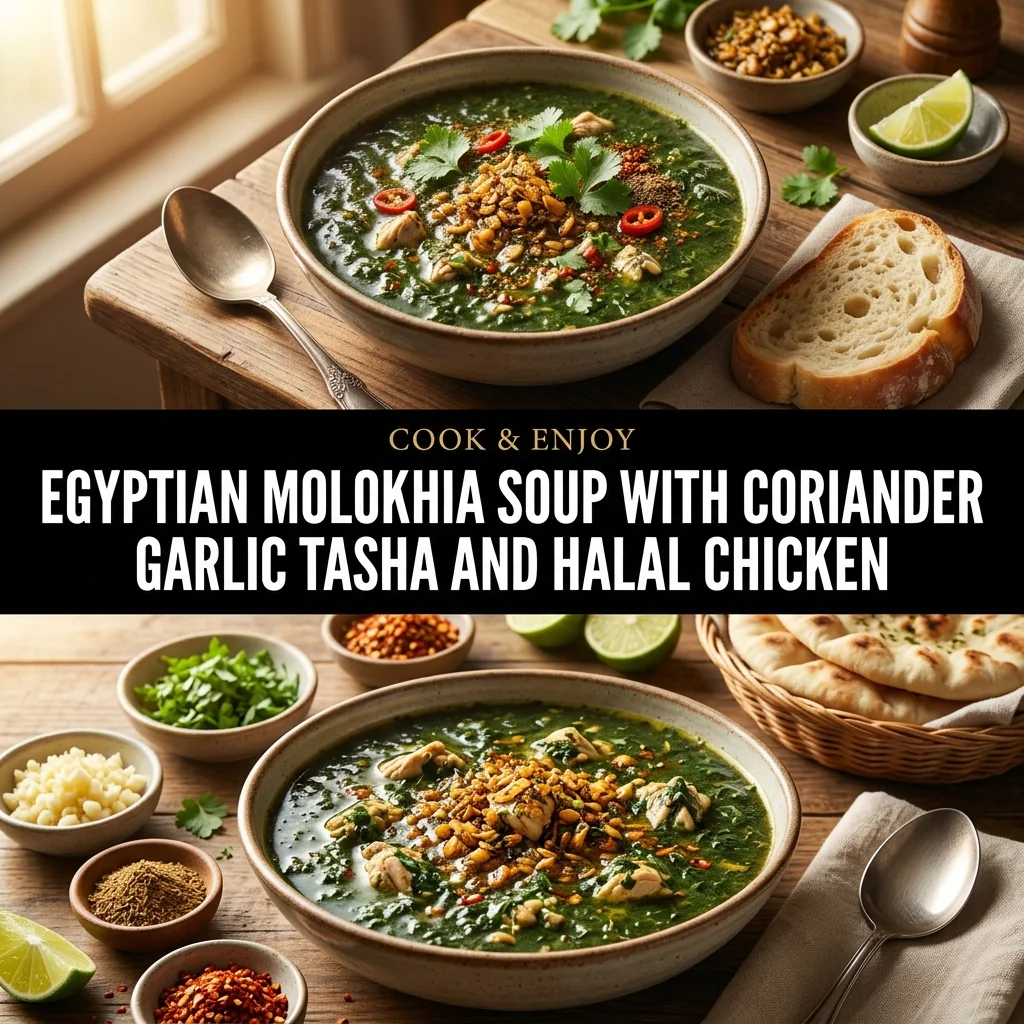
Molokhia is one of Egypt's most cherished culinary treasures, celebrated for centuries across the Nile valley. Prepared from finely minced jute mallow leaves, the soup possesses a uniquely silky, mucilaginous consistency that carries the savory richness of homemade poultry stock. What truly defines this dish is the tasha—a transformative final flourish of minced garlic and freshly ground coriander fried in golden ghee until fragrant, then stirred sizzling into the pot. Served alongside tender poached halal chicken and fluffy white rice, Egyptian molokhia is a comforting, fragrant masterpiece that showcases how simple aromatics, handled with care and traditional technique, create unforgettable depth.
Understanding Molokhia Texture
The signature characteristic of molokhia is its naturally viscous, velvety texture, derived from the soluble fiber within the jute leaves. For newcomers, this mouthfeel is reminiscent of tender okra. To achieve the proper balance, the ratio of broth to minced greens must be precisely controlled. Using too much broth results in a watery soup where the greens float loosely, while using too little produces a heavy paste. Gentle whisking while warming the leaves ensures they integrate seamlessly with the hot poultry broth, creating a cohesive, emerald-green soup that flows smoothly.
The Importance of the Tasha
The aromatic heartbeat of Egyptian molokhia is the tasha. This blooming technique extracts essential oils from finely minced fresh garlic and ground coriander seeds using hot ghee as the carrier. Timing during this phase is paramount: garlic cooks quickly and turns bitter if over-browned. The ground coriander is added during the final thirty seconds of frying, blooming into a nutty, warm aroma. Pouring this sizzling mixture directly into the pot creates an instant dispersion of flavor, infusing the entire soup with an irresistible, savory fragrance.
Crafting the Halal Chicken Stock
Because molokhia leaves are mild and herbaceous, the quality of the underlying poultry broth determines the soup's overall depth. Simmering bone-in halal chicken thighs with whole crushed cardamom, sweet yellow onion, and bay leaves produces an exceptionally clean, fragrant stock. Skimming any impurities during the initial boil keeps the liquid clear and pure. Straining the broth through a fine sieve removes stray particles, guaranteeing that the finished emerald soup looks glossy and uniform when presented at the dining table.
Before you start
Never cover the pot with a lid after adding the molokhia to the broth, and never allow the soup to come to a rolling boil. Covering the pot or boiling violently causes the delicate jute leaves to separate from the broth and drop to the bottom, ruining the signature glossy, cohesive texture. Keep the heat on low and stir gently with a wire whisk.
THE RECIPE
Egyptian Molokhia Soup with Coriander Garlic Tasha and Halal Chicken
4 servings · 20 minutes preparation · 40 minutes cooking · 10 minutes cooling, chilling or resting
Ingredients
Step-by-step instructions
- Combine the chicken thighs, water, onion, crushed cardamom pods, bay leaves, 1 teaspoon salt, and black pepper in a large stockpot over medium-high heat.
- Bring to a boil, skim off any foam that rises to the surface, reduce heat to low, cover, and simmer for 30 minutes until chicken reaches 165°F (74°C).
- Transfer the cooked chicken to a plate, let it rest for 10 minutes, then shred the meat from the bones and set aside warm.
- Strain the stock through a fine-mesh sieve into a bowl, discarding the aromatics, and measure out exactly 3 1/2 cups of clear broth into a clean pot.
- Bring the 3 1/2 cups of broth to a gentle simmer over low heat, whisk in the thawed molokhia, and cook gently for 3 to 4 minutes without letting it boil vigorously.
- Melt the ghee in a small skillet over medium-low heat, add the minced garlic, and sauté for 1 to 2 minutes until fragrant and pale golden.
- Add the ground coriander, ground cumin, and remaining 1/4 teaspoon salt to the skillet, stirring constantly for 30 seconds until the spices sizzle and release a toasted aroma.
- Immediately pour the sizzling garlic-coriander tasha into the simmering molokhia pot, stirring once to incorporate the fragrant oil, and remove from the heat.
- Ladle the soup into serving bowls and present immediately alongside the shredded chicken and warm Egyptian white rice.
Kitchen notes
Never cover the pot with a lid after adding the molokhia to the broth, and never allow the soup to come to a rolling boil. Covering the pot or boiling violently causes the delicate jute leaves to separate from the broth and drop to the bottom, ruining the signature glossy, cohesive texture. Keep the heat on low and stir gently with a wire whisk.
Storage & make-ahead
Cool the molokhia soup promptly and transfer to an airtight container; refrigerate within 2 hours of preparation for up to 2 days. Store the shredded halal chicken in a separate airtight container. To reheat, warm the soup gently over low heat until it reaches at least 165°F (74°C), stirring constantly without covering or boiling.
An original recipe guide inspired by themes in our Pinterest research. Recipe has not been independently kitchen-tested. AI-generated image is illustrative; your finished dish may look different.
Frequently asked questions
Can I use fresh molokhia leaves instead of frozen?
Yes, fresh jute leaves work wonderfully. Wash and thoroughly dry the leaves, then mince them extremely fine using a traditional crescent-shaped double-handled knife (makhrata) until they resemble a glossy puree before whisking them into the hot simmering broth.
Why did my molokhia sink to the bottom of the pot?
Molokhia sinks when the soup is allowed to boil vigorously or when the pot is covered with a lid. Trapped steam condenses and disrupts the suspension of the leaves, causing them to separate from the broth. Keep the heat very gentle and leave the pot uncovered.
What is traditionally served with Egyptian molokhia?
Molokhia is traditionally served alongside warm white Egyptian short-grain rice cooked with toasted vermicelli noodles, the shredded poached chicken, and a side of pickled red onions or lemon wedges to provide a crisp, acidic counterpoint to the rich soup.