WHY MAKE IT
A little comfort, a lot of flavor.
Regarded as Egypt's national comfort food, Koshari is an ingenious, carbohydrate-rich culinary assembly born on the streets of nineteenth-century Cairo. It brings together distinct components—fluffy basmati rice, earthy brown lentils, tender elbow pasta, rich cumin-infused tomato gravy, and fiery, tangy garlic dressing—into one unified platter topped with golden, crisp onions. Although assembling the elements requires orchestrating multiple pans, the culinary logic is straightforward and highly efficient. The aromatic oil rendered from slow-browning the onions forms the seasoning backbone for every subsequent element. The finished dish balances textures, earthy grains, sweet fried onions, and sharp garlic-vinegar brightness in each satisfying forkful, providing a nourishing and completely plant-based feast.
The Strategic Role of Brown Lentils
Brown or green Puy lentils are essential for Koshari because they retain their structural definition through par-cooking and subsequent steaming alongside the rice. Red lentils should never be substituted, as their split hulls quickly disintegrate into puree. Simmering the brown lentils until just tender preserves their toothsome texture. Furthermore, retaining the rich, dark cooking broth to cook the basmati rice infuses the entire grain base with an earthy, savory complexity and a natural mahogany color that unifies the lower layer of the dish.
Building the Tomato and Dakka Sauces
The dish relies on two contrasting sauces for its signature profile: a warm, deeply spiced tomato sauce and a sharp, cold garlic vinegar known as dakka. The tomato sauce derives its rich body from gentle simmering with toasted cumin, coriander, and onion-infused oil. In contrast, the dakka requires no prolonged cooking; raw garlic combines with distilled vinegar, citrusy coriander, and cayenne to deliver an acidic cut. This sharp punch pierces through the rich starches and sweet onions, keeping each hearty bite vivid, refreshing, and balanced.
Layering Mechanics for Optimal Texture
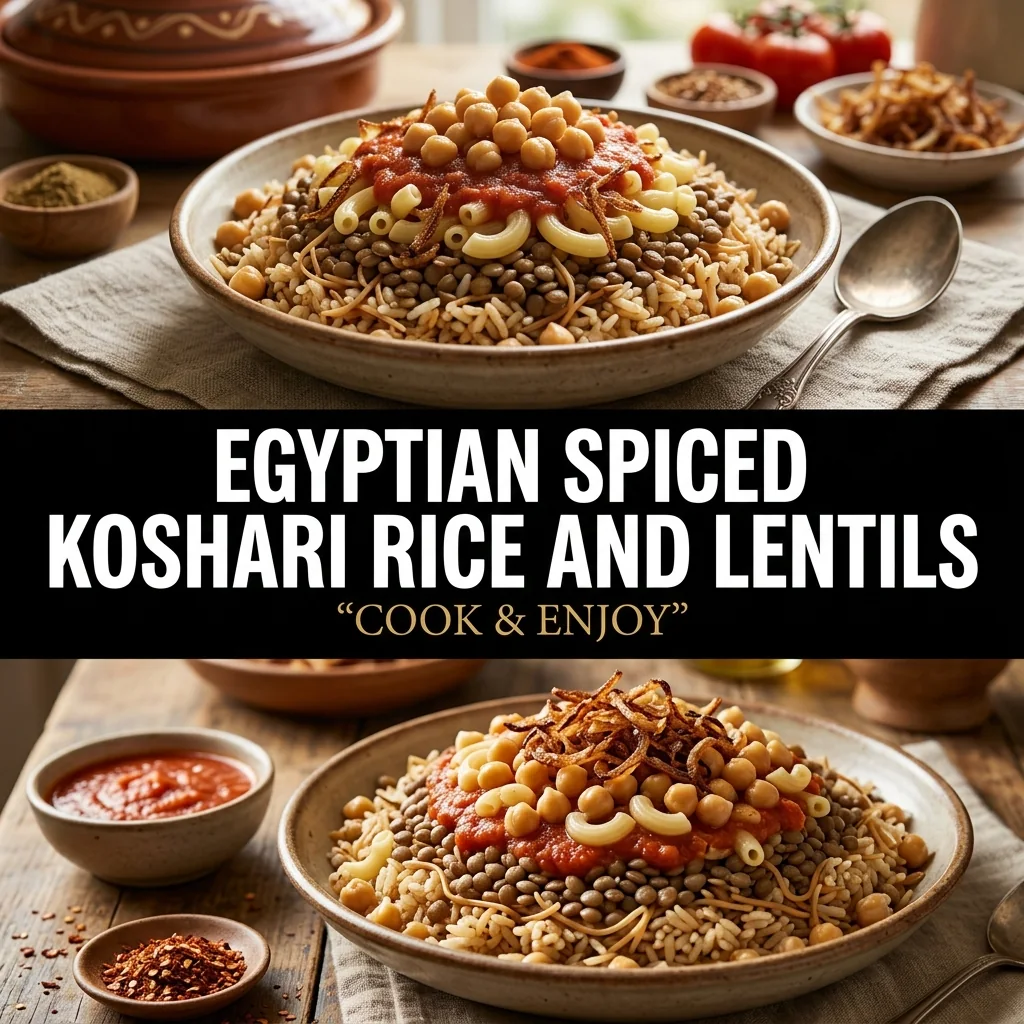
True street-cart Koshari is never stirred together into a uniform hash before serving. Instead, deliberate layering preserves textural diversity. The warm foundation of spiced rice and lentils provides steam and substance; the boiled pasta adds a neutral, chewy bite; the hot tomato sauce blankets the grains; the dakka introduces immediate sharpness; and the crispy onions provide crucial crunch. Tossing the cooked pasta in reserved onion oil prevents it from sticking while introducing flavor. Keep the elements layered until ready to eat to maintain onion crispness.
Before you start
Frying the onions first is central to the entire flavor structure of authentic Koshari. The infused oil left behind carries sweet, savory notes that are systematically reused to coat the boiled pasta, toast the raw basmati rice, and build the tomato sauce. Be patient during onion frying; do not rush the heat, as high temperatures scorch the sugars rather than crisping them gently. Drain the fried onions in a single layer on parchment or paper towels.
THE RECIPE
Egyptian Spiced Koshari Rice and Lentils
6 servings · 25 minutes preparation · 40 minutes cooking · 10 minutes cooling, chilling or resting
Ingredients
Step-by-step instructions
- Heat 1/4 cup neutral vegetable oil in a deep 10-inch skillet over medium heat, add the sliced yellow onions, and fry for 15 to 18 minutes, stirring frequently, until deep golden-brown and crispy; remove with a slotted spoon to drain on paper towels, reserving the fragrant cooking oil.
- Place 1 cup rinsed brown lentils into a medium 3-quart saucepan with 3 cups of water or halal-certified vegetable broth; bring to a boil, then reduce heat to medium-low, cover, and simmer for 15 minutes until tender yet firm.
- Drain the lentils over a measuring bowl, reserving the warm lentil cooking liquid, and set the lentils aside.
- In a separate 4-quart pot, bring 4 cups of salted water to a rolling boil, add 1 cup ditalini pasta, cook for 8 minutes until al dente, drain thoroughly, toss with 1 teaspoon of the reserved onion oil, and set aside.
- Heat 2 tablespoons of the reserved onion oil in a large heavy pot over medium heat, add the 1 1/2 cups drained basmati rice, and toast for 3 minutes; then add the par-cooked lentils, 1 teaspoon cumin, 1/2 teaspoon coriander, 1 teaspoon salt, and 2 1/4 cups of the warm reserved lentil cooking liquid (adding water if needed to reach volume).
- Bring the rice and lentil mixture to a boil, cover tightly, reduce heat to the lowest setting, and simmer for 15 minutes without lifting the lid; remove from heat and allow to rest covered for 10 minutes.
- In a 1-quart saucepan, warm 1 tablespoon of reserved onion oil over medium heat, add half the minced garlic, cook for 1 minute until fragrant, then add the 14 ounces tomato puree, 1 teaspoon cumin, 1/2 teaspoon coriander, 1/2 teaspoon salt, and 2 tablespoons of water; simmer gently for 10 minutes until lightly thickened.
- Prepare the dakka garlic-vinegar dressing by whisking together 1/4 cup white distilled vinegar, 2 tablespoons water, the remaining minced garlic, 1 teaspoon cumin, 1/2 teaspoon coriander, 1/2 teaspoon salt, and 1/2 teaspoon cayenne pepper in a small bowl.
- Assemble by fluffing the warm rice and lentil base, spreading it onto a wide platter, topping with the cooked ditalini pasta, spooning warm cumin tomato sauce over top, drizzling with spicy garlic vinegar, and crowning with the crispy fried onions.
Kitchen notes
Frying the onions first is central to the entire flavor structure of authentic Koshari. The infused oil left behind carries sweet, savory notes that are systematically reused to coat the boiled pasta, toast the raw basmati rice, and build the tomato sauce. Be patient during onion frying; do not rush the heat, as high temperatures scorch the sugars rather than crisping them gently. Drain the fried onions in a single layer on parchment or paper towels.
Storage & make-ahead
Store the components separately in airtight containers in the refrigerator within 2 hours. Keep chilled at 40°F (4°C) or colder for up to 4 days. Reheat the rice, lentils, pasta, and tomato sauce thoroughly until internal temperatures reach 165°F (74°C). Keep fried onions in a paper-lined container at room temperature.
An original recipe guide inspired by themes in our Pinterest research. Recipe has not been independently kitchen-tested. AI-generated image is illustrative; your finished dish may look different.
Frequently asked questions
Can I use store-bought fried onions instead of making them?
While commercial crispy onions save time, you lose the flavorful onion-infused oil used to cook the rice, pasta, and sauce. If using store-bought onions, use neutral vegetable oil for the remaining steps and add a pinch of onion powder.
Is the garlic vinegar sauce strictly necessary?
Yes, dakka is quintessential to Koshari. The stark acidity of the distilled vinegar cuts through the substantial starches and sweet fried onions. Serve it in a small pitcher tableside so diners can regulate their preferred level of tang.
Can I substitute brown rice for basmati rice?
Brown rice requires significantly longer cooking times and more water than par-cooked lentils, disrupting the steaming ratio. Stick with white basmati or long-grain white rice so the grains cook evenly alongside the tender lentils.


