WHY MAKE IT
A little comfort, a lot of flavor.
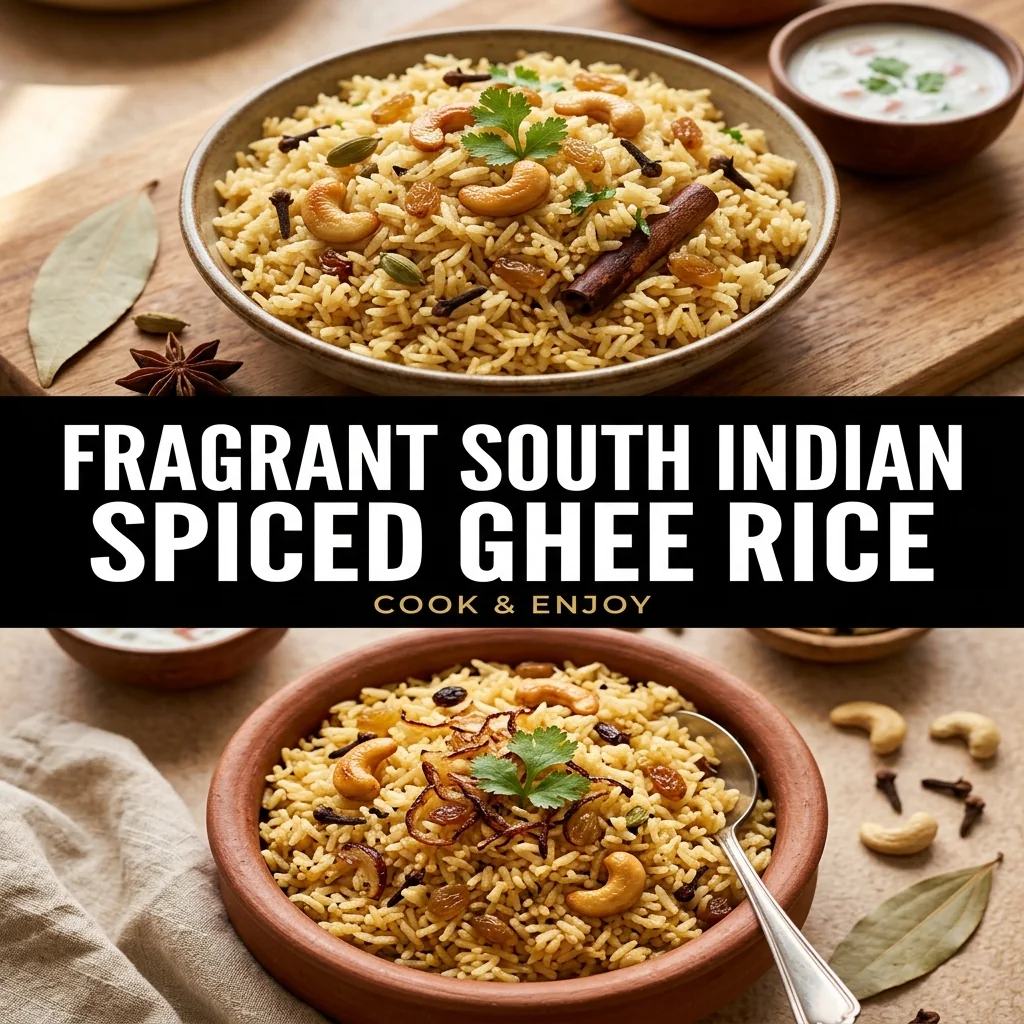
Celebrated across the Malabar coast of South India, traditional Neychoru, or ghee rice, transforms simple pantry staples into an intensely aromatic feast. Unlike everyday steamed rice, this regional specialty relies on small-grained, highly aromatic Kaima rice. Gently toasted in golden cow ghee, each delicate grain absorbs the nuanced warmth of whole green cardamom pods, pungent cloves, sweet Ceylon cinnamon, and fragrant bay leaves. The cooking process is quiet and precise, relying on measured boiling water and gentle trapped steam to produce separate, tender grains without excess moisture. Finished with crisp, slow-fried sweet onions, toasted buttery cashew nuts, and sweet, plump sultanas, this luxurious rice dish provides the classic foundation for pairing with rich halal curries and spiced gravies.
The Essence of Kaima Rice and Pure Ghee
Authentic Malabar ghee rice owes its signature profile to Kaima rice, also called Jeerakasala. This tiny aromatic grain cooks faster than standard basmati and carries a naturally buttery aroma that complements pure dairy fat. Pure cow ghee is non-negotiable; its rich milk solids and high smoke point allow whole spices to bloom without burning. The clarified fat coats each individual grain of rice during the initial sauté, sealing the starch exterior so the grains remain distinct, glossy, and separate after gentle steaming rather than fusing together into clumps.
The Art of the Fried Garnish (Bista)
The sweet and savory topping provides essential textural counterpoint to the soft, fragrant rice beneath. Thin, uniform onion slices must be fried patiently over moderate heat in ghee until moisture evaporates and natural sugars caramelize into deep amber tones. Removing half the onions alongside quickly blistered cashews and plumped golden raisins preserves their crispness. The remaining caramelized onions dissolve into the cooking fat, infusing the water and rice with subtle, savory depth that permeates throughout the entire pot as the dish simmers.
Steaming and Resting Precision
Cooking short aromatic grains demands exact liquid-to-rice ratios. Because Kaima rice is delicate, a ratio of 1.75 cups boiling liquid to 1 cup dry rice produces tender grains without waterlogging. Adding lemon juice not only brightens the rich ghee notes but also strengthens starch structure, keeping the grains pale and separate. Once the pot is removed from the flame, keeping the lid sealed for 15 minutes allows residual interior steam to fully gelatinize remaining starch cores, ensuring completely even texture throughout.
Before you start
Kaima (also sold as Jeerakasala) is a small, fragrant short-grain rice prized across Kerala for making authentic Malabar ghee rice (Neychoru). Its delicate starches can break easily if handled roughly. Sauté the dry, drained grains gently in the hot spiced ghee using a silicone spatula rather than a harsh metal spoon. Ensure the water added is at a vigorous rolling boil; pouring cold water into hot ghee-coated grains shocks the rice, resulting in uneven water absorption and sticky, ruptured grains.
THE RECIPE
Fragrant South Indian Spiced Ghee Rice
6 servings · 20 minutes preparation · 25 minutes cooking · 15 minutes cooling, chilling or resting
Ingredients
Step-by-step instructions
- Rinse the Kaima rice gently in several changes of cold water until the runoff is clear, then drain completely in a colander for 15 minutes.
- Heat 2 tablespoons pure cow ghee in a heavy 4-quart Dutch oven or wide saucepan over medium heat.
- Add the raw cashews to the hot ghee, frying for 1 to 2 minutes until golden, remove with a slotted spoon; add golden raisins, frying for 30 seconds until puffed, and set aside with the nuts.
- Add the thinly sliced yellow onion to the remaining ghee in the pot and fry slowly over medium-low heat for 10 to 12 minutes, stirring continuously until deep golden brown and crisp; remove half for garnish.
- Add the remaining 2 tablespoons ghee to the pot with the remaining caramelized onions, increasing heat to medium.
- Drop in the crushed cardamom pods, cloves, cinnamon stick, and bay leaf, sizzling the whole spices for 1 minute until fragrant.
- Add the ginger-garlic paste and drained Kaima rice, sautéing gently for 3 minutes until every grain is coated in ghee and looks translucent.
- Pour in 3.5 cups of boiling water, sea salt, and fresh lemon juice, stirring once to distribute the seasonings evenly.
- Bring to a rapid boil, cover with a tight-fitting lid, lower the heat to the absolute lowest setting, and cook undisturbed for 10 minutes.
- Remove the pan from the heat source and let it rest undisturbed with the lid on for 15 minutes to finish steaming.
- Gently fluff the spiced rice using a flat paddle or fork, transfer to a wide serving platter, and garnish with the reserved fried onions, toasted cashews, and plump golden raisins.
Kitchen notes
Kaima (also sold as Jeerakasala) is a small, fragrant short-grain rice prized across Kerala for making authentic Malabar ghee rice (Neychoru). Its delicate starches can break easily if handled roughly. Sauté the dry, drained grains gently in the hot spiced ghee using a silicone spatula rather than a harsh metal spoon. Ensure the water added is at a vigorous rolling boil; pouring cold water into hot ghee-coated grains shocks the rice, resulting in uneven water absorption and sticky, ruptured grains.
Storage & make-ahead
Cool remaining ghee rice to room temperature within 2 hours and transfer to an airtight container. Refrigerate for up to 3 days. When reheating, place the rice in a covered saucepan with 1 to 2 tablespoons of water or extra melted ghee over low heat, steaming until the internal temperature reaches 165 F / 74 C throughout. Fried nuts and onions soften in the fridge but can be crisped in a toaster oven.
An original recipe guide inspired by themes in our Pinterest research. Recipe has not been independently kitchen-tested. AI-generated image is illustrative; your finished dish may look different.
Frequently asked questions
Can I substitute basmati rice if Kaima rice is unavailable?
Yes, white basmati rice can be used. Increase the boiling water slightly to 3.75 cups for 2 cups of basmati, and simmer covered on low for 12 minutes instead of 10 before resting.
Why is boiling water required instead of cold tap water?
Adding boiling water maintains the Dutch oven's high cooking temperature instantly, allowing the rice to boil and set immediately. Cold water drops pan temperature, causing grains to soak and become mushy.
Can I make this dish using butter instead of ghee?
Ghee is strongly recommended because its milk solids have been removed, preventing burning during frying. If using unsalted butter, keep heat very low so milk solids do not scorch while blooming spices.


