WHY MAKE IT
A little comfort, a lot of flavor.
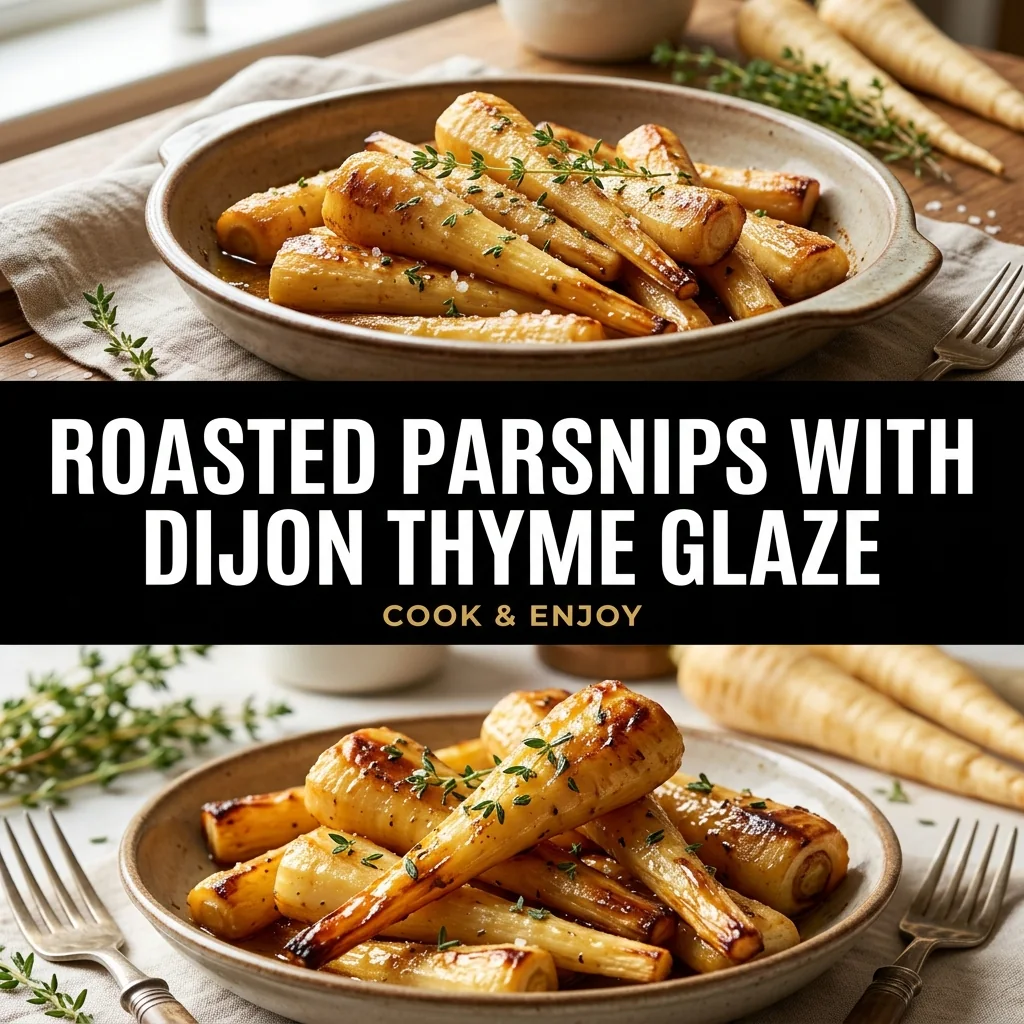
Parsnips are among the most rewarding winter root vegetables, possessing high natural starch levels that convert into concentrated, caramel sweetness under steady oven heat. While frequently relegated to soups or mashed mixtures, roasting them in long batons highlights their pleasant earthy perfume and tender, velvety interior. The challenge with parsnips lies in managing their intense sugar content so they do not taste cloying. This recipe solves that balance by tossing the raw roots in a zesty glaze of whole-grain Dijon mustard, sharp apple cider vinegar, fragrant fresh thyme, and pure maple syrup. The mustard seeds pop against the tender flesh, providing savory punctuation to every bite.
Selecting Parsnips and Managing the Core
When purchasing parsnips, seek out medium-sized roots that feel heavy and firm along their entire length. Giant parsnips may look impressive, but they contain a woody, fibrous central cylinder that does not soften during baking. If you are using larger roots, trim away that fibrous core before glazing. Peeling parsnips right before preparation prevents their pale flesh from oxidizing when exposed to air. Cutting them into even, three-inch-long batons allows hot air to circulate freely around each piece, promoting even browning and crisp, caramelized edges.
The Function of Mustard and Vinegar in the Glaze
Parsnips have a naturally high sugar content that intensifies as water evaporates during the roasting process. Pairing them with a sharp dressing brings necessary balance. Whole-grain Dijon mustard introduces pungent mustard oils and textural seeds, while raw apple cider vinegar provides an acidic counterpoint that cuts through the starch. A single tablespoon of pure maple syrup rounds out the sharp vinegar, creating a stable medium that adheres to the raw parsnips and browns gradually in the oven without charring into bitter carbon before the interior cooks through.
Oven Airflow and Pan Management
Roasting root vegetables requires adequate space between every cut piece on the sheet pan. If parsnips are piled atop one another, the steam released from their interiors will become trapped, resulting in boiled, limp batons lacking deep flavor. Use a large half-sheet pan, lining it with unbleached parchment paper. Parchment prevents the mustard seeds and maple glaze from sticking aggressively to the pan metal, allowing you to flip the batons cleanly halfway through the cooking cycle without tearing their caramelized exterior crust.
Before you start
Large, mature parsnips often hide a fibrous, woody central core that remains tough even after extensive roasting. When cutting your batons, slice down alongside the central core on the thick half of the root and discard that pale interior dowel. Uniformity in baton thickness ensures that every piece roasts evenly; thin tips will scorch while thicker wedges remain unpleasantly crunchy if the sizing varies dramatically across the sheet pan.
THE RECIPE
Roasted Parsnips with Dijon Thyme Glaze
4 servings · 20 minutes preparation · 35 minutes cooking · 5 minutes cooling, chilling or resting
Ingredients
Step-by-step instructions
- Preheat the oven to 400°F (204°C) with an oven rack positioned in the center.
- Line a heavy 18x13-inch rimmed sheet pan with parchment paper to prevent the mustard glaze from sticking.
- Prepare the 2 pounds of parsnips by trimming the ends, peeling the outer skin, and slicing the roots into uniform batons roughly 3 inches long and 1/2 inch wide; cut away and discard any hard, woody inner cores from the wider end of large roots.
- In a large mixing bowl, whisk together the 3 tablespoons olive oil, 2 tablespoons whole-grain Dijon mustard, 1 tablespoon maple syrup, 1 tablespoon apple cider vinegar, 1 tablespoon fresh thyme leaves, 2 minced garlic cloves, 1 teaspoon kosher salt, and 1/2 teaspoon black pepper until emulsified.
- Add the prepared parsnip batons to the bowl and toss thoroughly using clean hands or silicone tongs, ensuring every baton is coated in the mustard glaze.
- Arrange the parsnips onto the prepared sheet pan in a single, well-spaced layer, ensuring the pieces do not overlap so they roast rather than steam.
- Roast at 400°F (204°C) for 20 minutes, then remove the pan from the oven and carefully turn the batons using a thin metal spatula to brown a second side.
- Return the pan to the oven and roast for an additional 12 to 15 minutes, until the parsnips are fork-tender, blistered on the corners, and caramelized along the glazed edges.
- Remove from the oven, rest for 5 minutes on the sheet pan, transfer to a warm serving platter, scatter the 1 tablespoon chopped fresh parsley over top, and serve.
Kitchen notes
Large, mature parsnips often hide a fibrous, woody central core that remains tough even after extensive roasting. When cutting your batons, slice down alongside the central core on the thick half of the root and discard that pale interior dowel. Uniformity in baton thickness ensures that every piece roasts evenly; thin tips will scorch while thicker wedges remain unpleasantly crunchy if the sizing varies dramatically across the sheet pan.
Storage & make-ahead
Refrigerate leftovers within two hours of baking in an airtight glass container for up to 4 days. To reheat while reviving their caramelized edges, place the parsnips on a baking sheet lined with foil and warm in a preheated 375°F (190°C) oven for 8 to 12 minutes until heated through to an internal temperature of 165°F (74°C). Microwave reheating is safe but will soften the caramelized crust into a uniform limpness. Freezing is not advised due to texture loss.
An original recipe guide inspired by themes in our Pinterest research. Recipe has not been independently kitchen-tested. AI-generated image is illustrative; your finished dish may look different.
Frequently asked questions
What makes whole-grain Dijon mustard better here than smooth Dijon?
Whole-grain Dijon contains whole, coarse mustard seeds that toast lightly in the oven heat, adding a pleasant tactile pop and robust rustic flavor. Smooth Dijon works well for flavor, but it lacks the visual interest and textural crunch of the whole seeds.
Can I mix parsnips with carrots in this recipe?
Yes, parsnips and carrots make a classic pairing because their roasting times and cellular densities are nearly identical. Cut them to matching dimensions so both root vegetables achieve fork tenderness and caramelization simultaneously.
Can I use dried thyme instead of fresh?
Fresh thyme provides bright, lemony-herbal essential oils that complement the earthy root vegetable. If substituting dried thyme, reduce the amount to 1 teaspoon, as dried herbs have concentrated intensity and can taste medicinal if overused.