WHY MAKE IT
A little comfort, a lot of flavor.
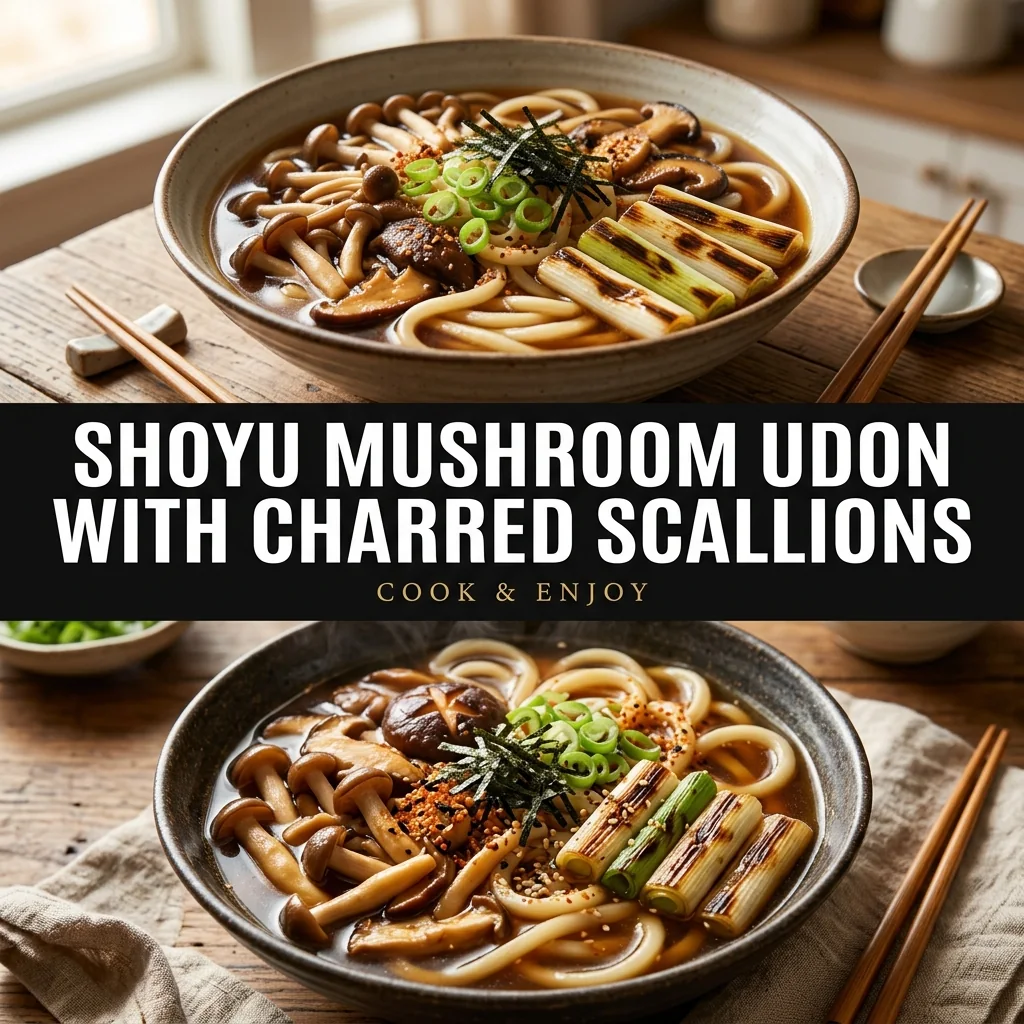
Shoyu Mushroom Udon with Charred Scallions is a soothing, deeply restorative Japanese noodle soup that highlights the unmatched earthiness of wild and cultivated fungi. Centered on a robust plant-based dashi crafted from dried kombu kelp and sun-dried shiitake caps, the clear broth provides a savory backbone that avoids non-halal brewing ingredients like mirin or sake. Thick, bouncy Sanuki udon strands provide satisfying heft, contrasting with the tender meaty chew of pan-seared king oyster mushrooms and the delicate crunch of enoki. Charring whole scallion segments over high cast-iron heat unlocks sweet, smoky allium oils that perfume the entire bowl.
Building Alcohol-Free Umami Broth
Traditional Japanese noodle broths frequently incorporate mirin or cooking sake for sweetness and depth. In this strictly halal preparation, rich umami is built through natural glutamate and guanylate synergies between dried kombu kelp and sun-dried shiitake mushrooms. Bringing cold water slowly to a simmer extracts clean marine minerals without extracting the bitter tannins of over-boiled seaweed. A small measure of pure cane sugar balances the savory punch of naturally fermented halal shoyu, while fresh grated ginger adds clean, sharp warmth to the aromatic finish.
Achieving Proper Mushroom Sear
King oyster mushrooms possess dense cellular walls that behave remarkably like steak when subjected to high dry heat. Scoring the surfaces in a diagonal crosshatch pattern serves two functions: it breaks the tough surface tension to promote even heat penetration, and it creates crevices that capture charred oils. Cooking them undisturbed in a smoking cast-iron skillet draws out moisture before rapidly caramelizing the exterior. Adding the enoki raw directly into the hot serving broth softens their slender stalks while retaining pleasant textural bite.
Noodle Texture and Assembly
The defining characteristic of excellent udon is 'koshi'—a springy elasticity that yields cleanly to the tooth. Frozen Sanuki udon requires only brief submersion in boiling water to loosen the noodles without compromising starch integrity. Draining the noodles thoroughly prevents residual water from diluting the delicate seasoned broth. Assembling the bowls immediately ensures the hot dashi warms the raw enoki and blooms the sesame seeds, delivering balanced temperatures across both solid toppings and liquid base.
Before you start
Always opt for frozen Sanuki udon over vacuum-packed dry varieties whenever possible. Frozen udon noodles are flash-frozen immediately after kneading and cutting, preserving their signature chewy 'koshi' texture that cannot be replicated by dried alternatives. When searing the scallions and king oyster mushrooms, use high heat and avoid crowding the skillet. Allowing the alliums to char deeply imparts a smoky nuance that replaces traditional alcohol-based cooking accents seamlessly.
THE RECIPE
Shoyu Mushroom Udon with Charred Scallions
4 servings · 20 minutes preparation · 25 minutes cooking · 5 minutes cooling, chilling or resting
Ingredients
Step-by-step instructions
- Combine the dried kombu, dried shiitake mushrooms, and 6 cups of cold water in a 4-quart saucepan; let stand at room temperature for 15 minutes to infuse.
- Place the saucepan over medium-low heat and bring slowly to a gentle simmer; remove the kombu just before the water begins to bubble vigorously, then reduce heat to low and simmer the shiitakes gently for 15 minutes.
- Strain the broth through a fine-mesh sieve into a clean bowl, discarding the shiitake stems and reserving the caps for garnish if desired; return the clear liquid to the saucepan, stir in the shoyu, sugar, and grated ginger, and maintain on low heat.
- Heat 1 tablespoon of neutral oil and the toasted sesame oil in a 12-inch cast-iron skillet over medium-high heat until shimmering, arrange the scallion lengths in a single flat layer, and sear undisturbed for 3 minutes until blistered and deeply charred; transfer to a plate.
- Add the remaining tablespoon of neutral oil to the same skillet, score the king oyster mushroom slices in a light crosshatch pattern, and sear for 3 to 4 minutes per side until golden brown and tender; remove and keep warm alongside the charred scallions.
- Add the trimmed enoki mushrooms to the simmering shoyu broth and cook thoroughly until piping hot and tender, at least 3 minutes. In a separate pot, boil the frozen udon according to package directions, then drain.
- Divide the hot drained udon noodles among four deep ceramic soup bowls, ladle the piping hot shoyu dashi broth generously over the noodles, arrange the seared king oyster mushrooms, charred scallions, and thoroughly cooked enoki mushrooms on top, and finish each bowl with a sprinkle of toasted sesame seeds before serving immediately.
Kitchen notes
Always opt for frozen Sanuki udon over vacuum-packed dry varieties whenever possible. Frozen udon noodles are flash-frozen immediately after kneading and cutting, preserving their signature chewy 'koshi' texture that cannot be replicated by dried alternatives. When searing the scallions and king oyster mushrooms, use high heat and avoid crowding the skillet. Allowing the alliums to char deeply imparts a smoky nuance that replaces traditional alcohol-based cooking accents seamlessly.
Storage & make-ahead
Store leftover broth, noodles, and mushroom toppings in separate airtight containers in the refrigerator within 2 hours. Keep chilled for up to 3 days. To reheat, warm the broth in a saucepan until it reaches a vigorous boil at 165 F / 74 C, place the noodles in a strainer and drop into the hot broth for 1 minute to heat through, then top with the warmed mushrooms.
An original recipe guide inspired by themes in our Pinterest research. Recipe has not been independently kitchen-tested. AI-generated image is illustrative; your finished dish may look different.
Frequently asked questions
Why must the kombu be removed before the water boils?
Kombu contains bitter tannins and mucilage that leach into the liquid at high temperatures. Removing the kelp just before the water hits a rolling boil preserves a sweet, clean broth and avoids an unpleasant, slimy mouthfeel.
Can I use button mushrooms instead of king oyster?
Cremini or portobello mushrooms can substitute for king oyster mushrooms in an emergency. However, king oysters provide a uniquely dense, chewy texture and flat surface area ideal for searing that standard button varieties cannot match.
How do I ensure my soy sauce is halal-certified?
Select Japanese-style shoyu that carries a certified halal logo on the packaging. Naturally brewed soy sauces can develop trace residual alcohol during fermentation; halal-certified brands monitor production to comply strictly with permissible zero-intoxicant thresholds.


