WHY MAKE IT
A little comfort, a lot of flavor.
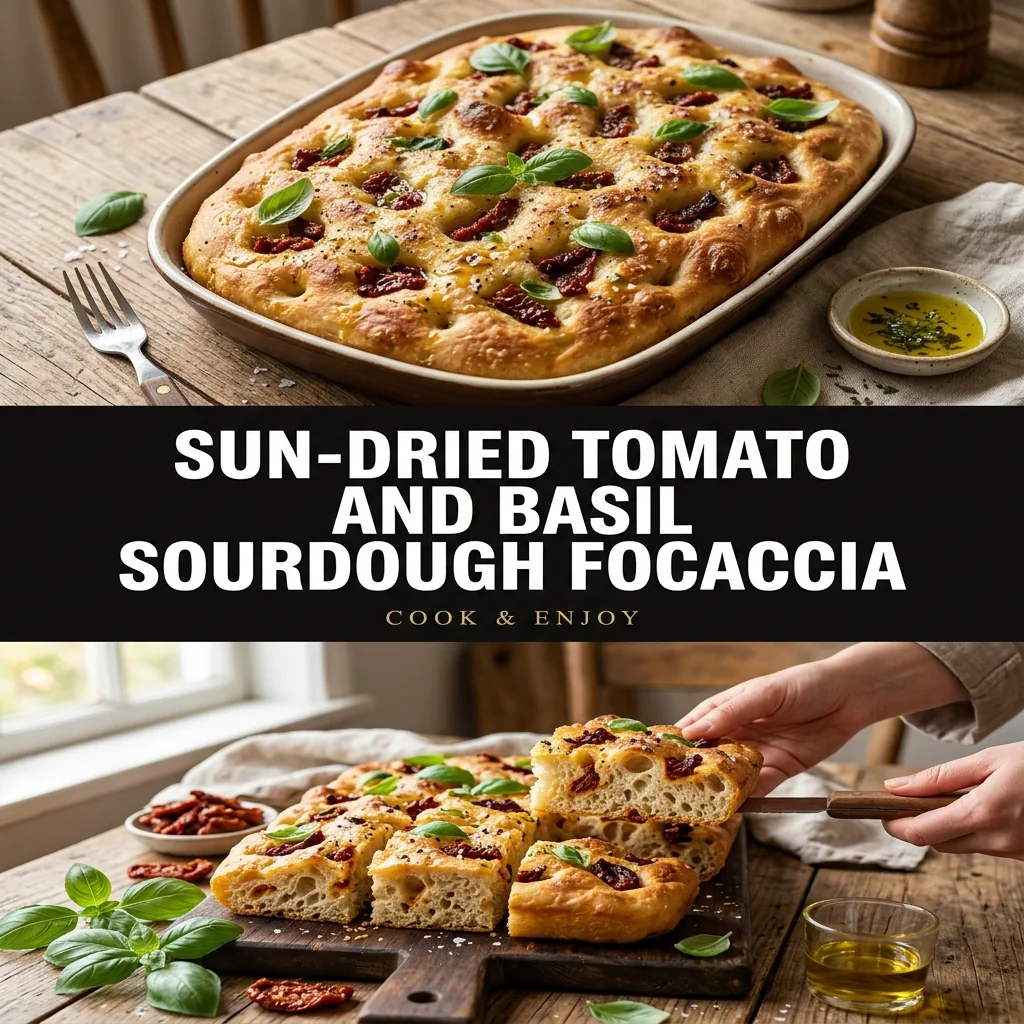
True sourdough focaccia demonstrates how long wild-yeast fermentation transforms modest pantry staples into an airy, aromatic flatbread. This version pairs an open, bubbly crumb with rich extra-virgin olive oil, sweet sun-dried tomatoes, and fresh basil leaves. Naturally leavened dough produces subtle lactic tang that cuts through the generous olive oil bath used to crisp the bottom crust. As the focaccia bakes, oil-cured tomatoes sink into deep finger dimples, infusing pockets of concentrated umami directly into the moist crumb. Fresh basil scattered immediately after baking perfumes the hot crust without scorching delicate aromatic oils, resulting in a vibrant centerpiece suitable for antipasto platters or everyday dipping.
Managing Sourdough Hydration
This dough formula runs at an 80 percent hydration level, which produces the signature gelatinized, open-celled crumb characteristic of authentic Italian focaccia. Strong bread flour with a high protein content (12.5 to 13 percent) is necessary to absorb this quantity of water and retain tensile strength throughout fermentation. Performing gentle stretch-and-folds during the first two hours aligns gluten strands without crushing delicate gas pockets, building the elastic scaffolding required to hold large aeration bubbles.
Pan Preparation and Bottom Crust
A light-colored heavy-gauge aluminum or seasoned steel 9x13-inch pan provides ideal thermal conductivity for baking focaccia. Generously coating the pan with 30 milliliters of good-quality extra-virgin olive oil prevents sticking while essentially shallow-frying the bottom crust as the dough heats up in the oven. This creates a crisp, golden underside that offers a satisfying textural contrast against the soft, pillowy, oil-infused interior crumb.
Preserving Herb and Tomato Flavors
Sun-dried tomatoes packed in olive oil provide rich depth, but their concentrated natural sugars can burn if exposed to intense overhead heating elements. Tucking tomato strips directly into the dough dimples shields them from dry convective heat. Dividing the fresh basil—baking half under the oil layer and finishing with fresh leaves when the focaccia emerges hot—balances deep cooked herb undertones with bright, fragrant essential oils.
Before you start
Press your oiled fingers firmly all the way to the bottom of the pan when creating focaccia dimples. If you only press halfway into the dough, the air bubbles will push your sun-dried tomatoes and basil upward during the oven spring, causing delicate toppings to scorch under direct heat. Pushing tomatoes down into the deep dimpled valleys shields them while infusing their savory tomato oil directly into the surrounding crumb.
THE RECIPE
Sun-Dried Tomato and Basil Sourdough Focaccia
12 servings · 30 minutes preparation · 25 minutes cooking · 390 minutes cooling, chilling or resting
Ingredients
Step-by-step instructions
- In a large glass or ceramic mixing bowl, whisk together 100 g active sourdough starter and 320 ml lukewarm water until dissolved and milky. Add 400 g bread flour and 8 g fine sea salt, stirring with a wooden spoon for 2 minutes until a shaggy wet dough forms.
- Cover the bowl with a damp cloth and let rest for 30 minutes at room temperature for autolyse. Perform four sets of stretch-and-folds directly in the bowl spaced 30 minutes apart over the next 2 hours (120 minutes), incorporating 15 ml olive oil during the final fold.
- Let the dough complete its bulk fermentation undisturbed at room temperature (72°F to 75°F / 22°C to 24°C) for an additional 90 minutes until aerated, domed, and displaying visible surface bubbles (total initial ferment: 240 minutes).
- Pour 30 ml extra-virgin olive oil into a 9x13-inch rimmed metal baking pan, coating the bottom and sides thoroughly. Gently tip the aerated dough into the oiled pan without punching down or deflating the structure.
- Gently stretch the dough toward the pan corners using oiled fingertips. Cover the pan loosely with an inverted sheet pan or plastic tent and let proof at room temperature for 120 minutes until the dough fills the pan corners and jiggles like gelatin when shaken.
- Preheat the oven to 425°F (218°C). Drizzle remaining 15 ml olive oil over the surface of the risen dough. Evenly scatter 75 g drained sun-dried tomato strips and half of the fresh basil leaves (about 8 g) across the top.
- Oil your fingers thoroughly, press straight down into the dough until your fingertips touch the metal base of the pan, and wiggle fingers slightly to create deep dimples across the entire surface, ensuring toppings settle safely into the dimples.
- Sprinkle evenly with 4 g flaky sea salt. Bake on the middle rack at 425°F (218°C) for 22 to 25 minutes until the crust is golden brown, the bottom is crisp, and internal temperature reads 205°F (96°C).
- Remove from oven, transfer focaccia onto a wire cooling rack using a metal spatula to preserve a crisp bottom crust, scatter remaining 7 fresh basil leaves over the hot bread, and let cool for 30 minutes before slicing into 12 squares.
Kitchen notes
Press your oiled fingers firmly all the way to the bottom of the pan when creating focaccia dimples. If you only press halfway into the dough, the air bubbles will push your sun-dried tomatoes and basil upward during the oven spring, causing delicate toppings to scorch under direct heat. Pushing tomatoes down into the deep dimpled valleys shields them while infusing their savory tomato oil directly into the surrounding crumb.
Storage & make-ahead
Cool briefly, then refrigerate in a sealed container within 2 hours for up to 3 days. Freeze tightly wrapped baked portions for up to 2 months. Reheat in a 350 F (177 C) oven until hot throughout and the center reaches 165 F (74 C).
An original recipe guide inspired by themes in our Pinterest research. Recipe has not been independently kitchen-tested. AI-generated image is illustrative; your finished dish may look different.
Frequently asked questions
Can I use commercial yeast instead of active sourdough starter?
Yes. If converting to commercial yeast, replace the 100 g starter with 50 g flour and 50 ml water added to the base recipe, plus 4 g instant yeast. Proofing times will decrease significantly to approximately 90 minutes total.
Why did my focaccia turn out flat and dense instead of airy?
Dense focaccia usually points to an under-active sourdough starter or insufficient final pan proofing. Ensure your starter is bubbly and fully doubled before mixing, and let the dough proof in the pan until visibly puffed and aerated.
How do I prevent the bottom crust from sticking to the baking pan?
Always use a metal pan rather than glass or ceramic, and apply the full measured olive oil across the bottom and sides. Alternatively, line the bottom with a sheet of parchment paper under the olive oil for effortless release.