WHY MAKE IT
A little comfort, a lot of flavor.
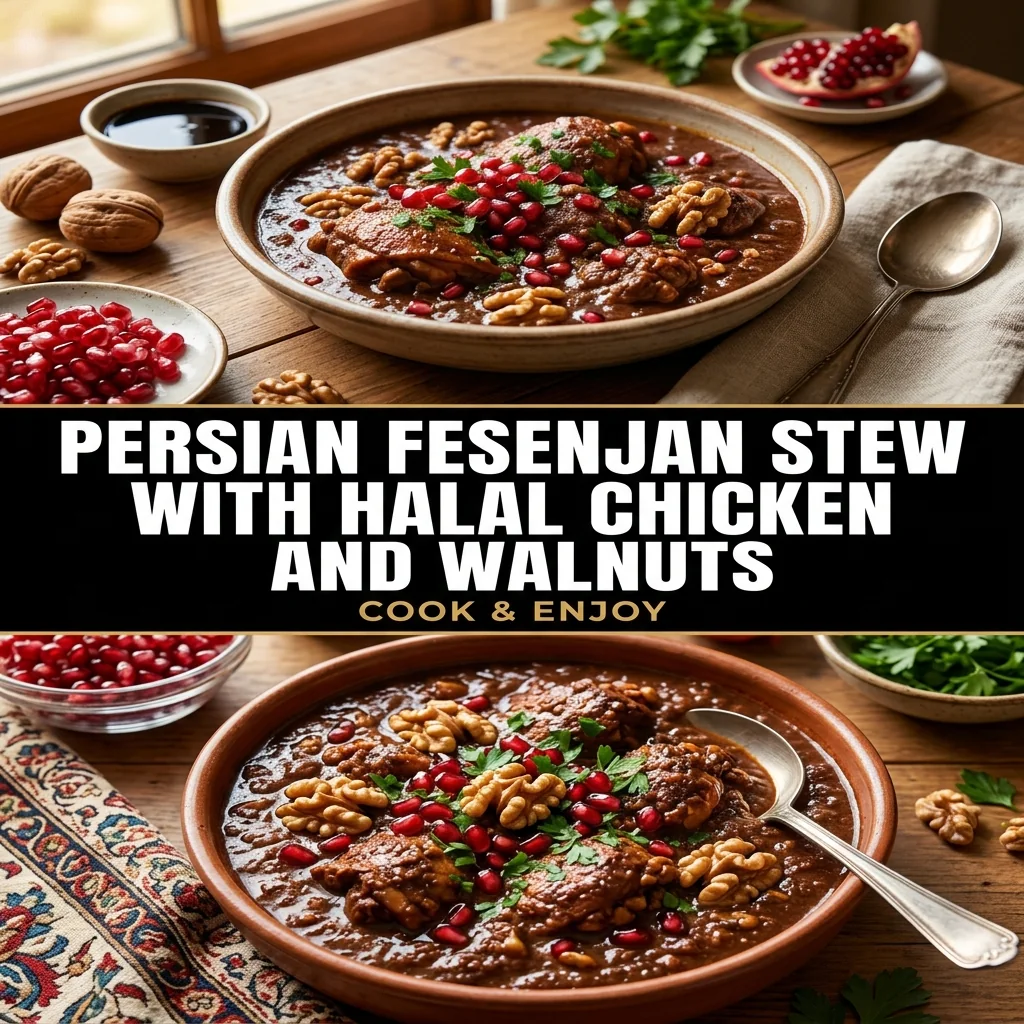
Fesenjan stands as one of the crown jewels of traditional Persian culinary heritage, famous for its luxurious contrast of toasted walnuts and tart pomegranate molasses. When ground walnuts simmer gently over an extended period, their natural oils emulsify into a dark, velvety sauce with an earthy backbone. Bone-in halal chicken absorbs these complex juices, becoming succulent and tender. The signature sweet-and-sour profile, known in Persian cuisine as malas, depends on the balance between your pomegranate molasses and a touch of sweetness. Rich and deeply comforting, this stew is traditionally served over buttery saffron basmati rice with tahdig, making it an extraordinary centerpiece for family gatherings.
Grinding and Toasting Walnuts
The foundation of an exceptional Fesenjan lies in properly handling the walnuts. Toasting them in a dry pan awakens their natural volatile oils and tempers raw bitterness. When pulsing the nuts in a food processor, work in short bursts. The goal is an extremely fine meal with tiny pebbled grains rather than a smooth, oily nut butter. This fine texture allows the walnuts to melt gradually into the simmering liquid, transforming over an hour into an opulent, rich gravy that drapes smoothly over poultry.
Achieving the Authentic Malas Balance
Pomegranate molasses varies significantly across brands, ranging from intensely puckering and sharp to mellow and sweet. Authentic Fesenjan aims for a balanced sweet-and-tart harmony. Taste your pomegranate molasses before adding it to the pot. If the molasses is exceptionally sour, stir in one to two tablespoons of granulated sugar near the end of braising to soften the edge. The finished stew should present a complex interplay where nutty walnut richness, sharp fruit acid, and mild sweetness complement one another seamlessly.
Slow Simmering Technique
Patience is critical when braising Fesenjan. The stew starts as a pale, soupy mixture but darkens into a deep mahogany as the walnuts cook down and release their rich oils. Using bone-in chicken thighs adds gelatin and structure to the sauce while guaranteeing the meat stays moist throughout the extended cook. Keep the Dutch oven covered over the lowest possible burner flame, checking periodically to stir the bottom. This prevents the dense walnut solids from adhering or charring against the metal surface.
Before you start
Adding cold water in separate stages is an authentic Persian technique that draws the natural oils out of the ground walnuts, yielding a luxurious, glossy stew. Simmering on low heat is essential because ground nuts catch and burn easily on the bottom of the pan. Stir down to the base every 10 to 12 minutes with a wooden flat-edged spatula, adjusting heat to the lowest setting to maintain a slow, gentle bubble.
THE RECIPE
Persian Fesenjan Stew with Halal Chicken and Walnuts
4 servings · 25 minutes preparation · 90 minutes cooking · 10 minutes cooling, chilling or resting
Ingredients
Step-by-step instructions
- Place the raw walnut halves in a wide dry skillet over medium-low heat and toast for 5 to 7 minutes, shaking frequently, until fragrant without scorching.
- Transfer the toasted walnuts to a food processor and pulse repeatedly until finely ground into a crumbly, coarse paste, stopping before it turns to butter.
- Heat the olive oil in a 5-quart heavy-bottomed Dutch oven over medium heat, add the grated onion, and sauté for 8 to 10 minutes until golden and excess water has evaporated.
- Stir in the ground turmeric and cinnamon, cooking for 1 minute, then add the finely ground walnuts, stirring for 2 minutes to incorporate with the aromatics.
- Pour in the chicken broth and 1 cup of cold water, stir well, bring to a gentle boil, then reduce heat to low, cover, and simmer for 30 minutes, stirring occasionally as the walnut oils release.
- Stir in the pomegranate molasses, sea salt, black pepper, and the remaining 1 cup of cold water, which shocks the walnut oils to the surface and creates a glossy dark sauce.
- Season the chicken thighs lightly with salt and nestle them deep into the walnut sauce; cover and simmer gently on low heat for 35 minutes until the chicken reaches 165 F (74 C).
- Uncover, taste the sauce, adjust sweet-sour balance with sugar if needed, simmer for 5 minutes uncovered to thicken to a gravy consistency, remove from heat, rest for 10 minutes, and scatter fresh pomegranate arils over top.
Kitchen notes
Adding cold water in separate stages is an authentic Persian technique that draws the natural oils out of the ground walnuts, yielding a luxurious, glossy stew. Simmering on low heat is essential because ground nuts catch and burn easily on the bottom of the pan. Stir down to the base every 10 to 12 minutes with a wooden flat-edged spatula, adjusting heat to the lowest setting to maintain a slow, gentle bubble.
Storage & make-ahead
Store refrigerated in a sealed glass or ceramic container within 2 hours of cooking for up to 4 days. The walnut sauce thickens considerably upon chilling. Reheat slowly in a saucepan over medium-low heat with an added splash of chicken broth or water to loosen the consistency, stirring steadily until heated thoroughly to an internal temperature of at least 165 F (74 C).
An original recipe guide inspired by themes in our Pinterest research. Recipe has not been independently kitchen-tested. AI-generated image is illustrative; your finished dish may look different.
Frequently asked questions
Can I use boneless chicken breasts instead of thighs?
Yes, but add them during the final 20 minutes of simmering rather than the full braise to prevent lean white meat from drying out, cooking until they register 165 F (74 C).
Why is my Fesenjan sauce looking pale instead of dark brown?
Fesenjan darkens as it simmers and the walnut oils oxidize with the dark pomegranate molasses. Extended, gentle simmering for the full prescribed time will naturally deepen the color to a classic rich chocolate-brown.
Can I make Fesenjan ahead of time?
Yes, Fesenjan tastes even better the next day. The walnut sauce deepens in flavor overnight as the poultry absorbs the tart pomegranate notes throughout storage.