WHY MAKE IT
A little comfort, a lot of flavor.
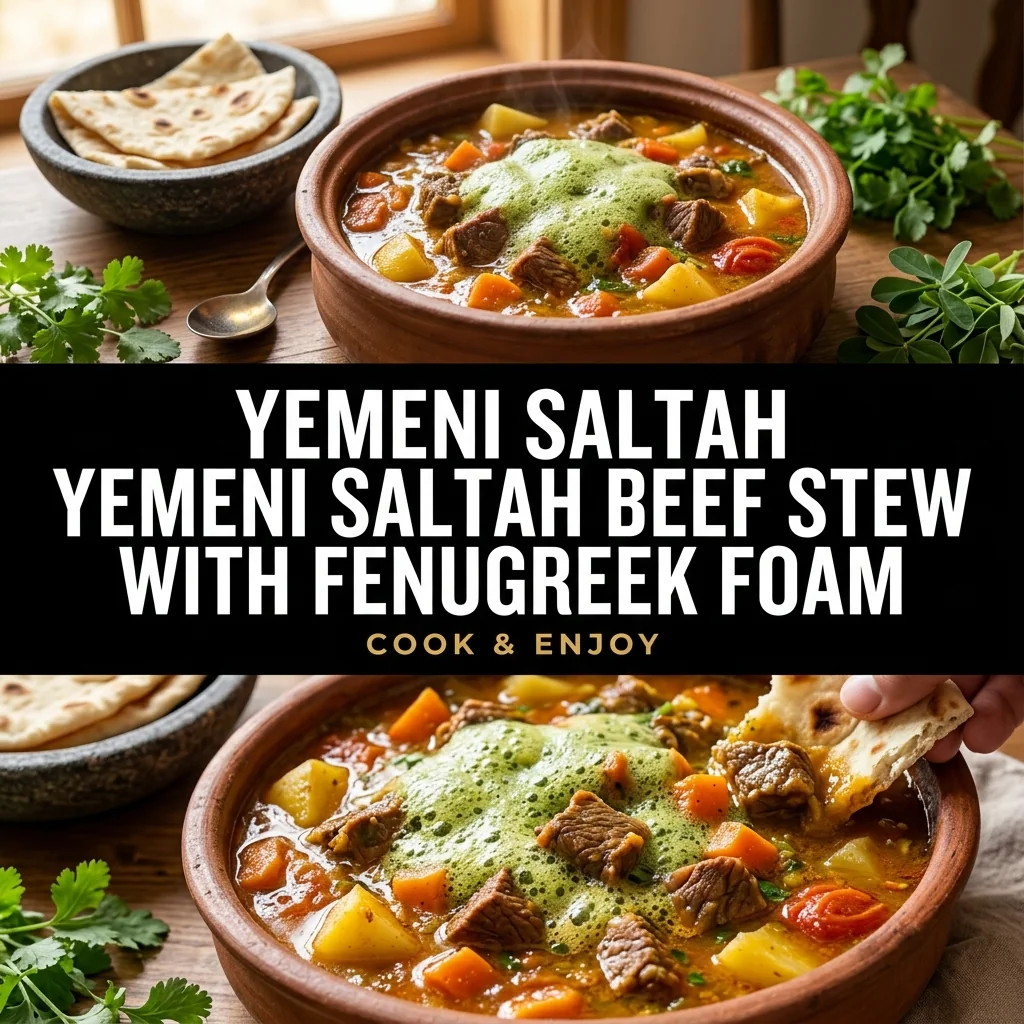
Saltah is widely cherished across Yemen as a comforting midday centerpiece, traditionally cooked and served in a carved black stone bowl known as a madra. This hearty version features tender halal beef chuck simmered in a spiced broth until it pulls easily into shreds. The meat is combined with root vegetables, tomatoes, and aromatic hawaij-style spices before being finished with the defining element of Yemeni cuisine: hilbeh. Hilbeh is a cool, whipped froth made from soaked fenugreek seeds, fresh chiles, and citrus. Spooned directly over the simmering stew, the frothy cap provides an herbal, slightly bitter contrast to the unctuous, piping-hot beef below.
The Science of Fenugreek Foam
Fenugreek seeds contain abundant soluble dietary fibers, specifically galactomannans, which swell significantly upon contact with water. Soaking the ground spice hydrates these mucilaginous compounds while drawing water-soluble bitter compounds into the soaking liquid. Pouring off the bitter liquid leaves a gelatinous paste. When whisked mechanically, the paste entraps ambient air similarly to egg whites or cream, stabilizing into a glossy, pale-green foam. Adding lemon juice and minced hot green chiles to this foam cuts the residual earthiness and produces a vibrant, airy sauce that holds its structure when floating on hot broth.
Building the Stew Base
The rich flavor of saltah relies on a concentrated broth created during the initial simmering of the beef chuck. Dicing the vegetables uniformly into half-inch cubes guarantees they soften at the same rate without turning to mush during the final reduction. Sautéing onions, garlic, and ground spices in oil before introducing the braising liquid blooms the fat-soluble aromatics, establishing a deeply fragrant foundation. The starch released by the diced potato helps naturally thicken the cooking liquid, giving the stew enough body to suspend the shredded beef and support the fenugreek topping.
Serving in Heat-Retentive Vessels
Traditionally, saltah is assembled in heavily preheated soapstone pots that retain heat far longer than standard stainless steel cookware. If a traditional Yemeni stone pot is unavailable, a small enamelled cast-iron Dutch oven or heavy ceramic casserole serves as an effective alternative. The vessel should remain hot enough to keep the broth actively bubbling at the table. Diners scoop up the hot stew and cool fenugreek foam together using torn pieces of freshly baked flatbread, such as mulawah or warm pita, bypassing individual spoons entirely.
Before you start
Soaking ground fenugreek in cold water is essential to leach out excessive bitter notes before whipping. Once soaked, drain every drop of standing surface water before beginning to whip. Whisking incorporates air rapidly, turning the dense seed paste into an airy, cloud-like mousse known as hilbeh. When serving, ensure the stew is boiling vigorously in the stone or cast pot so that when the cool fenugreek foam is spooned on top, the contrasting temperatures and textures create the signature bubbling presentation.
THE RECIPE
Yemeni Saltah Beef Stew with Fenugreek Foam
4 servings · 25 minutes preparation · 140 minutes cooking · 120 minutes cooling, chilling or resting
Ingredients
Step-by-step instructions
- Place 2 tablespoons of ground fenugreek powder into a bowl, cover with 2 cups of cold water, and let soak undisturbed for 2 hours to extract bitterness.
- In a 4-quart heavy pot, bring the 1.5 pounds of halal beef chuck and 5 cups of halal beef broth to a boil over medium-high heat, skimming any foam that rises to the surface.
- Reduce heat to low, cover, and simmer the beef for 1 1/2 to 2 hours until fork-tender, adding a little hot water if needed; remove beef to a plate, shred with two forks, and reserve the broth.
- Carefully pour off the excess water from the soaked fenugreek, leaving only the thick paste at the bottom of the bowl.
- Vigorously whisk the fenugreek paste with a wire whisk or handheld mixer for 4 to 5 minutes, incorporating the minced jalapeño, 2 tablespoons lemon juice, and 0.25 teaspoon of the salt until it becomes a light, pale, frothy foam (hilbeh).
- Heat 2 tablespoons of vegetable oil in a traditional stone pot, clay pot, or heavy Dutch oven over medium heat.
- Add the diced onion and minced garlic, sautéing for 4 minutes until softened, then add the diced potato, zucchini, chopped tomatoes, cumin, coriander, turmeric, and the remaining 0.75 teaspoon salt.
- Stir in the shredded beef and 2 cups of the reserved beef broth, bring to a vigorous boil, and simmer uncovered for 10 minutes until the potatoes are tender and the sauce is rich and thick.
- Ladle the prepared whipped fenugreek foam evenly over the violently bubbling stew, remove from the heat immediately, and serve piping hot with flatbread.
Kitchen notes
Soaking ground fenugreek in cold water is essential to leach out excessive bitter notes before whipping. Once soaked, drain every drop of standing surface water before beginning to whip. Whisking incorporates air rapidly, turning the dense seed paste into an airy, cloud-like mousse known as hilbeh. When serving, ensure the stew is boiling vigorously in the stone or cast pot so that when the cool fenugreek foam is spooned on top, the contrasting temperatures and textures create the signature bubbling presentation.
Storage & make-ahead
Store leftover stew and fenugreek foam in separate airtight containers in the refrigerator within 2 hours. The stew keeps for up to 3 days, while the foam will deflate and is best eaten within 24 hours. Reheat the stew to 165 F / 74 C before serving; do not boil the fenugreek foam directly.
An original recipe guide inspired by themes in our Pinterest research. Recipe has not been independently kitchen-tested. AI-generated image is illustrative; your finished dish may look different.
Frequently asked questions
Can I make the fenugreek foam without soaking it first?
No, unsoaked fenugreek powder is overwhelmingly bitter and will not whip into the required stable froth. Soaking for at least two hours allows the bitter compounds to separate into the water, which must be discarded.
What cut of beef works best for this stew?
Halal beef chuck roast is ideal because its intramuscular connective tissue breaks down during the initial simmer, yielding succulent shredded strands that blend smoothly into the thick vegetable broth.
Is it normal for the fenugreek foam to separate over time?
Yes, hilbeh foam will eventually lose its air and separate after sitting. For optimal volume and texture, whip the drained paste just before ladling it over the bubbling stew.